Charles Hendry
Department of Energy & Climate Change · GBR
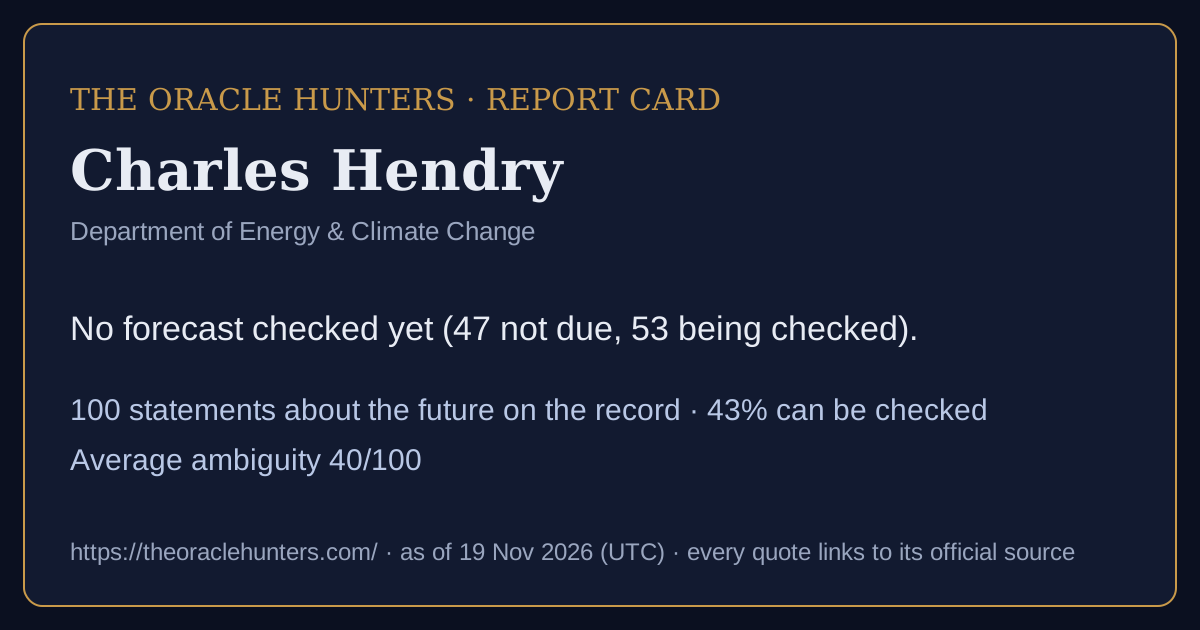
Track record: No forecast checked yet (47 not due, 53 being checked).
100forecasts & commitments on the record
43%can be checked as stated
40average ambiguity (0-100)
0goalpost moves recorded
0confirmed U-turns
Timeline
came true partly did not not due / being checked / too vague
Calibration score: shown after 10 checked forecasts with a stated likelihood (now 0).
How they speak about the future: based on data 82, stated on authority 16, educated guess 2.
Kinds of claim: forecast 69, mixed claim 24, commitment 4, scenario (if… then) 3. · Download this report card as a picture
In the nine words
πρόγνωσιςInference from evidence78 · 78%μαντείαInspired knowledge15 · 15%προαναγγελίαPublic pre-announcement4 · 4%πρόνοιαPreparing for the future3 · 3%
How to read this
Each box is one sentence a public figure or institution said about the future, word for word, with a link to the official text. Can be checked means it names what will happen, by when, and how likely - so it can be compared with official figures later. Too vague to check means it does not. Ambiguity (0-100) is how many different ways the sentence can be read. When the date passes, the forecast is compared with official data and marked came true, partly or did not come true. Labels judge the sentence, never the person. Full guide and glossary.On the record (100)
We hope that the Government of Kazakhstan will continue to engage strongly with this initiative and that in August this year we can celebrate Kazakhstan becoming a member of the EITI family.
Therefore it is key that this work starts now in Kazakhstan to find the mines that will produce in the 2030’s and beyond, as other mines come to the end of their lifecycles.
When I launched the UK Renewable Energy Roadmap last year, we said that offshore wind could deliver up to 18GW of clean energy by 2020, but that we need to address the issue of rising costs in this sector.
Looking forward to future industries, the Energy Technologies Institute, a public private organisation between global industries and the UK government, is today launching phase one of a project worth up to £3.2 million to identify ways of providing a cost effective deployment of tidal stream technologies at commercial scale in UK waters.
This is part of a co-ordinated programme of public sector support to innovation in marine energy which is expected to exceed £80m over the next few years.
And we expect around half of our electricity still to be from coal and gas, down from around 80% today.
We expect that, with some life extensions of our existing nuclear fleet and the first new build plants just coming though, nuclear will still account for around 20% of our electricity generation as it does today.
But they will also be better for the economy - that investment of £110 billion over the coming decade could lead to as many as 250,000 jobs in the energy sector.
As turbine sizes and efficiency have increased, we could see - if planners are willing to consent these larger sizes - that around half the numbers of turbines we need to meet that 2020 scenario are already in place.
The government, via the Technology Strategy Board (TSB), is providing support to build specific supply chain capabilities via the Advanced Manufacturing Supply Chain Initiative, a competitive fund of up to £125 million to support transformative projects in advanced manufacturing supply chains.
a new engineering contract between EDF and Kier/BAM for the UK’s first proposed new nuclear project at Hinkley Point, Somerset, meaning another £100m for companies operating in the South West and 350 jobs
a ground breaking £400m deal on nuclear reactors between Rolls Royce, Areva and EDF - this will underpin a new Rolls Royce factory in Rotherham and support 1,200 new jobs across the nuclear supply chain in Britain
The government will act as a gateway to market information, contact networks, activities and organisations, to help the supply chain fulfil the opportunities presented by nuclear projects, along with specific initiatives, such as in December 2009, we announced the new £25m Nuclear Advanced Manufacturing Research Centre (NAMRC), led by the University of Sheffield with Rolls-Royce as the lead industrial partner.
But substantial investment in low carbon technologies will not happen quickly enough unless we strengthen the incentives.
And we are committed to reducing the UK’s carbon emissions by 80 per cent by 2050.
This will be without public subsidy and I am encouraged by how many companies have indicated they are willing to invest on that basis - so far energy companies have announced their plans to build up to 16GW of new nuclear capacity in the UK by 2025.
By 2020 it’s likely that well over half of our energy use will still be fuelled by oil and gas, half of which might be from UK production.
And earlier this year the Secretary of State, in the Annual Energy Statement, made it clear that in future, we need more gas storage capacity, more gas import capacity, and greater assurance that our market will deliver gas when it is needed.
Its central findings - that developing and deploying smart grid technologies could create 9,000 new jobs and up to £5 billion in exports - powerfully restates the need for this country to be a leader in this sector.
Running from 2015 to 2023, this will clearly be a crucial opportunity to make sure the right investments are made to deliver and facilitate our low carbon goals.
The response set out that we will bring forward the planned completion of the rollout to 2019; at least one year ahead of previously published plans.
Projects will be supported from the £1bn capital we have made available and we also have the potential for low carbon Contracts for Difference which our reforms to the electricity market will make available.
Studies undertaken by the International Energy Agency (IEA) on behalf of the G8 have concluded that, to achieve a 50% reduction in global carbon emissions by 2050 cost effectively, CCS will be needed to deliver about a fifth of this target.
That same analysis shows that CCS could contribute 10GW of capacity to the UK electricity market by 2030 and up to 40GW by 2050.
Analysis undertaken for DECC’s Carbon Plan - which was published in December 2011 - suggests that around 40-70 GW of new low carbon electricity generating capacity will be needed by 2030, depending on demand and the mix of generation that is built.
With our delivery partners - the Technology Strategy Board, Energy Technologies Institute (ETI) and Research Councils - we expect to invest around £125m in our CCS research and development programme up to 2015.
Will remain so in the future and beyond 2030.
Compared to continuing with current policies, EMR could lead to a net gain to the economy of around £9bn over the period to 2030.
Without reform, we estimate electricity bills will be around £200 higher in 2030 compared with today’s average annual household bill.
The new Warm Home Discount scheme will provide help to around 2 million low income and vulnerable customers this year - including 600,000 of the poorest pensioners who will get energy bill rebates worth £120 this winter.
Renewable energy will stem the rise in our use of imported fossil fuels, with the need for gas imports projected to be 20-30% lower than they would have been in 2020.
Capitalised initially with £3bn, the UK Green Investment Bank will play a vital role in addressing market failures affecting green infrastructure projects in order to stimulate a step up in private investment. £1bn has also earmarked for commercial scale CCS demonstration in the UK.
It is growing by 4% a year, faster than developed world GDP, and will accelerate.
The Green Deal this year will focus on improving our energy efficiency, both at home and at our work places.
we will roll-out a smart meter to every UK home by 2020
I look forward to the opening of the Technology Centre at Mongstad in May this year, where vital testing can take place.
It also provides most of our heat now, for homes and businesses, and will continue to do so through to 2030.
We are committed to achieving our legally binding renewables target - to deliver 15% of our energy from renewables by 2020, which means 30% of our electricity - in the most cost effective way.
We are working closely on plans for a two-way electricity interconnector between our two countries, and I hope that we will see a decision this year.
As our production declines, we will need more imports; we have fundamentally reassessed the long-term role for gas and our analysis suggests we will import more gas in 2030 than we do now.
I hope the success of Durban will be matched when the Conference of the Parties moves to Doha later this year.
As with the wider world, it is clear that oil and natural gas is a critical part of the UK energy mix today and will continue to have a crucial role through to 2030 and beyond.
That is one of the reasons why we are working so hard to demonstrate CCS at commercial scale and encouraging CCS deployment internationally and why our £1bn CCS programme will be open to gas projects as well as coal.
Our 2050 analysis suggests that, even without CCS, gas usage in the UK could still be 60 per cent of 2007 consumption levels by 2050, if heroic decarbonisation efforts are made in other sectors.
Gas is still expected to meet around two-thirds of heat demand by 2030.
In the electricity sector, approximately a fifth (19 GW) of existing capacity is expected to come off the system between now and 2020, principally coal and nuclear generation due to environmental regulation and age.
We will need gas to retain sufficient electricity generation capacity margin in the face of coal/nuclear closures, to manage intermittency from increased renewables, and continue to meet the majority of our heat needs:
Natural gas is a critical part of the UK energy mix today and will continue to have a crucial role tomorrow, and beyond 2030.
Taking each of these in turn, in relation to the timetable, the response indicated that the rollout would be in two phases - the foundation stage beginning in April 2011, followed by the mass roll out, which is expected to start in 2014 and to be completed in 2019.
But the roll out in Great Britain will be especially ambitious, involving the installation of both gas and electricity meters in a framework that will help to ensure that energy consumers secure the £6 billion of benefits we forecast from this programme.
Showing the newest 50 - the ledger has all 100.
Also said - not checkable as stated (12 newest)
Remarks about the future with no date, figure or likelihood that could be checked. They are kept on the record and shown here, but not scored.
I should like to take this opportunity to extend my personal best wishes to all participants in this year’s Caspian Oil and Gas Exhibition.
Azerbaijan’s energy resources will increasingly play a vital role in the European and world economy in the years to come and Azerbaijan has been playing a central role in unlocking those resources for the benefit of all.
2013 will be an important year for the realisation of the Southern Gas Corridor project, with the continued development of the world class Shah Deniz field, and a number of key decisions being made on the final pipeline route to Europe.
However, much work still needs to be done to realise the full ambition of the Southern Corridor as a route for Central Asian gas to Europe.
A producer inevitably faces exposure to revenue risk, such as fluctuating commodity prices, and we need to be aware how these risks might be mitigated within these new laws.
The sector will also contribute to Kazakhstan’s economic and social objectives, through its contribution to regional development, diversification and jobs creation.
One of the lessons of the past decade is that all countries must continually improve their investment climate and Kazakhstan must be applauded for the steps that have been taken over the last few years through such initiatives as the Prime Ministers Investment Council and Foreign Investors Council.
Attracting foreign investment is a competitive business, and to successfully win incoming investment, Kazakhstan needs to provide the investment climate that appeals over that of other nations offering similar opportunities.
The Task Force’s report signals many areas where industry need to take the lead - for instance by undertaking contracting strategies and other ways to support the supply chain, and developing more innovative financing structures - and it also highlights areas where Government will continue to be committed to action..
The UK is the global leader in offshore wind, we already know of the rich resources that surround this island, but we are determined to do more - and not just to ensure that we have more control over where our energy comes from.
Even though renewable energy only accounts for a small part of consumers’ electricity bills, it is still essential that the industry recognises and acts on the need to bear down on costs, both to secure a competitive industry for the future, but also to provide long-term protection to consumers from volatile fossil fuel prices.
We are already starting to see the benefit of this joined-up approach, with the development of a common labour market intelligence model which will allow the group to plan targeted, evidence based interventions and industry must engage with them to ensure that we use the most up-to-date data to provide this information.