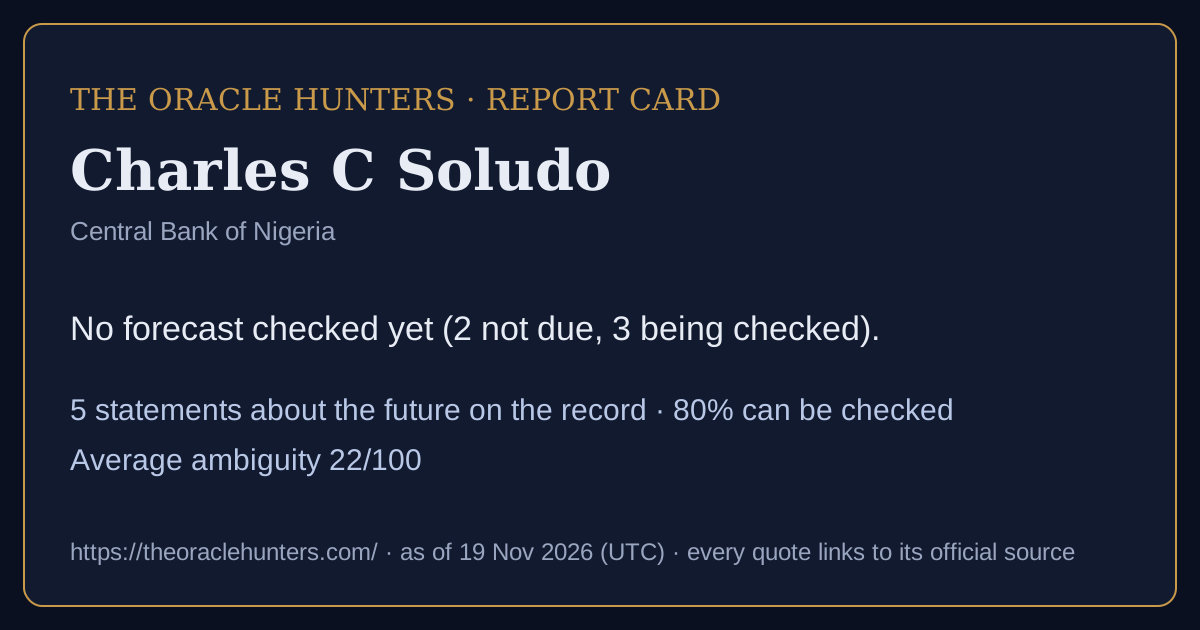
Charles C Soludo
Central Bank of Nigeria
Track record: No forecast checked yet (2 not due, 3 being checked).
5forecasts & commitments on the record
80%can be checked as stated
22average ambiguity (0-100)
0goalpost moves recorded
0confirmed U-turns
Timeline
came true partly did not not due / being checked / too vague
Calibration score: shown after 10 checked forecasts with a stated likelihood (now 0).
How they speak about the future: based on data 4, educated guess 1.
Kinds of claim: forecast 4, scenario (if… then) 1. · Download this report card as a picture
In the nine words
How to read this
Each box is one sentence a public figure or institution said about the future, word for word, with a link to the official text. Can be checked means it names what will happen, by when, and how likely - so it can be compared with official figures later. Too vague to check means it does not. Ambiguity (0-100) is how many different ways the sentence can be read. When the date passes, the forecast is compared with official data and marked came true, partly or did not come true. Labels judge the sentence, never the person. Full guide and glossary.On the record (5)
In the light of the new mandate as contained in the new CBN Act (2007) urging the CBN to ' ensure monetary and price stability ' as well as the need to provide a transparent, credible framework to lock-in inflationary expectations, the CBN will adopt inflation target as the nominal anchor for monetary policy with effect from January 1, 2009.
By end 2007, there will be about 7 or more banks with shareholders fund in excess of $1 billion and over 10 banks with market capitalization of over $2 billion each (there was none in 2004).
By end 2007, there will be about 7 or more banks with shareholders fund in excess of $1 billion, and over 10 banks with market capitalization of over $2 billion each (there was none in 2004).
Poverty reduction and employment generation are mostly local issues, and unless the system works at those lower levels, the efforts at the Federal level will continue to be grossly undermined in terms of outcomes.
Did I expect an independent Singapore, with a GDP of S$3 billion in 1965, to grow 15 times to S$46 billion in 1997 at 1965 dollars and to have the 8th highest per capita GNP in the world in 1997 according to the World Bank?
Also said - not checkable as stated (12 newest)
Remarks about the future with no date, figure or likelihood that could be checked. They are kept on the record and shown here, but not scored.
As you may recall, it is about three years since we launched (in this very Auditorium on July 6, 2004) the 13-point reform agenda designed to restructure, refocus and strengthen the Nigerian banking and financial system.
According to the 'Central Bank of Nigeria Act, 2007', (Section 2) the key objects of the Central Bank shall be to: (a) ensure monetary and price stability;
Our grand objective in the banking sector reforms was to re-engineer and fast-track a system that will engender confidence and power a new economy.
Individual banks now finance big projects valued at hundreds of millions of dollars and also operate in the oil and gas sector - a feat they never could do before now.
In due course, we shall respond appropriately.
This briefing is to clarify some pertinent issues regarding the state of Springbank, and to reassure the Nigerian public that the banking system is the safest and soundest it has ever been in its history, and that the CBN and NDIC will take all necessary measures to protect all depositors of the banking system.
As you are all aware, the banking sector consolidation programme was necessitated by the pervasive weaknesses and uncertainty of the banking system, and the need to re-engineer and fast-track a system that will engender confidence and power a new economy.
Today, individual banks can finance big projects valued at hundreds of millions of dollars and also operate in the oil and gas sector - a feat they never could do before now.
To put it succinctly, a new banking system has emerged, and will only get stronger for the benefit of the Nigerian economy.
Structured training for judges in specialized areas and especially the use of IT in court processes will have to be encouraged.
President Obasanjo has articulated a vision that in 2020 Nigeria should be among the 20 largest economies in the world.
In fact the state can never be treated as an exogenous actor in development policy and getting the prices right only has the desired consequences when you already have in place a set of property rights and enforcement that will then produce the competitive market conditions.