Charles Bean
Bank of England
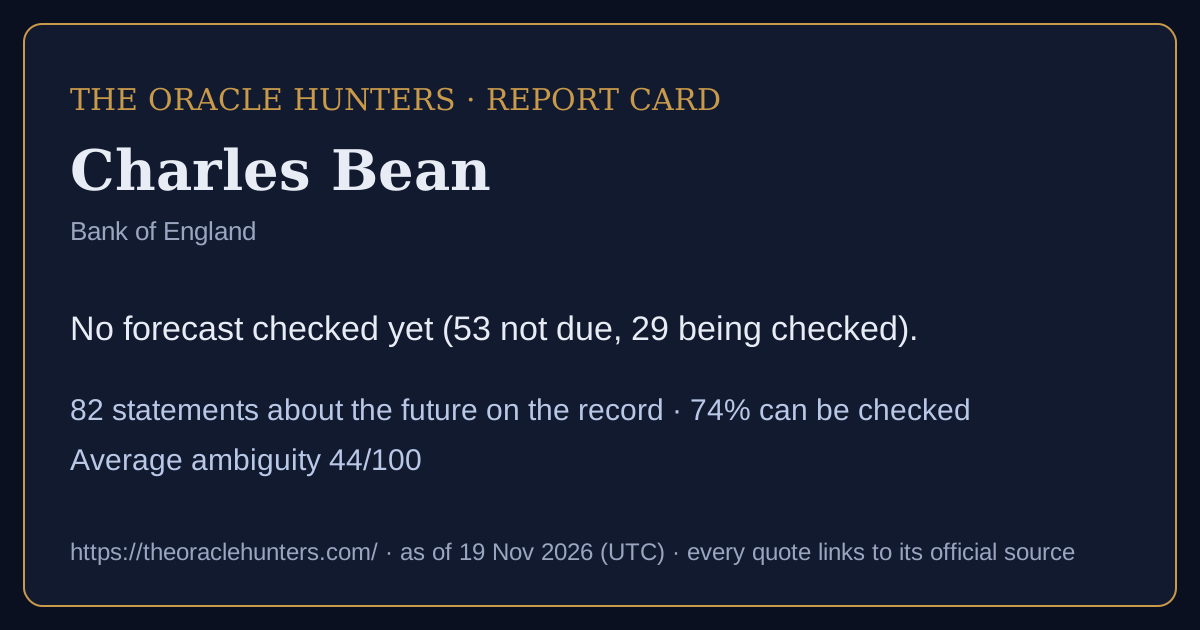
Track record: No forecast checked yet (53 not due, 29 being checked).
82forecasts & commitments on the record
74%can be checked as stated
44average ambiguity (0-100)
0goalpost moves recorded
0confirmed U-turns
Timeline
came true partly did not not due / being checked / too vague
Calibration score: shown after 10 checked forecasts with a stated likelihood (now 0).
How they speak about the future: based on data 61, stated on authority 11, educated guess 10.
Kinds of claim: forecast 61, mixed claim 14, scenario (if… then) 7. · Download this report card as a picture
In the nine words
πρόγνωσιςInference from evidence59 · 72%μαντείαInspired knowledge11 · 13%πρόνοιαPreparing for the future7 · 9%εἰκασίαConjecture4 · 5%πρόβλεψιςSeeing the signs1 · 1%
How to read this
Each box is one sentence a public figure or institution said about the future, word for word, with a link to the official text. Can be checked means it names what will happen, by when, and how likely - so it can be compared with official figures later. Too vague to check means it does not. Ambiguity (0-100) is how many different ways the sentence can be read. When the date passes, the forecast is compared with official data and marked came true, partly or did not come true. Labels judge the sentence, never the person. Full guide and glossary.On the record (82)
The opposite holds if productivity growth remains weak: unemployment falls more quickly, but we would then also need to begin raising Bank Rate earlier.
though the MPC would be unlikely to initiate such a programme until Bank Rate was high enough that it could be cut to maintain demand if conditions deteriorated.
We have also said that when Bank Rate does rise, it is likely to do so only gradually and to a level that is likely to remain materially below its pre-crisis average of 5% for some while.
In the event, though, unemployment fell rather faster than expected, reaching the 7% threshold in the data release for the three months to February.
What, I think, is more useful for businesses to hang on to is our expectation that when Bank Rate does rise, it will probably do so only gradually and to a level that is likely to remain materially below its pre-crisis average of 5% for some while - I have something like a 2-3% range in mind here.
That means the unemployment rate - currently 7.2% is likely to reach that 7% threshold earlier than expected.
When the MPC first provided explicit guidance over the future course of policy last August, the economy had shown early signs of recovery but we believed that there were still considerable underutilised resources in the economy that needed to be absorbed, otherwise we were likely to find inflation falling below our 2% target in the medium term.
According to the latest official estimates, business investment rose 8.5% over the past year, while investment intentions surveys suggest that this revival is likely to continue through this year (Chart 3).
Broadly speaking, we will be aiming to absorb that slack over the next two to three years, while keeping inflation close to the 2% target.
That market curve implies a first rise in Bank Rate in the spring of 2015, though I should stress that we are likely to learn a lot between now and then about the pace of the recovery, the amount of slack and the evolution of supply, and the impact on costs and prices.
As you will all know, we implemented that by committing not to raise Bank Rate until after the unemployment rate has fallen to 7%.
Moreover, we expected net trade to provide a significant stimulus, as global activity continued to recover and the 25% depreciation in sterling since the beginning of the crisis worked its magic.
Indeed, the Fund has revised down its world growth forecast for 2013 in every subsequent World Economic Outlook : it now expects just 2.9%, against the 4.6% it projected three years ago.
That should generate upward pressure on market interest rates as, other things equal, a reduction in the degree of monetary stimulus would indeed become appropriate sooner if growth turns out stronger than expected.
The primary reason for believing that the nascent resurgence in growth that we have seen this year will be sustained lies in the moderation of these past headwinds.
One of these stipulates that our own projection for inflation 18-24 months ahead should be at least as likely to fall below 2.5% as to be above it.
For instance, the International Monetary Fund (IMF) expects a current account deficit in the United States of just under 3% of GDP this year, while the Chinese surplus is expected to have fallen to around 2½% of GDP.
So the deviations of nominal income growth from around 5% appear to have been largely associated with forecast errors.
These forecasts are always in the region 4%—5%, with one notable exception, namely those made during 2009, when the Committee implicitly expected nominal income growth to recover more slowly than it in practice did.
Fifteen years ago, when the current arrangements were instituted, | calculated' that inflation should be expected to deviate from the target by more than one percentage point — thus triggering an Open Letter of explanation to the Chancellor — on about 40% of occasions.
International discussions about the implementation of a leverage ratio are still continuing and this instrument is only likely to become part of the FPC's toolkit after 2018.
Under Basel III, the countercyclical capital buffer will be phased in from the beginning of 2016, becoming fully effective only at the start of 2019.
8 For instance, if an employer is putting aside an additional 15% of the wage bill to cover accumulating pension liabilities and the price of buying a given stream of future income rises by 20%, then he would now need to put aside an additional 3% of the wage bill to meet those obligations.
Now QE widens the deficit from the start of our purchases in early 2009 onwards, and by the end of the period has raised it by about 10% of initial liabilities.
Econometric studies 4 carried out at the Bank imply that equity prices probably rose by about 20% as a result of the first phase of purchases.
As you will be aware, the Monetary Policy Committee has so far purchased £325 billion of gilts, £200 billion in a first phase during the worst of the recession in 2009 (QE1) and £125 billion in a second phase as the economy slowed at the end of last year and which was
Indeed, in the absence of the extra £50 billion of gilt purchases announced two weeks ago, we judged that inflation would be rather more likely than not to undershoot our 2% target in the medium term.
But inflation has been falling sharply, down from its peak of 5.2% in September to 3.6% in January and is likely to continue declining as increases in energy prices a year ago drop out of the calculation.
In fact, real household income declined a total of 2½% in the two years after output troughed, whereas in normal conditions it might have been expected to rise about 5% in that time.
And UK equity prices rose 50% during the programme, though only a small part of that is likely to be down to quantitative easing.
Output is reported to have contracted by 0.2% in the final quarter, though some of the business surveys at the start of this year suggest that the economy may again be expanding.
Without action, and despite the present excessive level of inflation, the extra margin of slack meant that inflation would consequently be more likely to undershoot, rather than overshoot, the 2% target in the medium term.
Indeed, as recently as our May meeting, a third of the Committee were voting to raise Bank Rate from its emergency level of 0.5 per cent.
As we go into next year, so last January's increase in VAT will drop out of the calculation, knocking around one percentage point off inflation.
And with higher utility prices pushing consumer prices up another 1¼ per cent since June, it is probable that real household disposable income will turn out to have fallen during the second half of this year too.
The impact on the stock of credit is, though, more modest: just 3-4% lower by the end of 2006.
6 If no other policies were available, then one might be tempted to conclude that the inflation target should just be higher in normal times, as advocated by Olivier Blanchard, Giovanni Dell'Ariccia and Paolo Mauro (2010).
It is worth noting that the current elevated inflation rate of 4.5% can be largely accounted for by the effects of energy and import prices and VAT: energy prices and VAT are probably each contributing around one percentage point to current inflation, and non-energy import prices around double that.
But the underlying picture is one of growth gradually picking up to around its historical average rate, reflecting continued recovery in investment and a higher contribution from net exports and, on the back of that, some modest strengthening in consumer spending as we go through next year.
The most recent survey of retailers by the British Retail Consortium suggested that the fine Easter weather and the royal nuptials may have brought a welcome fillip to the High Street, but with the squeeze on real pay likely to continue through this year, it seems likely that consumer spending will remain subdued through this year at least.
This shows inflation moving towards the target through next year, though, as I have already indicated, there is considerable uncertainty about the speed at which that will
The twelve-month inflation rate is likely to remain elevated through the remainder of this year, and indeed may rise further in the second half of the year, as utility prices are likely to rise sharply to reflect higher oil and wholesale gas prices.
The red line shows the central path for the level of output, relative to a continuation of its pre-crisis trend, from our most recent projections (the dash denotes the forecast period up to and including 2013).
Our remit from the Chancellor of the Exchequer tells us that our target is 2% inflation 'at all times', but also recognises 'that the actual inflation rate will on occasions depart from its target as a result of shocks and disturbances.
Why has inflation turned out both above the 2% target, and higher than the MPC expected?
Inflation has been running well above our 2% target, in part reflecting external forces, raising the possibility that elevated inflation may persist into the medium term.
Certainly, my own judgment is that, if anything, inflation may prove a little more persistent next year than presently embodied in our projections.
The bottom line is that while agricultural prices may fall back a little this year, oil (and also metals) prices are more likely to remain elevated.
Yet in January, CPI inflation reached 4% and is likely to move higher in the coming months, in part reflecting the recent surge in oil prices.
Back in August of last year, our central projection was for CPI inflation to be around 1.5% now.
Showing the newest 50 - the ledger has all 82.
Also said - not checkable as stated (12 newest)
Remarks about the future with no date, figure or likelihood that could be checked. They are kept on the record and shown here, but not scored.
I should also stress that this is a short-run concept, relevant to inflationary pressures a year or so ahead, and does not incorporate any endogenous improvement in productivity that may materialise in the wake of faster growth over a rather longer horizon.
In case this all sounds rather sanguine, I should say that I do not expect central banks' collective management of the exit from the present exceptionally stimulatory monetary stance will be easy.
We will be holding around 50 events across the UK to enable the public to see and feel examples of polymer notes, and to deliver feedback to the Bank.
And we will be running over 30 discussion events with audiences including regional chambers of commerce and retailers.
We will also publish a range of useful material on our website including a facility for the public to provide feedback directly to us.
In parallel with the public consultation we will conduct further outreach with the cash handling industry, to confirm our understanding of the impact on industry of a switch to polymer.
Once these exercises are complete, we will analyse the feedback we have received and use it to inform our final decision, which will be announced in December.
If a final decision is made to move to polymer, we will also use the opportunity to introduce notes which are somewhat smaller than the current series.
The knowledge that monetary policy will not be tightened until the UK's fledgling recovery is secured should boost confidence.
This, I believe, was particularly true during the worst of the post-crisis recession, though it may have become less so as markets have returned towards normality.
Bolstering aggregate demand through sustained low interest rates and quantitative and credit easing will indeed tend to work against the desired rebalancing of demand away from consumption towards saving and net exports this is what the previous Governor of the Bank of England christened the 'paradox of policy' (see King, 2009).
A sustained period of weak demand may also push many businesses that are perfectly viable in the long run into insolvency, especially if the supply of credit is impaired.