Chang Yong Rhee
Bank of Korea
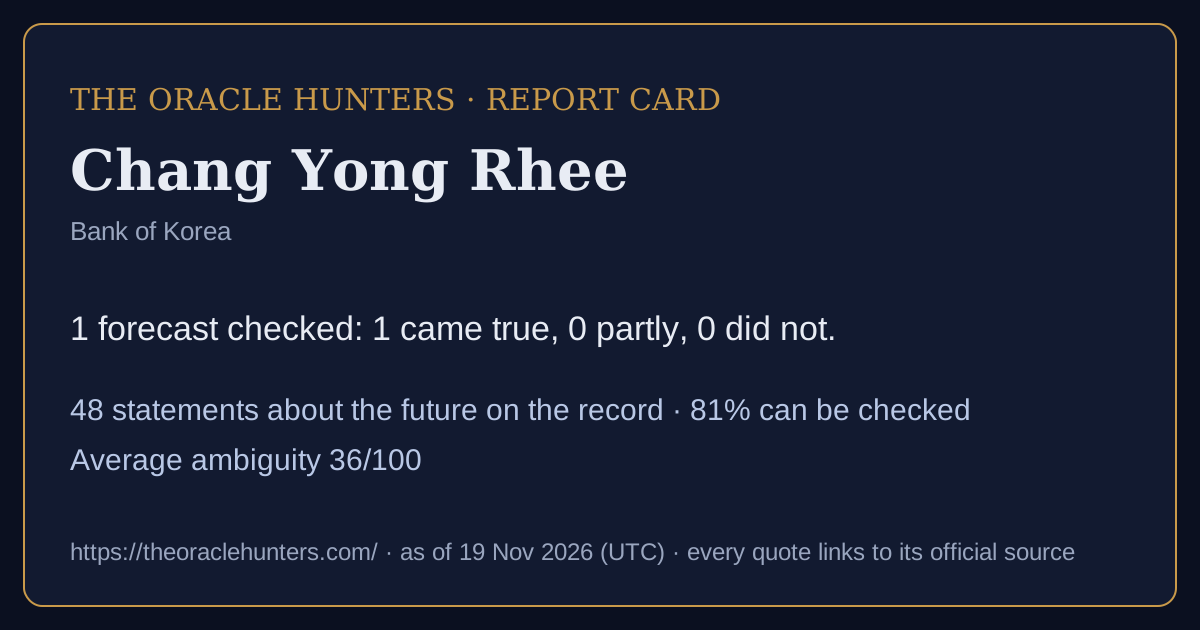
Track record: 1 forecast checked: 1 came true, 0 partly, 0 did not.
48forecasts & commitments on the record
81%can be checked as stated
36average ambiguity (0-100)
0goalpost moves recorded
0confirmed U-turns
Timeline
came true partly did not not due / being checked / too vague
Calibration score: shown after 10 checked forecasts with a stated likelihood (now 1).
How they speak about the future: based on data 26, educated guess 11, stated on authority 11.
Kinds of claim: forecast 34, scenario (if… then) 12, commitment 1, mixed claim 1. · Download this report card as a picture
In the nine words
πρόγνωσιςInference from evidence25 · 52%πρόνοιαPreparing for the future11 · 23%μαντείαInspired knowledge10 · 21%φρόνησιςPractical wisdom1 · 2%προαναγγελίαPublic pre-announcement1 · 2%
How to read this
Each box is one sentence a public figure or institution said about the future, word for word, with a link to the official text. Can be checked means it names what will happen, by when, and how likely - so it can be compared with official figures later. Too vague to check means it does not. Ambiguity (0-100) is how many different ways the sentence can be read. When the date passes, the forecast is compared with official data and marked came true, partly or did not come true. Labels judge the sentence, never the person. Full guide and glossary.Checked
However, inflation is expected to slow gradually due to heightened economic downward pressures at home and abroad, and show a further gradual decline next year, resulting
Came true. Said: inflation would fall in 2023. Official figures for Korea, Rep.: 5.1% in 2022, 3.6% in 2023 (World Bank open data). official data · checked 14 Nov 2026 · automatic check against official data (rules v3)
On the record (48)
2025, trade volumes grew 4.5%, well above the initial WTO forecast of 2.5%.
Ladies and gentlemen, Among the many topics addressed at this 'Asia in 2050' conference, the central question may well be this: can Asia ' s success over the past half-century be sustained?
China ' s share alone climbed from 5% in the 1970s to 35% by the mid-2010s following WTO accession, before declining to a projected 27% this year.
Six Monetary Policy Board members, excluding myself, then indicate their views on the rate path for the next year using dots. 27 While the growth and inflation forecasts are public, the interest rate paths remain internal.
Staff present quarterly growth and inflation forecasts for the next two years alongside corresponding interest rate paths.
As noted in last month's economic outlook, the GDP growth forecast has been revised downward to 0.8% for the
While this year's projected growth is similar to levels seen during the Global Financial Crisis, a simple comparison between the two periods would be misleading.
Significant uncertainty also looms over the 1.6% growth outlook for next year.
In particular, construction investment is projected to contract for five consecutive quarters through the second quarter of this year, emerging as the single largest source of the downward pressure on growth.
The projected growth rate for this year is the lowest in the past three decades, excluding the periods of the Asian Financial Crisis, the Global Financial Crisis, and the COVID-19 pandemic.
As a result, GDP growth in the first half of this year is expected to come in at just 0.1% compared to the same period last year.
At the same time, weak demand from China-which accounts for over 19% of Korea's exports-is expected to further weigh on our economy.
According to the National Assembly Budget Office (2025), Korea's national debt-to-GDP ratio, currently 46.9%, is projected to reach 182% within 50 years if fertility remains at 0.75.
According to a recent Bank of Korea study, Korea's potential growth rate, currently around 2%, may approach near 0% by the late 2040s (Lee et al., 2024).
Gradually reducing the 90% free allocation rate and tightening the emissions cap will create stronger market incentives for effective emissions trading.
If the fertility rate remains at 0.75, Korea will inevitably face prolonged negative economic growth after 2050.
About 20% of national river embankments are already rated as "inadequate" or "poor," and projections suggest half of Korea's dams may fail to prevent flooding by 2040.
It could fall to as low as the 0% range by the late 2040s if we fail to address these issues (Lee ., 2024).
If capital outflows continue, it could prolong a vicious cycle where financing difficulty hampers the growth of new businesses.
However, if we use monetary and fiscal policies as a mere painkiller by simply comparing the absolute growth figure lower than 2% to the past growth rates, it may lead to larger negative sideeffects.
This year, the conditions surrounding our economy are expected to be more challenging than ever.
As of last November, the Bank of Korea forecast this year's growth rate to be 1.9%; however, downside risks have since grown.
On the other hand, if we shift the policy stance too early, the slowdown in inflation will decelerate, exchange rate volatility will increase, and the growth in household debt will accelerate.
Moreover, if a premature pivot to a dovish stance leads back to unstable inflation and necessitates another rate hike, the policy cost at that time will be much higher.
We cannot expect sustainable growth without addressing these structural problems, as we will face a huge social shift in the light of climate change and AI innovations.
In the case of Korea, if we do not take external factors into account too much, there is a possibility that the neutral interest rate will decline in the long run driven by internal factors such as demographic shifts due to the low birthrate and the population aging.
For example, in the case of Korea as a non-reserve currency economy, an all-out implementation of an unconventional monetary policy such as quantitative easing, as utilized in advanced economies, might be challenging even if it is confronted with the zero lower bound.
As we approach 2030, the pressures of global regulations and goal attainment related to environmental issues will only intensify.
In a national awareness survey on climate change's impact on health, approximately 63% of respondents considered it "serious." However, in the future, the number of people who perceive the climate crisis as a health crisis will increase even more. 2
In line with this, the Republic of Korea has made a commitment to reduce greenhouse gas emissions by 40% from 2018 levels by 2030, and to increase Official Development Assistance (ODA) for green projects.
If we pool our wisdom and strengthen our leading role as a central bank, this will enhance the effectiveness of our policy and make the Bank of Korea more trustworthy.
This year is likely to be challenging, amid ongoing high economic uncertainties at home and abroad.
As organizational innovation at the Bank of Korea will start on a full scale this year, many changes are expected to come along with it.
In addition, as the materialization of effects of Base Rate hikes is likely to increase the possibility of a conflict among price stability, steady growth, and financial stability, a more refined policy mix will be of utmost importance this year.
If successful, a Chinese economic recovery would pick up, which could boost international commodity prices.
We hope to provide you with more details in the first half of next year after going through every possible alternative here.
Going forward, consumer price inflation will likely remain at around 5% for some time.
Furthermore, the size of the increase in electricity bills next year will significantly reflect the burden of rising costs accumulated so far, and is highly likely to be larger than what is reflected in our November forecast.
However, inflation is expected to slow gradually due to heightened economic downward pressures at home and abroad, and show a further gradual decline next year, resulting
Came true. Said: inflation would fall in 2023. Official figures for Korea, Rep.: 5.1% in 2022, 3.6% in 2023 (World Bank open data). official data · checked 14 Nov 2026 · automatic check against official data (rules v3)
However, despite the expected gradual decline in inflation next year, we do deem it warranted to maintain our policy focus on prices, as inflation is expected to remain high, running well above the target level of 2%.
First, we aimed to ensure that financial markets did not overreact to the unprecedented 50bp hike, while we anticipated that inflation would stabilize at around 3% within the coming year, mainly owing to declining oil prices.
With regard to the future policy direction, the BOK has made it clear that it will prioritize price stability to the utmost as long as inflation remains high in the 5-6% range.
Specifically, consumer price inflation is expected to remain high in the 5-6% range, reflecting the unexpected rise in the exchange rate, while downside risks to the Korean economy have increased with weaker global growth prospects.
The federal funds rate at the end of 2022 as per the dot plot is 50bp higher than we expected back in July and August.
If we make good use of technological innovation, it will help to develop our regional financial markets much faster and enable Asia to keep its place as the growth engine of the global economy going forward, while promoting payment system stability, financial inclusion and enhancing cross-border payments.
For example, unconventional policies trying to lower interest rates could lead to excessive depreciation of the local currency if the market perceives the policy as being inconsistent with the macroeconomic fundamentals of the country.
If we make good use of technological innovation, it will help to develop our regional financial markets much faster and enable Asia to remain the growth engine of the global economy going forward.
Rate hikes may increase difficulties for vulnerable groups in the short term, but if we get the timing wrong and inflation broadens further, the damage would be even greater.
Also said - not checkable as stated (12 newest)
Remarks about the future with no date, figure or likelihood that could be checked. They are kept on the record and shown here, but not scored.
I have no doubt that, under the incoming Governor Hyun Song Shin, who needs no introduction in the central banking community, you will restore stability to our foreign exchange and financial markets without delay.
As structural reforms are under way, I hope that the Bank of Korea will continue to study medium- to long-term challenges to address structural issues facing the Korean economy, including education, housing, balanced regional development, youth employment, and elderly poverty.
What they demand, however painful the path, are structural reforms in labor markets, in education, and across the many other areas where competing interests and entrenched conflicts must be confronted and resolved.
In my inaugural address four years ago, I said that "our responsibility cannot be confined to the boundaries of monetary policy alone," and that we should work to make the Bank of Korea "the nation's top think tank best informed on our economy," bona fide reflecting my belief that structural reforms are essential to ensuring the effectiveness of monetary policy.
China ' s growth rate would moderate with maturity, its expanding economic size would keep its contribution steady. 6 Yet the recent sharp decline suggests that geopolitical tensions, population aging, and real estate deleveraging are exerting a much heavier toll than previously expected.
Both saw declining contributions as demographic headwinds weighed on growth, though their deep integration into China-centered production networks in the 2000s likely cushioned this decline.
India, the Philippines and Bangladesh, expected to follow within the next decade. 10 Asia ' s rapid growth has also been the key force reversing the nearly 200-year trend of widening global income inequality. 11
Should Korea face a similar situation, I would likely draw on Bank Indonesia's approach while addressing fiscal monetization concerns.
As textbooks tell us, fiscal policy is more effective than monetary policy in a liquidity trap, and monetary policy should not become 'the only game in town.' 23 In that context, I wonder whether quasi-fiscal tools such as FFL could be more effective than UMP.
That said, I do not believe conditional forward guidance (CFG) should also be ruled out. 'Conditional' FG presents an endogenous interest rate path consistent with the economic outlook.
Nevertheless, we must be prepared for the possibility that we may inevitably enter an ELB environment in the distant future.
We will also make ongoing efforts to improve the financial and economic structure.