Chairman Jerome H Powell
Federal Reserve · USA
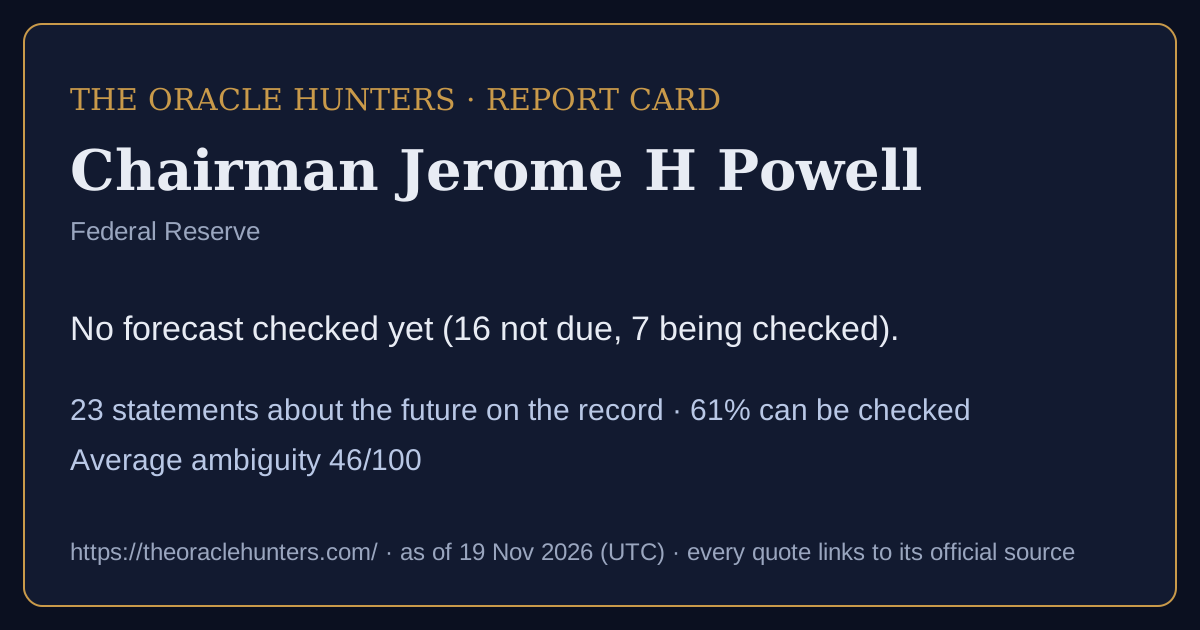
Track record: No forecast checked yet (16 not due, 7 being checked).
23forecasts & commitments on the record
61%can be checked as stated
46average ambiguity (0-100)
0goalpost moves recorded
0confirmed U-turns
Timeline
came true partly did not not due / being checked / too vague
Calibration score: shown after 10 checked forecasts with a stated likelihood (now 0).
How they speak about the future: based on data 17, stated on authority 3, educated guess 3.
Kinds of claim: forecast 16, scenario (if… then) 3, commitment 2, mixed claim 2. · Download this report card as a picture
In the nine words
πρόγνωσιςInference from evidence15 · 65%πρόνοιαPreparing for the future3 · 13%προαναγγελίαPublic pre-announcement2 · 9%πρόβλεψιςSeeing the signs2 · 9%μαντείαInspired knowledge1 · 4%
How to read this
Each box is one sentence a public figure or institution said about the future, word for word, with a link to the official text. Can be checked means it names what will happen, by when, and how likely - so it can be compared with official figures later. Too vague to check means it does not. Ambiguity (0-100) is how many different ways the sentence can be read. When the date passes, the forecast is compared with official data and marked came true, partly or did not come true. Labels judge the sentence, never the person. Full guide and glossary.On the record (23)
Shell (2018), "60% of District's Jobs Could Face Automation in the Next 20 Years," Federal Reserve Bank of St. Louis, Regional Economist, vol. 26 (third quarter), pp. 19-20, 22-23; and Charles Davidson (2017), "Tending to the Farm, Part 3: Technology Reshapes Agriculture," Federal Reserve Bank of Atlanta, Economy Matters, January 12.
Because this core resilience is so important, we are committed to preserving and strengthening the key improvements since the crisis, particularly those in capital, liquidity, stress testing, and resolution.
My FOMC colleagues and I, as well as many private-sector economists, are forecasting continued solid growth, low unemployment, and inflation near 2 percent.
The first is to explain how changes in the Phillips curve help account for the somewhat surprising but broadly shared current forecasts of continued very low unemployment with inflation near 2 percent.
I am referring to the most recent forecast for year-end 2018 through 2020.
As the value of C increases, higher inflation this year translates more into higher inflation next year.
A natural starting point is the simplest form of a Phillips curve equation, which posits that inflation this year is determined by some combination of current labor market slack, inflation last year, and some other factors that I will leave aside for this discussion (figure 4):7
The unemployment rate for each forecast bottoms out at 3.4 percent or 3.5 percent in 2019 and remains below 4 percent.
For example, the medians of the most recent projections from FOMC participants and the Survey of Professional Forecasters, as well as the most recent Congressional Budget Office (CBO) forecast, all have the unemployment rate remaining below 4 percent through the end of 2020, with inflation staying very near 2 percent over the same period.1
As the most recent FOMC statement indicates, if the strong growth in income and jobs continues, further gradual increases in the target range for the federal funds rate will likely be appropriate.
While inflation has recently moved up near 2 percent, we have seen no clear sign of an acceleration above 2 percent, and there does not seem to be an elevated risk of overheating.
In contrast, if the unemployment rate is above u*, lower the real federal funds rate relative to r*, which will stimulate spending and raise employment.
One general finding is that no single, simple approach to monetary policy is likely to be appropriate across a broad range of plausible scenarios.19 More concretely, simulations like these inform our risk management by assessing the likelihood that misperception would lead to adverse outcomes, such as inflation falling below zero or rising above 5 percent.
Under Chairman Greenspan's leadership, the Committee converged on a risk-management strategy that can be distilled into a simple request: Let's wait one more meeting; if there are clearer signs of inflation, we will commence tightening.13 Meeting after meeting, the Committee held off on rate increases while believing that signs of rising inflation would soon appear.
If central banks were instead to try to exploit the nonresponsiveness of inflation to low unemployment and push resource utilization significantly and persistently past sustainable levels, the public might begin to question our commitment to low inflation, and expectations could come under upward pressure.
For example, Londono and Wilson (2018) find that U.S. monetary policy variables account for only roughly 10 percent of the six-month ahead forecast error variance of the VIX.
The median of FOMC participants' projections of this longer-run trend growth rate is 1.8 percent.
The median projection in the March SEP calls for unemployment to fall well below 4 percent for a sustained period, something that has not happened since the late 1960s.
The authors of one well-regarded study concluded that even when using sophisticated statistical techniques, the natural rate of unemployment could be as much as 1-1/2 percentage points above or below their point estimate.
Consistent with this view, the median of FOMC participants' projections in our March survey shows inflation moving up to 1.9 percent this year and to 2 percent in 2019.
Over the next few years, we will continue to aim for 2 percent inflation and for a sustained economic expansion with a strong labor market.
Inflation has continued to run below the FOMC's 2 percent objective but we expect it to move up in coming months and to stabilize around 2 percent over the medium term.
We will remain alert to any developing risks to financial stability.
Also said - not checkable as stated (12 newest)
Remarks about the future with no date, figure or likelihood that could be checked. They are kept on the record and shown here, but not scored.
And racial wealth disparities make black students more likely than white students to borrow for their education.15 Similarly, racial wealth disparities mean access to credit is critical for would-be entrepreneurs who must borrow to supplement personal savings and support from friends and family.
To the extent that banks serve much broader areas using online or other non-branch delivery systems, or have so many assessment areas that examiners cannot do a thorough evaluation in each, the financial needs of many rural communities may be overlooked.
See Lael Brainard (2018), "Keeping Community at the Heart of the Community Reinvestment Act," speech delivered at the Association of Neighborhood and Housing Development Eighth Annual Community Development Conference, New York, May 18.
We believe that revisions to the CRA's implementing regulations should more effectively encourage banks to seek opportunities in underserved areas.19
These perspectives will inform our deliberations on this critical regulation, and we will make a summary of our discussions available to the public.
I understand that you will shortly be presenting awards to people who are working at the local and national levels and in both the public and private sectors and whose efforts have improved housing conditions for the rural poor.
Researchers found that, as in many urban areas nationwide, a large portion of renters in rural communities struggle to afford their rent‑‑a finding that will not come as a surprise in this room.
See, for example, Economic Innovation Group (2016), The New Map of Economic Growth and Recovery (Washington: EIG, May).
As my colleague Governor Brainard has noted, one of the principles guiding our CRA modernization work is that any redesign of CRA regulations should continue to encourage banks to seek opportunities in underserved areas, including rural communities.
Productivity has picked up in recent months after several years of very slow growth, but it is not clear whether this is a trend that will be sustained.
To paraphrase a famous line, "eternal vigilance is the price of financial stability." We will publish these reports regularly as part of our vigilance.
Instead, these reports should be viewed as you might view the results of a regular health checkup.