Chairman Ben S Bernanke
Federal Reserve · USA
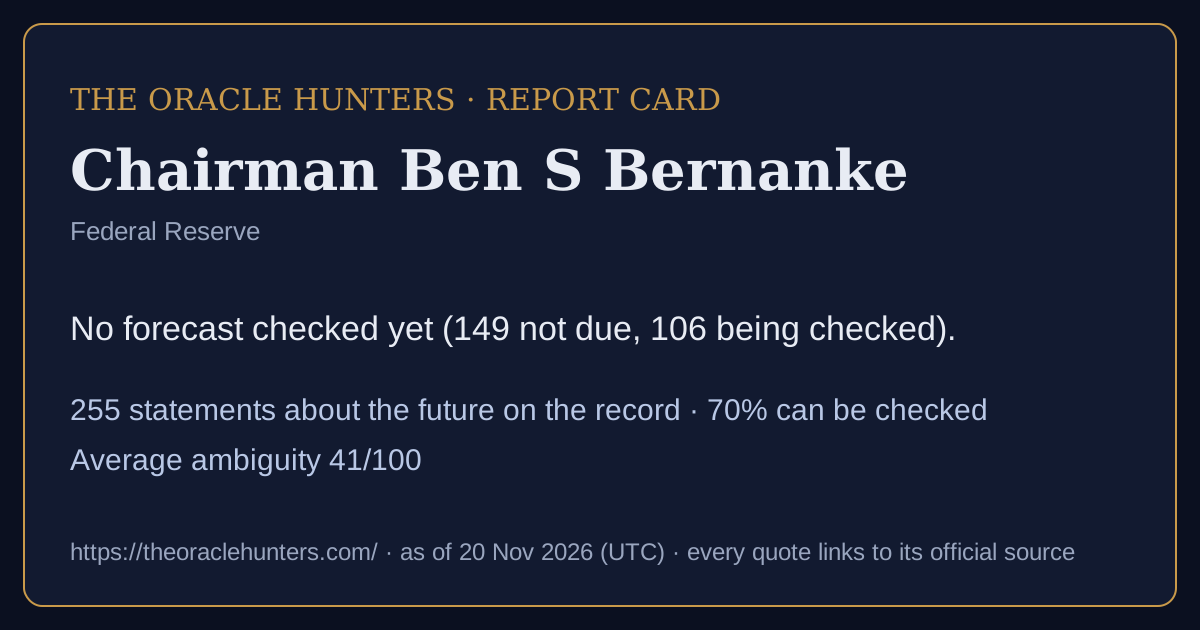
Track record: No forecast checked yet (149 not due, 106 being checked).
255forecasts & commitments on the record
70%can be checked as stated
41average ambiguity (0-100)
0goalpost moves recorded
0confirmed U-turns
Timeline
came true partly did not not due / being checked / too vague
Calibration score: shown after 10 checked forecasts with a stated likelihood (now 0).
How they speak about the future: based on data 141, stated on authority 61, educated guess 53.
Kinds of claim: forecast 161, scenario (if… then) 54, mixed claim 24, commitment 16. · Download this report card as a picture
In the nine words
πρόγνωσιςInference from evidence133 · 52%πρόνοιαPreparing for the future54 · 21%μαντείαInspired knowledge48 · 19%προαναγγελίαPublic pre-announcement16 · 6%εἰκασίαConjecture4 · 2%
How to read this
Each box is one sentence a public figure or institution said about the future, word for word, with a link to the official text. Can be checked means it names what will happen, by when, and how likely - so it can be compared with official figures later. Too vague to check means it does not. Ambiguity (0-100) is how many different ways the sentence can be read. When the date passes, the forecast is compared with official data and marked came true, partly or did not come true. Labels judge the sentence, never the person. Full guide and glossary.On the record (255)
The interest rate on excess reserves can be raised, which will put upward pressure on short-term rates; in addition, the Federal Reserve will be able to employ other tools, such as fixed-rate overnight reverse repurchase agreements, term deposits, or term repurchase agreements, to drain bank reserves and tighten its control over money market rates if this proves necessary.
The FOMC reduced the target federal funds rate from 5-1/4 percent in the summer of 2007 to a range of 0 to 1/4 percent by the end of 2008, a very rapid easing.
Federal fiscal policy was expansionary in 2009 and 2010.18 Since that time, however, federal fiscal policy has turned quite restrictive; according to the Congressional Budget Office, tax increases and spending cuts likely lowered output growth in 2013 by as much as 1-1/2 percentage points.
At its most recent meeting, the Committee reaffirmed and clarified its guidance on rates, stating that it expects to maintain the current target range for the federal funds rate well past the time that the unemployment threshold of 6-1/2 percent is crossed, especially if projected inflation continues to run below the Committee's 2 percent longer-run goal.13
Near-term fiscal policy at the federal level remains restrictive, but the degree of restraint on economic growth seems likely to lessen somewhat in 2014 and even more so in 2015; meanwhile, the budgetary situations of state and local governments have improved, reducing the need for further sharp cuts.
Two years ago, we established 2 percent as our inflation goal, and we regularly communicate policymakers' views of the level of unemployment expected to correspond to maximum sustainable employment over time.
The central tendency of the projections for the longer-run normal unemployment rate (which drops the three highest and three lowest values submitted by FOMC participants) was 5.2 to 5.8 percent in September.
At the time, the latest reading on the unemployment rate was 8.1 percent, and both we and most private-sector economists were projecting only slow reductions in unemployment in the coming quarters.
Currently, FOMC participants' estimates of the longer-run normal unemployment rate, as publicly reported in the quarterly Summary of Economic Projections, range from 5.2 to 6 percent.3
As reflected in the latest Summary of Economic Projections and the October FOMC statement, the FOMC still expects that labor market conditions will continue to improve and that inflation will move toward the 2 percent objective over the medium term.
The Committee additionally expected that inflation would be moving back toward its 2 percent objective over time.
For example, the Eurodollar futures rate for mid-2015 rose about 40 basis points in the few days following the June FOMC meeting, far more than could be explained by revisions to the economic outlook.
As you probably know, the Federal Reserve is also celebrating an anniversary this year--the centennial of its founding.
By the way, Keynes argued at that time that such a view was shortsighted and, in characterizing what he called "the economic possibilities for our grandchildren," he predicted that income per person, adjusted for inflation, could rise as much as four to eight times by 2030.
In particular, I will be looking beyond the very real challenges of economic recovery that we face today--challenges that I have every confidence we will overcome--to speak, for a change, about economic growth as measured in decades, not months or quarters.
We specifically exempted community banking organizations with $10 billion or less in total assets from the requirement that they run their own stress tests as those institutions cannot reasonably be expected to have the resources that larger banks devote to stress testing.11
While no institutions below $50 billion in assets are subject to supervisory stress testing or the requirements of CCAR, the Dodd-Frank Act does require that institutions with between $10 billion and $50 billion in assets conduct their own stress tests.10 The initial tests by these firms will begin this year and will be completed by March.
In October, the Federal Reserve Board adopted rules implementing these requirements.9 The 11 additional companies with assets of $50 billion or more will be subject to DFAST and CCAR for the first time next year.
For our most recent supervisory stress tests, we collected and analyzed loan- and account-level data on more than two-thirds of the $4.2 trillion in accrual loans and leases projected to be held by the 18 firms we evaluated this year.
For example, projected aggregate loan losses under this year's most stressful scenario (the so-called severely adverse scenario) were 7 percent lower than the comparable figure last year, in part because the riskiness of banks' portfolios continues to decline.
In the current environment, both policymakers and market participants widely agree that supporting the U.S. economic recovery while keeping inflation close to 2 percent will likely require real short-term rates, currently negative, to remain low for some time.
We will, however, be evaluating these issues carefully and on an ongoing basis; we will be alert for any developments that pose risks to the achievement of the Federal Reserve's mandated objectives of price stability and maximum employment; and we will, of course, remain prepared to use all of our tools as needed to address any such developments.
Rates 100 basis points higher than the expected paths in chart 4 by 2014 are certainly plausible outcomes as judged by each of the three measures, and this uncertainty grows to as much as 175 basis points by 2017.
The green line gives the Congressional Budget Office forecast published in February, and the blue line presents the median from the Survey of Professional Forecasters, as reported in the first quarter of this year.
Finally, the purple line shows a forecast based on the term structure model used for the decomposition of the 10‑year yield in chart 2.12 While these forecasts embody a wide range of underlying models and assumptions, the basic message is clear--long-term interest rates are expected to rise gradually over the next few years, rising (at least according to these forecasts) …
With the expected inflation component of the 10-year rate near 2 percent and the rate itself a bit below 2 percent recently, it is clear that the combination of the other two components--the expected path of short-term real interest rates and the term premium--must make a small net negative contribution.
The budget deficit, which peaked at about 10 percent of GDP in 2009 and now stands at about 7 percent of GDP, is expected to narrow further in the coming years as the economy continues to recover.
In addition to announcing new purchases of MBS, at our September meeting we extended our guidance for how long we expect that exceptionally low levels for the federal funds rate will likely be warranted at least through the middle of 2015.
Preventing a sudden and severe contraction in fiscal policy early next year will support the transition of the economy back to full employment; a stronger economy will in turn reduce the deficit and contribute to achieving long-term fiscal sustainability.
However, the CBO projects that, under a plausible set of policy assumptions, the budget deficit would still be greater than 4 percent of GDP in 2018, assuming the economy has returned to its potential by then.
Indeed, under almost any plausible scenario, next year the drag from federal fiscal policy on GDP growth will outweigh the positive effects on growth from fiscal expansion at the state and local level.
First, the Congress and the Administration will need to protect the economy from the full brunt of the severe fiscal tightening at the beginning of next year that is built into current law--the so-called fiscal cliff.
In September, we took the added step of stating that we will continue actions to put downward pressure on longer-term interest rates until the outlook for the job market improves substantially in a context of price stability.
FOMC participants generally expected that inflation was likely to run at or below the Committee's inflation goal of 2 percent over the next few years.
It extended the period over which it expects to maintain exceptionally low levels of the federal funds rate from late 2014 to mid-2015.
In January, the Committee noted that it anticipated that economic conditions were likely to warrant exceptionally low levels of the federal funds rate at least through late 2014--a year and a half later than in previous statements.
The FOMC coupled these changes in forward guidance with additional asset purchases, announcing that it will purchase agency mortgage-backed securities (MBS) at a pace of $40 billion per month, on top of the $45 billion in monthly purchases of long-term Treasury securities planned for the remainder of this year under the MEP.
If, in contrast, the Fed were to raise rates now, before the economic recovery is fully entrenched, house prices might resume declines, the values of businesses large and small would drop, and, critically, unemployment would likely start to rise again.
That doesn't mean that we expect the economy to be weak through 2015.
In the category of communications policy, we also extended our estimate of how long we expect to keep the short-term interest rate at exceptionally low levels to at least mid-2015.
I have noted on other occasions that the declines in unemployment we have seen would likely continue only if economic growth picked up to a rate above its longer-term trend.28 In fact, growth in recent quarters has been tepid, and so, not surprisingly, we have seen no net improvement in the unemployment rate since January.
Even if unjustified, such a reduction in confidence might increase the risk of a costly unanchoring of inflation expectations, leading in turn to financial and economic instability.
By March 2011, forecasters had lowered the projected unemployment rate at the policy liftoff date to about 8-1/2 percent, again accompanied by inflation near 2 percent.
In October 2009, private forecasters in the Blue Chip survey projected that the unemployment rate would be near 10 percent and overall inflation as measured by the consumer price index (CPI) would be 2 percent at the time that short-term interest rates (three-month Treasury bill rates) rose above 50 basis points.
And by March 2012, forecasters projected that the unemployment rate would have fallen below 7-1/2 percent, and that CPI inflation would be moving up to close to 2-1/2 percent, before short-term interest rates would rise appreciably above the current target range.
The SLOOS found that even when the loans were accompanied by a 20 percent down payment, many banks were less likely to originate loans to borrowers with given GSE-eligible credit scores, despite the originating bank's ability to sell the mortgage to the GSEs.
Nevertheless, their aggregate Tier 1 common ratio was projected to be 6.3 percent at the end of the scenario period, and 15 of the 19 bank holding companies were projected to maintain capital ratios above all four of the regulatory minimum levels--even after taking into account their proposals for capital actions such as dividends, share buybacks, and share issuance in …
The latest CCAR, conducted earlier this year, demonstrated that most of the 19 firms would likely have sufficient capital to withstand a period of intense economic and financial stress and still be able to lend to households and businesses.
Under this highly adverse scenario, the 19 bank holding companies were projected to incur aggregate losses of more than $500 billion through the fourth quarter of 2013.
If structural factors are the predominant explanation for the increase in long-term unemployment, it will become even more important to take the steps needed to ensure that workers are able to obtain the skills needed to meet the demands of our rapidly changing economy.
Showing the newest 50 - the ledger has all 255.
Also said - not checkable as stated (12 newest)
Remarks about the future with no date, figure or likelihood that could be checked. They are kept on the record and shown here, but not scored.
The crisis has passed, but I think the Fed's need to educate and explain will only grow.
The ability of this institution to support a healthy economy--an economy with high levels of employment, low inflation, and a stable financial system--will require our continued efforts to engage in two-way communication--explaining our actions and, importantly, listening to what our fellow citizens have to say.
Of course, we will continue to talk to economists and market participants, but that is not enough.
Given the well-known difficulties that economists have in forecasting even the next few quarters, I will happily point out one important advantage in making a 100-year forecast, which is that I won't be around to explain why the forecast went wrong.
Nevertheless, I will venture one prediction that I don't think is too bold, which is this: The values that have sustained and served the Federal Reserve at its best, and have permitted it to make critical contributions to the economic health of our nation during the past century, will continue to serve it and the nation well in the century …
More recently, of course, the Federal Reserve took controversial but necessary measures to arrest what was arguably the worst financial crisis in American history, helping to avert what likely would have been a much more severe economic downturn than the Great Recession we did experience.
Among the Fed's most important values is the belief that policymaking should be based on dispassionate, objective, and fact-based analysis.
Additionally, our monetary policy has come to rely more heavily on "forward guidance." With our short-term policy rate about as low as it can practicably go, we have sought to ease financial conditions further and provide additional impetus to the recovery by communicating both quantitatively about the likely future path of our policy rate and qualitatively about the likely evolution …
The Federal Reserve found ways to carry out its traditional central bank functions in this environment, and we are working with other policymakers, domestically and internationally, to put in place a strengthened regulatory framework that will help preserve stability in the face of the complexity, interconnectedness, and innovation in our modern financial system.
As I already noted, improved communication can help our policies work better, whether through the disclosure of bank stress-test results or by helping the public and market participants better understand how monetary policy is likely to evolve.
Among the topics, no doubt, will be the prospects for partnership between the public and private sectors, the importance of establishing institutions capable of managing crises, the effects of new regulatory and supervisory structures on the banking industry, and the role of the banking sector in promoting economic growth.
In addition, we must push banking organizations of all sizes to ensure their compensation practices link pay to performance and do not encourage excessive risk-taking.