Cecilia Skingsley
Sveriges Riksbank
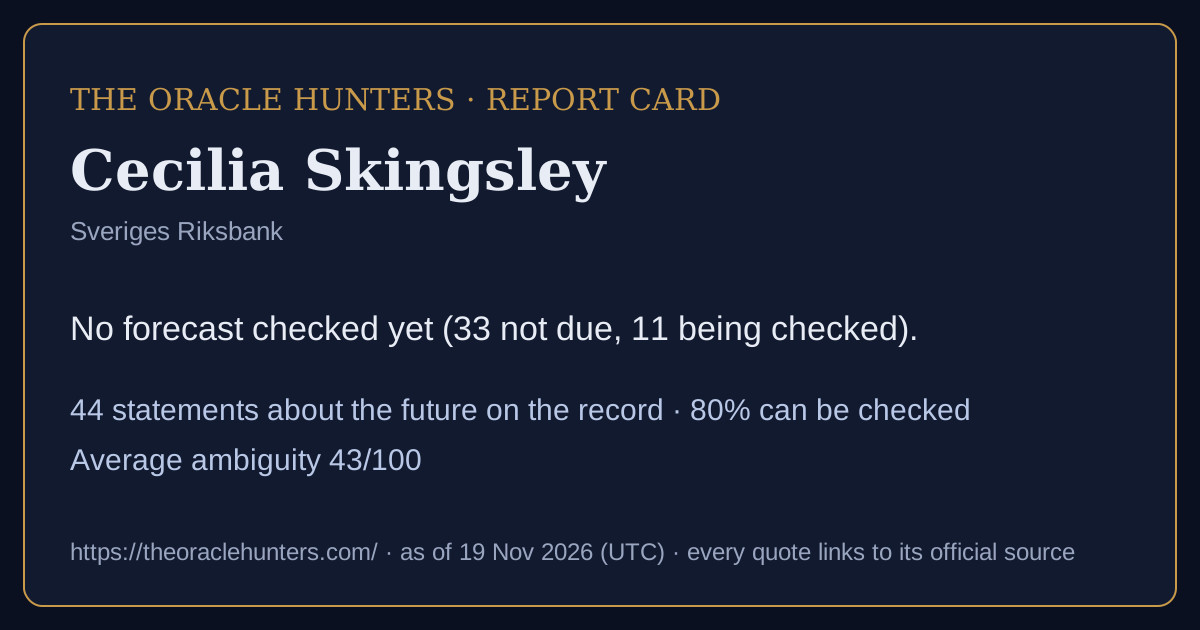
Track record: No forecast checked yet (33 not due, 11 being checked).
44forecasts & commitments on the record
80%can be checked as stated
43average ambiguity (0-100)
0goalpost moves recorded
0confirmed U-turns
Timeline
came true partly did not not due / being checked / too vague
Calibration score: shown after 10 checked forecasts with a stated likelihood (now 0).
How they speak about the future: based on data 33, educated guess 10, stated on authority 1.
Kinds of claim: forecast 25, scenario (if… then) 11, mixed claim 8. · Download this report card as a picture
In the nine words
πρόγνωσιςInference from evidence30 · 68%πρόνοιαPreparing for the future11 · 25%εἰκασίαConjecture2 · 5%μαντείαInspired knowledge1 · 2%
How to read this
Each box is one sentence a public figure or institution said about the future, word for word, with a link to the official text. Can be checked means it names what will happen, by when, and how likely - so it can be compared with official figures later. Too vague to check means it does not. Ambiguity (0-100) is how many different ways the sentence can be read. When the date passes, the forecast is compared with official data and marked came true, partly or did not come true. Labels judge the sentence, never the person. Full guide and glossary.On the record (44)
The UK government bond has a long maturity term of on average around 15 years. 21 This means that it will take a very long time before the holding decreases to any great extent if a representative sample of the bond stock has been purchased, as the Bank of England has done.
Otherwise, if market participants suspect that the central bank's commitment is not long-term, there is a risk that the transmission mechanism will remain damaged, and the operation will have failed, so to speak.
Bank of England (2022), 'Monetary Policy Summary and minutes of the Monetary Policy Committee meeting, published 5 May, available at Bank Rate increased to 1% - May 2022 | Bank of England.
As early as the forecast period up to the second quarter of 2025, the holding may well have been halved through maturities.
The plan from the beginning of the autumn also meant that consideration would be given to selling securities before maturity, once the policy rate had reached 1 per cent, which it did in connection with the most recent monetary policy announcement on 5 May.
For this reason, the Riksbank wrote to the Riksdag in the spring of 2019 providing input to an inquiry that should, among other things, clarify the Riksbank's mandate regarding the e-krona. 11 The inquiry was appointed in December 2020 and will deliver its report in November 2022.
One example of this is that during earlier periods we could see directly the effect of a 0.25 percentage points lower repo rate on the inflation forecast.
The Riksbank cut its policy rate by 4.5 percentage points to 0.25 per cent between October 2008 and July 2009, at the same time as the forecast indicated that it would not be raised again until the middle of 2010.
This may sound cryptic, but goal independence means that the central bank determines its own operational target, which is to be attained to meet the legislator's intention of price stability, for instance an inflation rate of 2 per cent.
Estimates indicate, for instance, that the policy rate in the United States would actually need to have been cut to -4 per cent. 20 This gave rise to a discussion on which new monetary policy tools could be used to attain further stimulation.
I am fairly certain that most people would consider it an advantage if central banks could continue using the interest rate as their man tool to stimulate the economy, counteract unemployment and hold inflation low and stable. 5
They therefore want to make it clear that they are endeavouring to attain an average inflation rate of 2 per cent - 'average inflation targeting'. 17 However, they have not committed to any specific formula for calculating the mean value, for instance, over which period this will apply - hence the term 'flexible'.
Firstly, that monetary policy shall be aimed at inflation overshooting 2 per cent for a period of time if inflation has previously undershot 2 per cent.
It may also be worth noting that there is an international debate that emphasises that as the neutral interest rate is historically low, even an inflation target of 2 per cent provides too little scope for monetary policy.
If this merely means that we accept that inflation will not quite reach 2 per cent within the coming years, then it is of course true - this is after all what we are forecasting.
This is the case with the Riksbank's and the ECB's forecasts, but also the Federal Reserve's forecasts are below the target for two years ahead, not reaching target level until 2023 (see Figure 2). 1 It appears to be the case that central banks are increasingly making the assessment that they will have difficulty conducting a sufficiently expansionary policy to …
13 Stefan Fölster replicated a study by Frey and Osborne (2013) using Swedish data and found that more than 50 per cent of all jobs could be replaced by digital and automated technology in the coming 20 years.
If the present trend continues, cash could actually be phased out as a means of payment in a few years, as many banks and a growing number of retailers no longer offer services involving cash.
The assessment we made in February was that it is probably time to slowly start raising the repo rate during the second half of this year.
If the central bank introduces a negative interest rate, economic agents will choose to hold cash, which does not have an interest rate, instead of deposits with the banks.
And the greater, therefore, is the 'buffer' monetary policy can use to stimulate the economy if necessary - the risk is smaller that the policy rate will reach its lower bound and, if average inflation expectations are higher, it will be easier to bring the real interest rate down.
interest rates will remain low for a fairly long time to come. 10 For example, Rachel and Smith (2015) estimate that the global real interest rate will be about or just below 1 per cent in the medium to long term.
Model simulations suggest that this has increased the probability that the interest rate will hit its lower bound from 5 per cent to 15 per cent (see Kryvtsov and Mendes, 2015).
If monetary policy should now turn out to be less effective in the period ahead than it has been historically, one consequence could be that the central banks would be forced to accept below-target inflation for longer periods of time.
If a recession should occur within, say, the next five years, our scope for cutting the repo rate would probably be very limited.
The Riksbank's latest forecast indicates that, in the middle of 2019, the repo rate will be 0.7 per cent.
Measures taken to improve the prospects for our trading partners are of course also positive for the Swedish economy, but if the negative interest rate differential between Sweden and the rest of the world were to increase, it could contribute to a strengthening of the krona.
If the real interest rate rises to 3 per cent, and the inflation target remains unchanged at 2 per cent, the nominal interest rate will be 5 per cent, and so on.
This year some 38 billion e-commerce transactions will take place.
If, for example, one raises the inflation target in a situation where inflation is much higher than the target, there is a risk that this will be perceived as giving in and taking the easy way out and that one will be expected to continue doing this the next time there is a problem.
If this were to be the case, a lot more groups in the economy will experience downward pressure on their wages.
Schück, Johan (2015), 2 procents inflation är ett orealistiskt mål. [2 per cent inflation is an unrealistic target] Column, Dagens Nyheter , 8 May.
The reason for the figure of 2 per cent was not that research had determined that this was the absolutely most appropriate level; it was probably more because this was the approximate level of inflation in most of the countries that began to introduce inflation targets and it appeared to be a reasonable figure in general.
19 The Riksdag Committee on Finance's external evaluation of monetary policy in Sweden 2010-2014 will be completed towards the end of the year and will be processed by the Committee and the Riksdag in 2016.
Instead of aiming to bring up inflation to 2 per cent, which will be difficult and risks causing other problems, one should therefore lower the inflation target, the argument goes.
Starting from 2015, we will carry out extensive information campaigns aimed at both market participants and the general public.
If the providers of the banks' market funding were to lose confidence in the banks, or in the situation on the mortgage market, the price of funding could increase and access to funding decrease.
Since 1995, the aggregate household debt ratio, that is total household debt as a percentage of disposable income, has increased from 90 to 174 per cent, and it is expected to continue to increase in the years immediately ahead.
However, it may then take longer for inflation to approach the target and for resource utilisation to normalise than if we do not take such uncertainty into account. 3 This line of reasoning may therefore mean that a higher repo-rate path is better balanced than the example's lower path, despite the fact that it will take longer for inflation to …
The Riksbank's forecasts show that inflation will reach 2 per cent within the forecast period at the same time as resource utilisation will improve.
CPIF inflation was 1.2 per cent in August, which was somewhat higher than expected.
According to the forecast, the repo rate will remain at this level until the end of 2014.
In the forecast, the real interest rate will remain negative until the beginning of 2015, which shows that monetary policy is expansionary.
The forecasts in July and September were that inflation was expected to rise towards two per cent in 2015 and that resource utilisation was expected to increase as growth picked up.
Also said - not checkable as stated (12 newest)
Remarks about the future with no date, figure or likelihood that could be checked. They are kept on the record and shown here, but not scored.
We have entered a period in which the repo rate needs to be raised - and much more than we expected earlier. 'The inflation map has been redrawn', and this is a situation we share with many other central banks worldwide (see Figure 1).
Add to this that system changes may have a certain lead time, and it is clear that central banks need to act quickly, too.
In practice, we will analyse thoroughly a number of key issues, ranging from the consequences for monetary policy and financial stability to governancerelated aspects and possible contingency solutions.
We will now perform an in-depth analysis of all relevant aspects that will provide the basis for deciding whether the Riksbank should enter into contractual negotiations with the Eurosystem.
The preparatory steps that we have decided to take will provide a basis for deciding whether the Riksbank should enter into contractual negotiations with the Eurosystem.
We will invite for further dialogue around this in due course.
It was necessary to ensure as soon as possible that the financial system could manage to maintain credit granting at very low interest rates.
The prohibition means, for instance, that the Riksbank may not purchase debt instruments directly from the state.
Others, such as Andrew McAfee and Erik Brynjolfsson at MIT, say that the effects of digitalisation have passed under the radar and that we will see major productivity increases in the future when the new technologies are used more broadly in the business sector. 5 Economic historian Joel Mokyr also points out that the productive potential in new technologies will …
Will my job still exist in the future, or will it be done by a robot or an algorithm?
Some economists, such as Robert Gordon, say we are in a period of very low productivity growth that will be the new normal for a rather long time.
Swish payments are now as common as cash payments. 9 In a few years' time, it may be the case that the use of cash is at such a low level that the general public no longer has access to any form of central bank money that can be used to make payments in ordinary shops.