Carolyn Wilkins
Bank of Canada · GBR
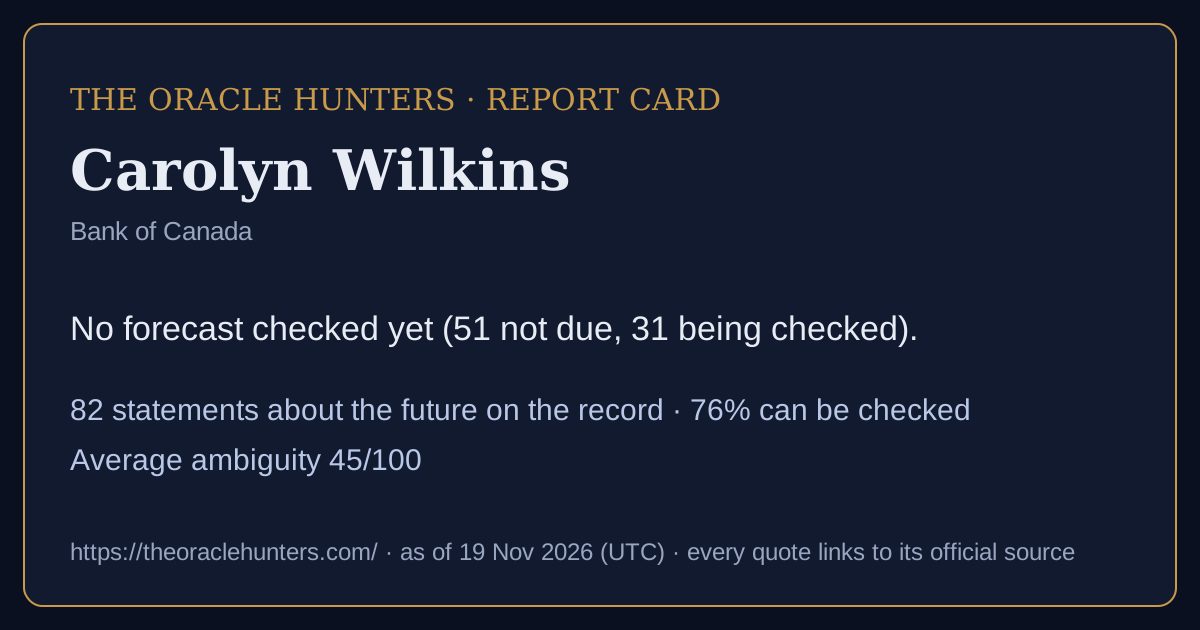
Track record: No forecast checked yet (51 not due, 31 being checked).
82forecasts & commitments on the record
76%can be checked as stated
45average ambiguity (0-100)
0goalpost moves recorded
0confirmed U-turns
Timeline
came true partly did not not due / being checked / too vague
Calibration score: shown after 10 checked forecasts with a stated likelihood (now 0).
How they speak about the future: based on data 66, educated guess 11, stated on authority 5.
Kinds of claim: forecast 59, scenario (if… then) 15, mixed claim 7, commitment 1. · Download this report card as a picture
In the nine words
πρόγνωσιςInference from evidence61 · 74%πρόνοιαPreparing for the future15 · 18%μαντείαInspired knowledge5 · 6%προαναγγελίαPublic pre-announcement1 · 1%
How to read this
Each box is one sentence a public figure or institution said about the future, word for word, with a link to the official text. Can be checked means it names what will happen, by when, and how likely - so it can be compared with official figures later. Too vague to check means it does not. Ambiguity (0-100) is how many different ways the sentence can be read. When the date passes, the forecast is compared with official data and marked came true, partly or did not come true. Labels judge the sentence, never the person. Full guide and glossary.On the record (82)
Recent work presented at Jackson Hole just a few weeks ago argues that this could make settlement faster or cheaper where cross-border banking is slow or costly.footnote In 2024, sending a USD 200 remittance cost around 6.4% on average globally, while costs in Sub-Saharan Africa averaged about 8.5%.footnote
The Bank of England’s framework for systemic sterling-denominated stablecoins, which will be finalised at the end of this year, goes further on some of these issues.footnote It is more restrictive about reserve assets and puts more weight on liquidity contingency planning, payment-system access and arrangements for failure.
While we have some results from our research on alternative frameworks, we still need to consider comments we've received from experts as well as feedback from our online survey. 17 It's too early to draw firm conclusions, but you can be sure that when we settle on an agreement with the government next year, it will be clear why we …
All told, we expect the level of Canadian potential output to be about 3 percent lower by the end of our projection horizon in 2022, relative to what we expected
It will likely remain high for a while, particularly if global interest rates remain low.
Our policy interest rate may be relatively low now, but at 1.75 percent we still have room to manoeuvre.
Also, the share of new mortgages going to highly indebted borrowers fell to a low of 13 percent.
Even if the trade war doesn't get any worse, by 2021 it could cost around US$1 trillion in lost economic output around the world.
It is expected to return sustainably to target by around mid-2020 as slack in the economy is absorbed and these temporary effects wane.
Despite this, we expect overall investment in this sector to contract further in 2019 before stabilizing over the next two years.
As Governing Council continues to monitor incoming data, we will pay particular attention to developments in the energy sector and the impact of trade conflicts on the prospects for Canadian growth and inflation.
Here's the bottom line: when we take into account the impact on the global economy and commodity prices, trade conflicts and uncertainty are projected to reduce the level of Canadian GDP by as much as 2 percent by the end of 2021.
To the extent that this buildup is unplanned, it may dampen production in some sectors later this year.
We also projected growth would rebound modestly to a 1.3 per cent pace in the second quarter and further accelerate later in the year.
In April, we said tariffs over the past two years and trade policy uncertainty would chop 0.4 per cent from global GDP by the end of 2021-that's about US$350 billion.
Overall, we said growth in Canada will slow to 1.2 per cent this year from 1.8 per cent in 2018.
Our April forecast estimated that trade uncertainty, including uncertainty with respect to the ratification of the Canada-United States-Mexico Agreement (CUSMA), would cut the level of business investment in Canada by about 2.5 per cent by the end of 2021.
In this situation, growth will keep debt as a percentage of GDP on a stable or declining path, even if a country is running a limited budget deficit.
Finally, economic growth will make public debt more sustainable-if we play our cards right.
If you use the trend or 'natural' rate of unemployment as a guide-that's the rate that puts neither upward nor downward pressure on inflation-then, at first glance, the answer could be yes. 1 That's because our most recent staff analysis puts Canada's trend or natural rate of unemployment in the range of 5½ to 6½ per cent. 2
Wage growth has picked up considerably to average about 2½ per cent in 2018, compared with 2 per cent over the past five years. 5 But we are still shy of what one would expect in a tight labour market.
For example, the central bank could commit to keeping the level of aggregate prices on a steady growth path-say, 2 per cent a year.
10 See 'Why Has Canada's Inflation Target Been Set at 2 Per Cent?' Bank of Canada backgrounder, May 29, 2012.
Some economists have suggested that we could address the issue of limited firepower by raising the level of the inflation target to, say, 3 or 4 per cent. 12 They argue that a higher inflation target would restore some conventional policy room
3 Bank of Canada research shows the policy rate could be lowered to -0.5 per cent if warranted, meaning the effective lower bound would be below zero.
Let me conclude with a few words on the direction our work will take leading up to the next agreement on Canada's monetary policy framework in 2021.
2 See the Bank's web page devoted to the 2021 renewal cycle, where over the next three years work done under the inflation target renewal (ITR) research program will be posted.
All told, we estimate that this amounts to a drag on the global economy of 0.3 per cent by the end of 2020.
Inflation was running near the upper end of our 1 to 3 per cent target range in July and August, a little higher than we had expected in our July MPR.
A recent study by the Bank for International Settlements (BIS) shows how virtually all regions in Canada, Mexico and the United States could expect lower real wages if these countries reverted from NAFTA to World Trade Organization tariff rates. 11
This effect will largely recede by the first quarter of next year.
Those measures have remained around 2 per cent, supporting our assessment that the inflation increase will be temporary.
Some of you might recall that in our July forecast we were counting on a quick rebound from the marked slowdown in gross domestic product (GDP) growth that we saw during the first quarter of this year.
Taken together, the Bank estimates that the combination of reduced confidence and trade measures already taken will shave about two-thirds of 1 per cent from GDP in Canada by 2020. 8
We expect the quarterly profile of GDP growth to be volatile for the rest of 2018, but to still average around 2 per cent.
Stress tests are an excellent way to help us understand what could happen if financial institutions were subject to adverse events, such as a steep house price decline or a Brexit vote.
If their employment rate were raised to the same level as that for the rest of the labour force, we could add up to 12 million workers.
Inflation was actually a bit stronger than we projected in October, rising to just above our 2 per cent target near the end of last year.
In Canada, economic growth is expected to average around 2 1/2 per cent in the short term, before slowing to a more sustainable pace over the projection horizon.
Gervais, 'A lternativ e Scenario to the October 2017 M PR Base-Case Projection: Higher Potential Growth,' Bank of Canada Staff A nalytical Note No. 2017-18 (October 2017). 17
While this may be the optimal strategy, central banks could potentially achieve lower volatility of inflation and less buildup of financial vulnerabilities from credit if they were more confident about the effectiveness of unconventional policy tools.
This forecast includes the monetary policy actions likely to be needed to bring inflation back to our 2 per cent target over the projection horizon.
Generally speaking, while growth might bounce around from quarter to quarter, it is more likely to be sustainable over the medium term if its sources are broad-based.
You will remember that the Bank of Canada reduced the policy rate by 50 basis points in 2015, to near-historical lows.
One challenge we have when assessing the geographic diversity of growth is that it takes longer for provincial data to be published-this year's data on growth by province will not be available until well into 2018.
If we see an increasing proportion of people at the lower end of the income distribution, recessions and other negative events could result in more financial stress. 17
Our best estimate is that potential output will rise by an average of 1 1/2 per cent per year over the next few years-that is not very impressive relative to history.
If potential growth turns out to be greater than we expect, the economy could expand further before generating inflationary pressures.
Overall, we project economic growth in Canada to slow from an annual pace of 3.8 per cent in the first quarter to just over 2 per cent for the remainder of the year.
Under our baseline outlook for growth and potential, the economy will absorb its excess capacity sometime in the first half of 2018, a bit sooner than we projected in January.
Showing the newest 50 - the ledger has all 82.
Also said - not checkable as stated (12 newest)
Remarks about the future with no date, figure or likelihood that could be checked. They are kept on the record and shown here, but not scored.
She also considers what could happen if US dollar stablecoins become widely used, and what that could mean for the future of international monetary power.
The strategic issue here is what role stablecoins will play in a system where money, payments and geopolitical power are becoming increasingly intertwined.
Private banks issue their own sterling banknotes, which circulate pound-for-pound with other sterling money and are fully backed by ring-fenced assets, but the basic monetary promise is familiar: a privately issued claim that people expect to maintain its value at par.
Each time, the statutory limit on note issuance was temporarily relaxed so that the Bank could lend into the panic.
Today, I'd like to take us beyond the current context and discuss what we will need to thrive in the post-pandemic world.
I'm starting here because many of you are wondering how we are going to service the debts that will emerge from the pandemic.
Conventional wisdom says that we should embrace technological change because it will create more jobs than it will destroy.
First, we must address the reality that market forces will leave some people behind.
In the morning session, we will compare monetary policy frameworks and provide an update on the horse race.
One challenge I laid out in that speech has become crystal clear today: central banks are likely to run out of conventional firepower if we see an economic downturn in a low-interest-rate world.
Another challenge is that long periods of low interest rates encourage investors to take on risk that may be excessive.
First: Can we articulate another framework that will do a better job than the inflation-targeting framework that's been in place for over 25 years?