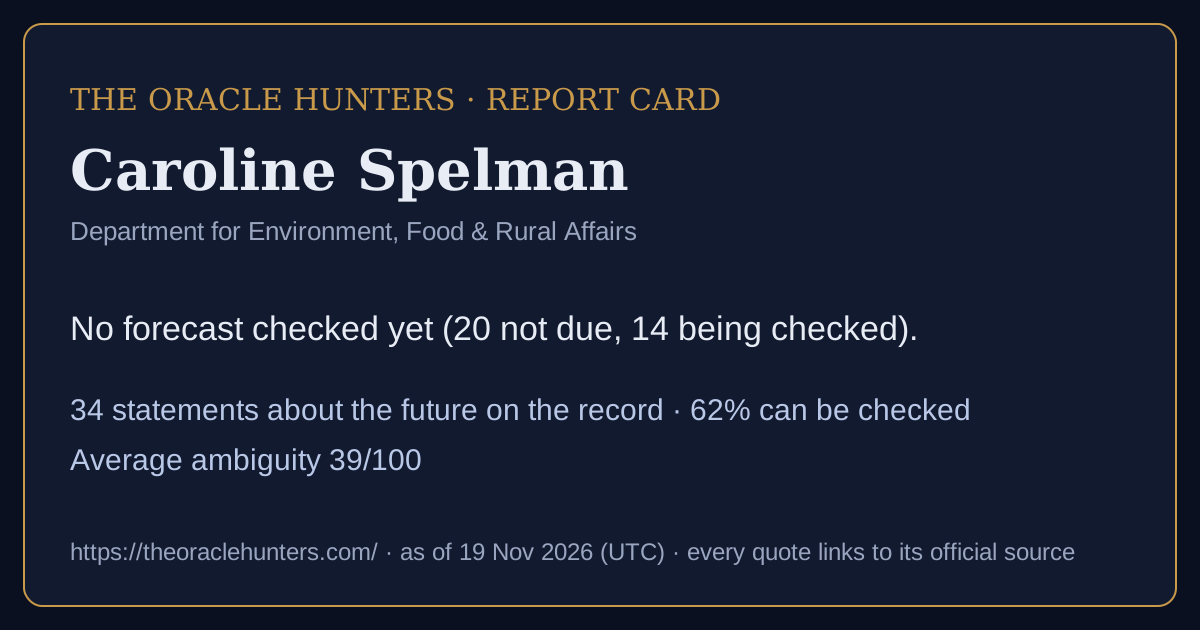
Caroline Spelman
Department for Environment, Food & Rural Affairs · GBR
Track record: No forecast checked yet (20 not due, 14 being checked).
34forecasts & commitments on the record
62%can be checked as stated
39average ambiguity (0-100)
0goalpost moves recorded
0confirmed U-turns
Timeline
came true partly did not not due / being checked / too vague
Calibration score: shown after 10 checked forecasts with a stated likelihood (now 0).
How they speak about the future: based on data 27, stated on authority 7.
Kinds of claim: forecast 24, mixed claim 5, commitment 4, scenario (if… then) 1. · Download this report card as a picture
In the nine words
πρόγνωσιςInference from evidence24 · 71%μαντείαInspired knowledge5 · 15%προαναγγελίαPublic pre-announcement4 · 12%πρόνοιαPreparing for the future1 · 3%
How to read this
Each box is one sentence a public figure or institution said about the future, word for word, with a link to the official text. Can be checked means it names what will happen, by when, and how likely - so it can be compared with official figures later. Too vague to check means it does not. Ambiguity (0-100) is how many different ways the sentence can be read. When the date passes, the forecast is compared with official data and marked came true, partly or did not come true. Labels judge the sentence, never the person. Full guide and glossary.On the record (34)
So by 2030, the world is expected to need at least 50% more food, 45% more energy, and 30% more water.
By 2030, the world will need at least 50% more food 45% more energy, and 30% more water, and this will need to be produced without further damaging the environment.
These and the sixty new schemes starting this year will help us exceed our goal to better protect 145,000 households by March 2015.
Without action, annual damages to properties could rise to between £2 and £12 billion by the 2080s, taking projected population growth into account.
If farming isn’t sustainable - if it fails to support biodiversity, protect our natural resources and both mitigate and adapt to climate change - then it will fail to feed the growing global population, with an extra billion mouths to feed in just 13 years time.
It will be supporting 33 new projects with funding of £8.5 million over the next three years.
We will call for an absolute commitment to inclusive green growth as the only way forward.
It’s very clear agriculture will be affected again this year.
So I warmly support the UN Secretary General’s Sustainable Energy for All by 2030 initiative, which will be launched this year at Rio+20.
So we will be pushing for a clear commitment to sustainable development and green growth from politicians around the world.
Ban Ki Moon’s excellent report notes that by 2030, the world will need at least 50% more food, 45% more energy, and 30% more water.
We must work towards a clear position beyond 2015 - one which builds on the existing MDGs, and one in which the Sustainable Development Goals could play an important part.
Annually we invest £30 to £50 billion on infrastructure: road, rail, energy, and water hardware, much of which will be here for many decades.
In the Autumn Statement, the Chancellor announced that we will invest over £200m in a new, state-of-the-art animal virology laboratory at Pirbright.
There will also be a £3.5m innovation competition in water security, to be launched by the Technology Strategy Board in the spring.__
The UN estimates that, by 2030, the world will need 30 percent more fresh water and 50 percent more energy; and that by 2050 demand for food will increase by 70 percent.
There’s also the recent McKinsey research, showing that global resource efficiency could create 3.7 trillion dollars by 2030, at the same time making half of the carbon savings needed to keep climate change within 2 degrees.
As research I published earlier this year showed that making better use of resources could save British business around £23 billion a year.
A report that found UK business could save 23 billion pounds a year by improving the way they use energy and water.
Total spend on HLS will increase by at least 80% over the next three years.
The UK’s first Climate Change Risk Assessment - currently underway and due to be published by January 2012 will provide us with an even better understanding of both the risks and the costs of climate change to our society, infrastructure and economy, and help us to plan for the future.
We have also confirmed that providers of public infrastructure projects must provide a climate risk assessment under the Climate Change Act - the first reports will be published next year.
The global 2020 targets agreed at Nagoya will pose a new challenge and focus for biodiversity.
And the GEF has also established a new $250 million programme for sustainable forest management which will deliver climate change and biodiversity benefits.
I am also delighted to say that the UK will not only sustain the existing level of funding of £7m per year, but now plans to increase it over the next four years.
Even so, we are increasing our funding for international biodiversity and we will meet our commitment to provide 0.7% of our GNI in overseas development assistance from 2013.
And it’s estimated that the NHS could save over £2 billion through increased activity in open green spaces - our own natural health service.
And Defra’s own first National Ecosystem Assessment, co-chaired by our Chief Scientist Bob Watson, which will be published in Spring next year will give us a much better idea of the state of the UK’s ecosystems.
They are already home to more than one million businesses and employ over 5.5 million - rolling out Superfast broadband is probably the single most important thing we can do to help our rural communities and businesses thrive and grow.** **
By this time next year, the National Ecosystems Assessment will tell us how they may change in the future and how the UK can best respond to these changes.
This month, for example, we’ve learned that the cost to the UK of losing bees and other pollinators could be as much as £440 million a year - that’s 13% of the country’s entire income from farming.
In 2000, it was forecast that global demand for this oil would double by 2020.
The Task Force will make its first recommendations as early as possible next year.
The Trust’s catering manager estimates up to £400 million could be saved each year if this scheme was rolled out across the NHS.
Also said - not checkable as stated (12 newest)
Remarks about the future with no date, figure or likelihood that could be checked. They are kept on the record and shown here, but not scored.
And I’m pleased to see the private sector represented here because at Rio we really do need to make progress on business sustainability reporting - and see commitments from business to put sustainability at the heart of their own decision making, Governments can set the framework, but it is the private sector who will drive the green economy.
My hope is we will leave the planet in better condition than we found it for the sake of generations to come.
The UK and the World Bank will be holding a Natural Capital Summit - where we would like to secure a new commitment to sustainability from Governments - and businesses too
Economic growth, and development is necessarily a priority for all countries The world’s economic activity must be green it must be sustainable, and it must enhance wellbeing and societal progress.
In three weeks time, the world will meet in Rio de Janeiro to make the case for greening the world economy, a transformation which must address how to use the Earth’s natural resources more sustainably.
• The UK, together with the World Bank and Natural Capital Declaration, will be holding a Natural Capital Summit, where we hope to showcase commitments from Governments and businesses on integrating the value of natural capital into our decision making.
We also need to reduce greenhouse gas emissions and the negative effects which agriculture can have on our environment, as well as helping agriculture adapt to increasingly variable and unpredictable growing conditions.
We will continue to work with you as we develop Climate Ready, the cross-government programme for adapting to climate change risks.
And with this Government’s help, we will succeed.
There we’ll be working towards tangible outcomes which will put us on the path to a strong, green, climate-resilient economy. **
The UK leads the world in climate science, and Government will ensure it continues to do so.
We could also promote how far farmers already in agri-environment schemes should be considered to be “green by definition.”