Caleb M Fundanga
Bank of Zambia
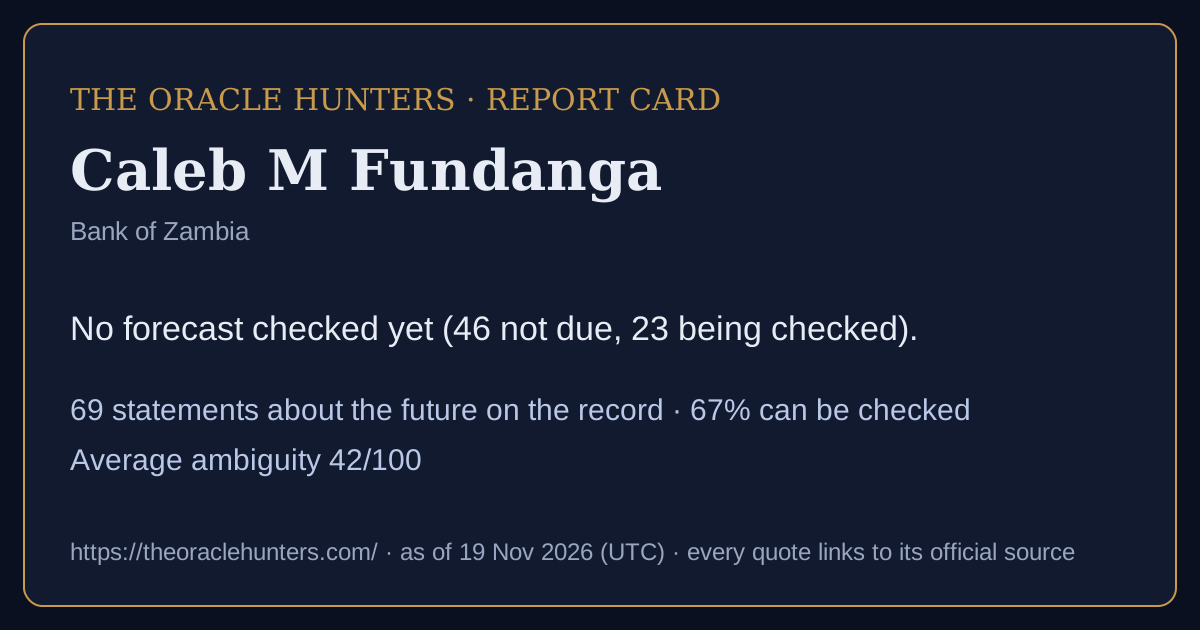
Track record: No forecast checked yet (46 not due, 23 being checked).
69forecasts & commitments on the record
67%can be checked as stated
42average ambiguity (0-100)
0goalpost moves recorded
0confirmed U-turns
Timeline
came true partly did not not due / being checked / too vague
Calibration score: shown after 10 checked forecasts with a stated likelihood (now 0).
How they speak about the future: based on data 58, stated on authority 6, educated guess 5.
Kinds of claim: forecast 57, scenario (if… then) 6, commitment 5, mixed claim 1. · Download this report card as a picture
In the nine words
πρόγνωσιςInference from evidence57 · 83%πρόνοιαPreparing for the future6 · 9%προαναγγελίαPublic pre-announcement5 · 7%μαντείαInspired knowledge1 · 1%
How to read this
Each box is one sentence a public figure or institution said about the future, word for word, with a link to the official text. Can be checked means it names what will happen, by when, and how likely - so it can be compared with official figures later. Too vague to check means it does not. Ambiguity (0-100) is how many different ways the sentence can be read. When the date passes, the forecast is compared with official data and marked came true, partly or did not come true. Labels judge the sentence, never the person. Full guide and glossary.On the record (69)
you may be aware, GDP growth has averaged above 6% over the last five years, supported by low inflation and a positive external sector performance.
- Real GDP is projected to grow by at least 6.8 percent and will continue to be driven by strong performance in the agricultural, mining, construction and tourism sectors.
- Inflation is expected to slow down to 7.0 percent by end of 2011.
- (iii) Growth in Deposits: total deposits have increased by 661% to K18,297 billion as at 31st May 2011 from K2,405 billion as at 31st December 2001.
- (ii) Growth in Bank's Total Assets: total assets have increased by 614% to K24,693 billion as at 31st May 2011 from K3,460 billion as at 31st December 2001.
This growth in M3 was below the quarterly projection of 3.2%.
Annual overall inflation is projected to remain above 8.0% during the first quarter of 2011, mainly due to the following factors:
However, on an annual basis, overall inflation was little changed at 7.7% in September 2010 when compared to the 7.8% recorded in June 2010, but was above the projected 7.3% for the period.
In the fourth quarter of 2010, annual overall inflation is projected to remain below the end year target of 8.0%.
However, the annual overall inflation rate was largely unchanged at 7.7% in September 2010 compared to the 7.8% recorded in June 2010, but was above the projected 7.3% for the period.
Consistent with this outturn, inflation projections indicate an annual overall inflation rate of 7.3% for end-December 2010.
Preliminary estimates indicate that growth in broad money (M3), comprehensively defined to include foreign currency deposits, was 7.2% in the third quarter of 2010 down from 13.3% as at end-June 2010, and was above the 4.0% projected quarterly growth rate.
As you may be aware, a large component of the work being undertaken under the Financial Sector Development Plan (FSDP) and the National Payment Systems Vision and Strategy 2007-2011 is focused on improving financial access and contributing to the establishment of inclusive financial markets in general.
This year's conference follows the success of the inaugural 2009 conference and it is therefore my earnest anticipation that as in 2009, you will find the 2010 conference productive and beneficial.
You may wish to know that personal loans, which stood at a paltry 6% of total bank loans at the turn of this decade now account for 26%.
There has been renewed concern that the economic slowdown, if prolonged, could create liquidity pressures in the banking system in Zambia.
According to the most recent forecasts by the IMF, the global economy is projected to record positive growth of 3.9% in 2010, after contracting by 0.8% in 2009.
Although projections of GDP growth for 2009 had been revised downwards to 4.3% on account of the effects of the global financial and economic melt-down, preliminary data indicates that the economy posted a real GDP growth rate of 6.3% compared with the 5.7% recorded in 2008.
Although projections of GDP growth for 2009 had been revised downwards to 4.3% on account of the effects of the global financial and economic melt-down, preliminary data indicates that the economy posted a real GDP growth rate of 6.3% compared with the 5.7% recorded in 2008.
Indeed, without the participation of women, who make up more than 50% of Zambia's population, it will not be possible to achieve our Vision 2030.
- (i) According to the Central Statistical Office, GDP growth is now forecast at 6.3% for 2009, up from 5.7% recorded on 2008, primarily driven by increased output in the mining, construction and agriculture sectors:
The Bank of Zambia and the Government will continue with efforts to deal with challenges from the global economic and financial crisis, which still remain significant and continue to threaten macroeconomic stability and the long term growth path of the economy.
Similarly, the flow of foreign investments at the Lusaka Stock Exchange switched from a net inflow of US$2.5 million during the period January to May 2008 to a net outflow of US$8.5 million in the similar period this year.
The findings of the on-going follow up Survey, whose results are due to be finalized by the end of this year, will give us an indication of the direction and level of access today.
Arising from this, Government in collaboration with cooperating partners developed a performance assessment framework, under which a target of at least 50% by end-2009 has been set for the level of financial access.
However, despite improvements in growth witnessed since 1999, significant reductions in poverty will not occur without a significant increase in growth rates to above 7% on a sustained basis.
For Africa, as a whole, recent estimates by the IMF are that budget deficits will drop from a surplus of 2.8% of GDP in 2008 to a deficit of 5.4% of GDP in 2009 - with fiscal outturns deteriorating across both oil and non-oil commodity exporters.
In my reflections on the impact and implications of the global economic crisis on Africa, I wish to emphasize four key points: The first and perhaps the most significant effect of the global financial and economic crisis has been the marked slow-down in real GDP growth in SSA, to a projected 1.5% in 2009 from an estimated 5.5% in 2008.
Further, growth in Sub-Saharan Africa is projected to decelerate sharply to 1.5% from 5.5% in 2008.
Although emerging and developing economies are projected to perform much better, with a projected growth rate of 1.5%, this rate of growth is significantly below the estimate of 6.0% growth in 2008.
For the United States of America and the Euro Area, growth in 2009 is projected to contract by 2.6% and 4.8%, respectively; whilst in Japan and the United Kingdom, growth is projected to contract by 6.0% and 4.2%, respectively.
The most recent projections by the IMF suggest that global growth will contract by 1.4% in 2009 before recovering to a growth rate of 2.5% in 2010.
The key intermediation role of the banking sector in providing finances will remain compromised if the costs of banking remain high.
As at 31 May 2009, the bank accounted for about 14% of the banking sector's total assets, while its deposit base accounted for 15% of total sector deposits.
In addition, the deterioration in corporate and household balance sheets is now being translated into higher non-performing loans (NPLs) as a percentage of total assets in the banking sector (from 6% in mid-2008 to 10% in May, 2009 - an increase of 67%.).
Similarly, the flow of foreign investments at the Lusaka Stock Exchange has switched from a net inflow of US$2.5 million during the period January to May 2008 to a net outflow of US$8.5 million in the same period this year.
We shall no doubt be confronted with such and many more similar challenges as we strive to achieve economic growth and poverty reduction in our country.
Ladies and Gentlemen, as we strive to achieve the Vision of becoming a middle income country by the year 2030, we shall no doubt be confronted with such and many more similar challenges both economically and politically.
One such target is to increase the level of access to financial services to 48% by 2008 and 50% by the end of 2009.
On the fiscal front the Government is expected to limit domestic borrowing to 1.2 percent of GDP in 2008.
Thus GDP growth is projected to rise by no less than 7.0% in 2008 and beyond.
For example, the National Payments Systems Act was enacted in June 2007, while Access Bank, the fourth largest bank in Nigeria is expected to open a branch in the country by July 2008, raising the number of commercial banks to 14.
It is projected to slow down further to 7.0% by December 2008.
Since that period, the size of the outstanding issues has grown from 7% of GDP in 1994 to 17% by the end of 2007.
I am aware that the expansion programme is backed by a capital injection of approximately K40.0 billion which will make it possible for Barclays Bank Zambia to increase its services in the country, particularly to the SMEs sector.
The draft law is currently undergoing legal review and is expected to be effected in the course of next year.
You will note that over the period 2001-2006 growth in real national output averaged 5.0% per annum and was above the average population growth over the
It is therefore the expectation of the Bank of Zambia that all banks will comply with this requirement by June 2008.
The issue of the K68.620 billion senior unsecured floating rate note under the Development Bank of Zambia (DBZ) K150 billion Medium Term Note Programme and listing of the note on the Lusaka Stock Exchange (LuSE) is a landmark transaction for two key reasons.
The price of copper has since increased sharply and by May 2006 it had risen to over US $8,000 per metric ton;
Showing the newest 50 - the ledger has all 69.
Also said - not checkable as stated (12 newest)
Remarks about the future with no date, figure or likelihood that could be checked. They are kept on the record and shown here, but not scored.
The robust GDP Growth momentum is expected to be maintained premised on favourable growth performance in mining, agriculture, construction, tourism, manufacturing among other sectors.
This will be supported by favourable commodity prices on the international market, Government's investment in infrastructure and expected increases in foreign direct investment.
Further, inflation is expected to remain in single digits owing to prudent macroeconomic policies and the bumper harvest recorded during the 2010/11 harvest season which is expected to dampen any negative effects on overall inflation through the food component.
Accordingly, interest rates are expected to decline further.
The bumper harvest recorded during the 2010/11 harvest season is expected to dampen effects on overall inflation through the food component.
- In addition, the major infrastructure projects currently taking place are expected to support growth in the construction sector.
- As the global economy continues to recover from effects of the global economic crisis, growth in tourism is also expected in 2011.
- The MFEZs are expected to significantly contribute to employment creation in the country.
The Bank of Zambia will, therefore, continue to work in close collaboration with the financial sector to cultivate partnerships in order to establish the framework necessary for building strong institutions that will mitigate risks and build confidence in the sector.
Ladies and Gentlemen , in the face of an ever growing fear of donor fatigue, public deposits and private capital are likely to be the main source of funding for the microfinance industry to achieve the growth required for it to have significant impact on financial inclusion and poverty reduction across the region.
A robust credit reporting apparatus will enable the financial sector to share critical customer information that will lead to lowering the credit risk and ultimately lending rates in the financial sector.
It is my sincere hope that CETZAM will further reduce lending interest rates to these clients that they are targeting for savings deposits.