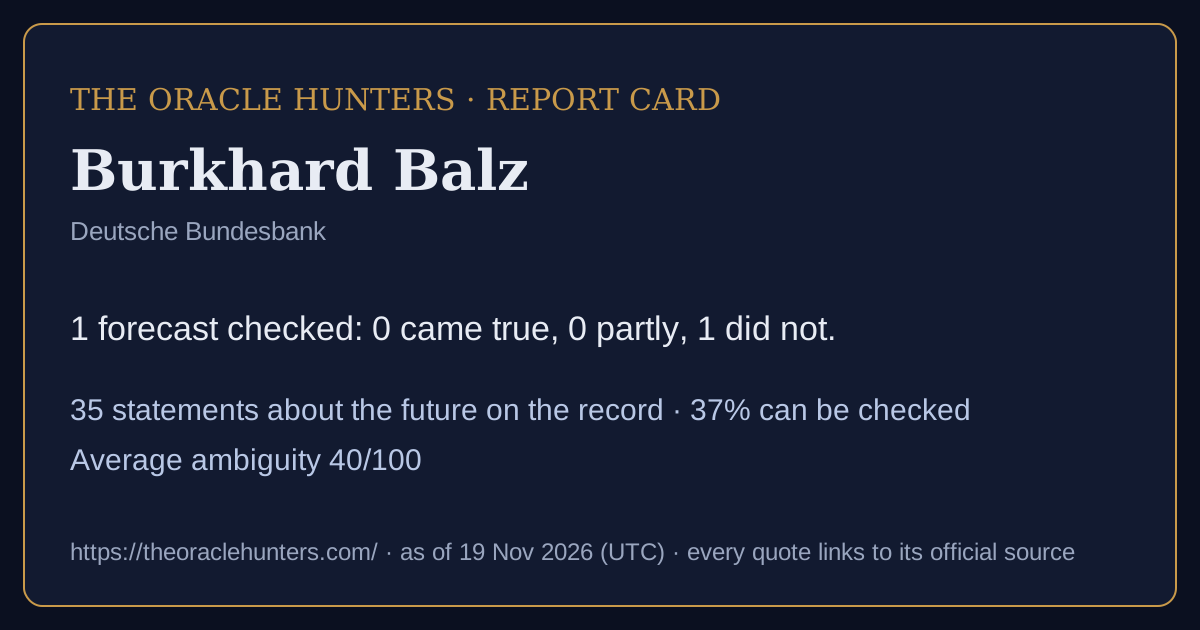
Burkhard Balz
Deutsche Bundesbank
Track record: 1 forecast checked: 0 came true, 0 partly, 1 did not.
35forecasts & commitments on the record
37%can be checked as stated
40average ambiguity (0-100)
0goalpost moves recorded
0confirmed U-turns
Timeline
came true partly did not not due / being checked / too vague
Calibration score: shown after 10 checked forecasts with a stated likelihood (now 1).
How they speak about the future: based on data 30, educated guess 3, stated on authority 2.
Kinds of claim: forecast 28, mixed claim 4, scenario (if… then) 3. · Download this report card as a picture
In the nine words
πρόγνωσιςInference from evidence30 · 86%πρόνοιαPreparing for the future3 · 9%μαντείαInspired knowledge2 · 6%
How to read this
Each box is one sentence a public figure or institution said about the future, word for word, with a link to the official text. Can be checked means it names what will happen, by when, and how likely - so it can be compared with official figures later. Too vague to check means it does not. Ambiguity (0-100) is how many different ways the sentence can be read. When the date passes, the forecast is compared with official data and marked came true, partly or did not come true. Labels judge the sentence, never the person. Full guide and glossary.Checked
The annual average inflation rate for 2023 is also expected to be more than 7%.
Did not come true. Said: inflation above 7% in 2023. Official figure for Germany: 5.9% (World Bank open data). Missed. Off by 1.1 points. official data · checked 14 Nov 2026 · automatic check against official data (rules v3)
On the record (35)
Uncertainty about the long-term role of cash accelerates the downward spiral: if banks and merchants assume cash will soon disappear, they underinvest and the prediction fulfils itself.
It is important to note that, even with this progress, the digital euro will not be introduced before 2029.
At the Bundesbank, we anticipate a gradual introduction no earlier than 2028.
When we take a look at what we have achieved already and what we still have to achieve by 2027, we could say that reaching the G20 targets will be a very ambitious climb.
Based on this reading, inflation will not reach its target until 2025.
The results of how a digital euro might be designed will therefore be presented to the ECB Governing Council in October of this year.
When people ask me when a digital euro would be ready for distribution among users, I remain cautious: We are talking about a minimum of three years, so probably not before 2027.
It is only projected to be almost back at the 2% target in 2025.
The MarchECB staff projections suggest that inflation will decline only gradually. 1 The euro area rate will probably significantly exceed the target rate again in 2024, at an average of 2.9%.
This is what could happen if households, enterprises and wage bargainers expect higher inflation rates not just now but also in the future.
The annual average inflation rate for 2023 is also expected to be more than 7%.
Did not come true. Said: inflation above 7% in 2023. Official figure for Germany: 5.9% (World Bank open data). Missed. Off by 1.1 points. official data · checked 14 Nov 2026 · automatic check against official data (rules v3)
According to the IMF, global consumer prices are expected to rise by 8.8% this year.
If everything goes to plan, the first users could pay with digital euro in autumn 2026.
By the end of the investigation phase in autumn 2023, theECB's Governing Council will decide, in close consultation with the legislative bodies of the European Union, whether to launch a realisation phase on a digital euro, which would take another three years.
Thanks to its widespread availability, cash and possibly a digital euro could serve as a fall-back solution in the event of geopolitical tensions or if sanctions were imposed against Europe.
The introduction of a digital euro could follow in autumn 2026.
By the end of the investigation phase in autumn 2023, the Eurosystem will decide whether to launch a realisation phase on a digital euro.
More than one-quarter of the central banks surveyed are in the process of developing a CBDC (Central Bank Digital Currency) or running pilot projects, and over 60% are conducting proofs-of-concept or experiments with CBDC (Central Bank Digital Currency) concepts.
Then, at the end of 2023, the Eurosystem will decide whether to enter the realisation phase, which could take three years.
As a result, retail CBDC (Central Bank Digital Currency), as a new means of payment for everyday transactions, may exist in at least some countries at the end of the decade, so by 2030.
By the end of 2021, 140 million respective digital wallets had already been issued according to People's Bank of China representatives, although it remains unclear, how many of these are used regularly.
We will proceed investigating in order to be able to take a decision on a realisation phase at the end of 2023.
Last week, the International Monetary Fund published its World Economic Outlook, in which it envisages global growth of 3.6% this year, following on from around 6% last year.
According to the March projections of ECB staff, inflation rates in the euro area will drop back towards the 2% target over the next two years.
On average this year, our economists now expect Germany to see inflation of around 6%.
The estimate for world economic growth this year is thus 0.8 percentage points lower than it was in the January forecast.
For this year, according to its latest projection, the Eurosystem is expecting the HICP to even go up to 5.1%, which would put inflation well above the ECB's 2% inflation target.
Until mid-2023, the Eurosystem will be investigating use cases, the potential design and the features of a digital euro.
On the one hand, the BIS predicts that central banks representing a fifth of the world's population will issue a general purpose CBDC in the next three years.
We all should keep going and deliver. 2021 will be a decisive year for the future of European payments!
Bundesbank online surveys of April and May 2020 found out that 73% of respondents who changed their payment behaviour during the pandemic said they would probably or even certainly stick to this new behaviour.
In total, the punitive tariffs are likely to dampen global trade by just under 1 per cent after a certain interval.
The current IMF staff projections expect the global economy to expand just as strongly in 2018 and 2019 as it did last year.
A model-based analysis by the Bundesbank indicates that the tax reform alone will probably add substantially to the pace of US economic growth this year and next.
The IMF staff are expecting activity in Germany, and in the euro area, too, to expand by around 2 per cent this year and next, and are forecasting an even stronger rate of growth for the United States.
Also said - not checkable as stated (12 newest)
Remarks about the future with no date, figure or likelihood that could be checked. They are kept on the record and shown here, but not scored.
What the stars are to the seafarer, our mandate is to us central banks: the ideal of safeguarding trust in our currency, however rough the seas may be.
Third, make the elevators safer and more diverse: private digital payments will grow; we must keep them robust - and, in the Eurosystem, install a public elevator in the form of a digital euro, designed for resilience from the outset.
Central banks can counter this by articulating a long-term vision: cash will remain available and usable, and digital payments will be promoted, but not at the expense of inclusion and resilience.
Bank-based cash infrastructure is still the backbone of cash supply and must continue to support a resilient cash cycle.
Oversight should ensure that critical infrastructures and providers maintain robust contingency plans, redundancy and strong cyber security.
We should engage stakeholders through consultations, working groups and public communication to build a shared understanding of objectives and trade-offs.
By the way, this commitment has evolved over time: You might be surprised to learn that, back in the Cold War, the Bundesbank was prepared for emergencies in true James Bond style - complete with a secret bunker in the Moselle valley stocked with 7 emergency currency .
- Integration with existing systems: The digital euro will be distributed through supervised intermediaries such as banks and other payment service providers.
If resilience in payments means that public money must remain available under all circumstances, then a key question arises: How can central bank money continue to fulfil this role in an increasingly digital world?
This is especially important in situations where digital infrastructure is temporarily unavailable, though it comes with technical limitations that must be carefully managed.
And above all, they expect security and the ability to trust in the payment systems they use.
From our perspective as a central bank, it is essential that we reduce the current high level of fragmentation in our payment landscape along national borders. 25 years after the launch of the euro, Europe still lacks a truly European digital means of payment which works not only in a domestically but also across borders.