Burhanuddin Abdullah
Bank Indonesia
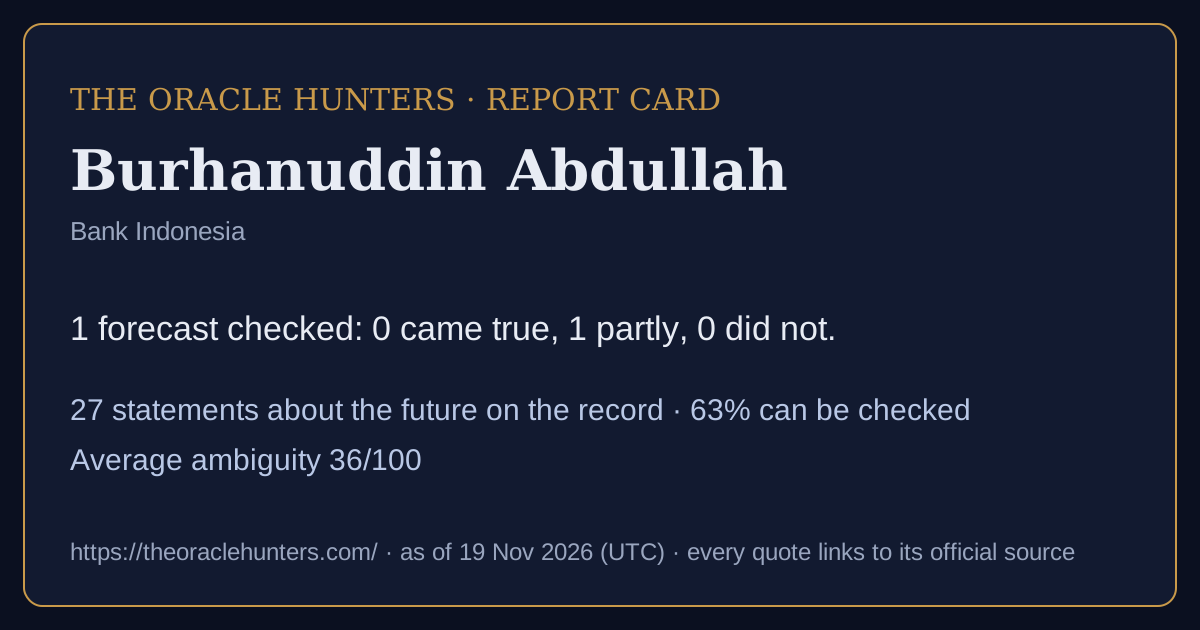
Track record: 1 forecast checked: 0 came true, 1 partly, 0 did not.
27forecasts & commitments on the record
63%can be checked as stated
36average ambiguity (0-100)
0goalpost moves recorded
0confirmed U-turns
Timeline
came true partly did not not due / being checked / too vague
Calibration score: shown after 10 checked forecasts with a stated likelihood (now 1).
How they speak about the future: based on data 25, stated on authority 2.
Kinds of claim: forecast 20, mixed claim 6, commitment 1. · Download this report card as a picture
In the nine words
πρόγνωσιςInference from evidence25 · 93%μαντείαInspired knowledge1 · 4%προαναγγελίαPublic pre-announcement1 · 4%
How to read this
Each box is one sentence a public figure or institution said about the future, word for word, with a link to the official text. Can be checked means it names what will happen, by when, and how likely - so it can be compared with official figures later. Too vague to check means it does not. Ambiguity (0-100) is how many different ways the sentence can be read. When the date passes, the forecast is compared with official data and marked came true, partly or did not come true. Labels judge the sentence, never the person. Full guide and glossary.Checked
We fully expect our macroeconomic policy, coupled with the consistent implementation of our structural reform, will allow economic growth to reach 4% this year and will establish the base of real growth of 6% over the medium-term.
Partly came true. Said: economic growth around 4% in 2003. Official figure for Indonesia: 4.8% (World Bank open data). Close: outside the margin, but within one more half point. Off by 0.8 points. official data · checked 14 Nov 2026 · automatic check against official data (rules v3)
On the record (27)
I hope that the public will already be able to access a bank's GCG report from the respective bank's website by the middle of this year.
The year 2010 will see a banking industry comprising of banks that are not only stronger in their capital structure, but also with greater focus regarding their direction and strategies.
Thoughts and anticipative measure have to be prepared as soon as possible because formally the market opening process has been agreed to be in effect by 2015.
Taking into account current ATMR calculation regulations, where credits insured by state-owned enterprises have a risk weighting of 50%, then we project that we will immediately adjust the ATMR calculation for KUR to around 30 to 40%.
We expect economic growth to continue to rise through 2009 and will gradually reach 7% annually.
However, under the assumption of the banks' good intentions, we can say that all banks have been able to meet the minimum capital requirement, and will also be able to meet the Rp100 billion capital requirement by the end of 2010.
In 2007, credit growth is expected to reach 15%-18% with a focus on infrastructure and labor intensive - low import content sectors, such as the agricultural sector and its respective sub-sectors.
Conversely, the opposite may also be true in the form of sluggish economic growth; reaching just 5.7%, if various constraints and downside risks are unable to be mitigated.
Against this backdrop, Bank Indonesia predicts that economic growth may reach 6.3% with private investment as the primary driver as well as consumption
Greater economic activity in 2007 is not expected to add excessive pressure on prices, in general, so that CPI inflation is expected to remain within the target range set forth by the government, namely 6% ±1%.
According to our projection, the current account balance for 2007 will reach a surplus of 1,87% of GDP.
Economic growth in 2007 is projected to reach 6.0% (within a range of 5.7%-6.3%), which surpasses economic growth in 2005 and 2006.
During the beginning of 2006, we will conduct an in-depth evaluation of bank business plans through 2008.
Therefore, as a vision, we may expect to see a more complete picture of the banking industry's new shape by the end of 2010.
As we understand, starting from 2006, guarantee coverage of the Deposit Insurance Corporation will gradually decrease from Rp 5 billion on March 2006 to become Rp 100 million in March 2007.
- From the fiscal side, fiscal stimuli through government consumption and investment would provide a strong jump start towards economic recovery, especially if the government could make use of the unrealized 2005 budgeted spending, carry it forward to 2006 and immediately make it realized within the first quarter of this year.
Considering the abovementioned aspects, this year, we will be making adjustments to Regulation No. 7/2/PBI/2005.
If coordination of these policies is able to be conducted coherently, we will see an improved economic growth supported by the needed investment and consumption levels from the second semester of 2006 Overall, Bank Indonesia projects that the 2006 GDP will reach 5.0-5.7%.
The challenges in penetrating export markets will become significantly harder in 2005 with the elimination of textile export quotas, while so far, almost 60% of our textile and textile products have been sold to quota countries such as the United States and the European Union.
We predict that the Indonesian economy will grow in the range of 5.0%-6.0% while shifting to healthier balance in sources of growth.
Then, having put into place all the prerequisite conditions, we can look forward to having a banking industry at the end of 2010 that will be fully capable of applying best practices and most importantly Basel II.
This is expected to boost lending in 2005 by 20% or about Rp 106.2 trillion.
These are specifically the policies that we will institute to accelerate the consolidation process in the banking industry, as I touched on earlier.
These are points that I expect to become the focus in our efforts to take the development of the banking industry to a new level in support of 7% economic growth in year 2008.
The Government will press forward with the divestment of the remaining IBRA banks with plans to sell majority stakes in Bank Lippo and Bank Internasionel Indonesia by November of this year, and Bank Permata by February 2004.
We fully expect our macroeconomic policy, coupled with the consistent implementation of our structural reform, will allow economic growth to reach 4% this year and will establish the base of real growth of 6% over the medium-term.
Partly came true. Said: economic growth around 4% in 2003. Official figure for Indonesia: 4.8% (World Bank open data). Close: outside the margin, but within one more half point. Off by 0.8 points. official data · checked 14 Nov 2026 · automatic check against official data (rules v3)
Looking forward to 2004, we will continue to strengthen our macroeconomic fundamentals to be the basis for stronger growth in 2004 onward.
Also said - not checkable as stated (12 newest)
Remarks about the future with no date, figure or likelihood that could be checked. They are kept on the record and shown here, but not scored.
In short, communication may serve as an additional 'instrument' that a central bank should use at its disposal to complement other monetary instruments for monetary policy to operate effectively.
This float will in part create a break on imprudent overseas borrowing, because in doing so market participants will have to factor in the cost of possible movements of rupiah.
Uncertainty over future inflation will ease because public inflation expectations have a point of reference, and thus economic costs arising from uncertainty will also be reduced.
Communication to the public on the future monetary policy direction is also vital so that the public can anticipate the central bank monetary policy and to avoid 'surprises' that could trigger volatility in the money market.
Such a poor signal of monetary policy direction and targets obviously fails to meet the need to maintain market expectations on the future exchange rate movement.
Second, monetary policy must be implemented on a forward-looking basis, responding to future developments in inflation.
The challenges that we are going to faced, first is the heightened competition among banks that requires bankers to make the basic strategic decision.
On bilateral level, cooperation among bankers in the region is also essential in preparing the system for a more sophisticated and complex banking practice in the globalized era so that the region could still achieving financial stability.
- I believe that the ASEAN Bankers Association will deliberate at length a strategic review of cooperation in Finance, Investment, and Trade;
Bankers need to figure out where they want to be in terms of a whole spectrum of activities whether they want to be a local bank, regional, or global bank.
In the face of these challenges and implication, ASEAN countries should make every effort to take advantage of the globalization and liberalization of investment and trade, knowing that it is the order of our global economy today.
In line with the objective to maintain financial stability, there is an even greater need to promote our common interest and exchange views on regional issues.