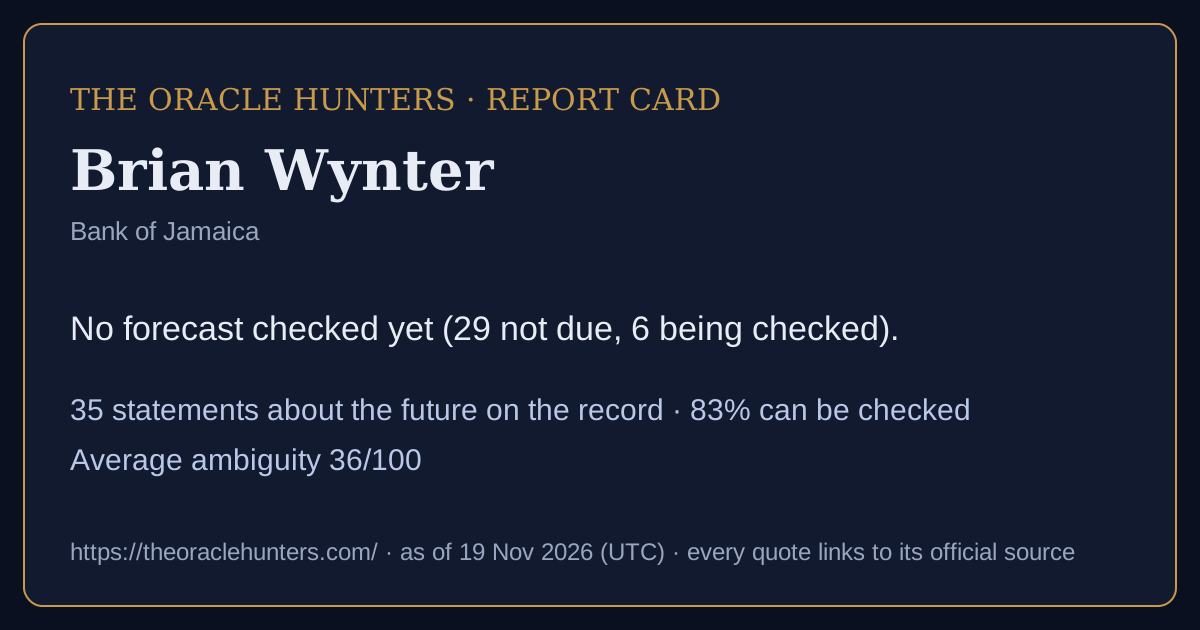
Brian Wynter
Bank of Jamaica
Track record: No forecast checked yet (29 not due, 6 being checked).
35forecasts & commitments on the record
83%can be checked as stated
36average ambiguity (0-100)
0goalpost moves recorded
0confirmed U-turns
Timeline
came true partly did not not due / being checked / too vague
Calibration score: shown after 10 checked forecasts with a stated likelihood (now 0).
How they speak about the future: based on data 28, stated on authority 7.
Kinds of claim: forecast 29, commitment 4, mixed claim 2. · Download this report card as a picture
In the nine words
πρόγνωσιςInference from evidence28 · 80%προαναγγελίαPublic pre-announcement4 · 11%μαντείαInspired knowledge3 · 9%
How to read this
Each box is one sentence a public figure or institution said about the future, word for word, with a link to the official text. Can be checked means it names what will happen, by when, and how likely - so it can be compared with official figures later. Too vague to check means it does not. Ambiguity (0-100) is how many different ways the sentence can be read. When the date passes, the forecast is compared with official data and marked came true, partly or did not come true. Labels judge the sentence, never the person. Full guide and glossary.On the record (35)
Against this background, real GDP growth for the September quarter as well as FY2013/14 is projected to be in the range of 0.0 per cent to 1.0 per cent.
Despite the significantly lower than expected outturn of inflation for the first four months of the fiscal year, the Bank is maintaining the FY2013/14 forecast for inflation to be in the range of 8.5 per cent to 10.5 per cent.
It is encouraging to be able to report that headline inflation was 1.2 per cent for the June 2013 quarter, below the outturn of 2.7 per cent for the March 2013 quarter and well below the forecast range for the June quarter of 2.0 to 3.0 per cent that we announced when we last met in May.
The first is fiscal sustainability which means implementing the necessary revenue and expenditure measures as well as a public debt management strategy that will enable the Government to achieve a primary surplus equivalent to 7.5 per cent of GDP in each of the next four years.
In addition, the World Bank and the Inter-American Development Bank publicly announced that they will provide loans amounting to US$510 million each to support Jamaica's economic programme.
Unlike the Bank's normal liquidity support provided in accordance with the Bank of Jamaica Act, no haircuts will apply so that eligible entities can borrow up to 100% of the pledged nominal amount relating to the new GOJ bonds.
First, it bears mentioning that the Bank, as a major holder of GOJ bonds, will be participating in the exchange with 100% of its holdings.
Annual inflation declined to 7.8 per cent in August from 12.6 per cent a year earlier and is expected to fall further during this fiscal year to settle within the target band of 6.0 per cent to 8.0 per cent.
The reform, which was set out in the Green Paper tabled in Parliament earlier this year, will simplify the tax system, widen the tax base and improve equity mainly through the rationalization of tax waivers, exemptions and incentives.
The fall will not be as pronounced as the 5.5 percentage points fall that we saw in the 2010/11 fiscal year.
But we will be striving for a meaningful reduction all the same, a reduction that is aimed at taking us decisively along the path towards our longer term goal for Jamaica, which is the average inflation rate of our major trading partners (currently about 4 per cent).
Gross international reserves, at US$2.98 billion, represented 23.7 weeks of projected goods and services imports.
A combined total of US$2.4 billion, amounting to about 20 per cent of GDP, is expected to be received by Jamaica over the programme's twoyear period to provide budgetary support and meet balance of payments needs.
Lower demand for financing from the domestic market by the Government will continue to result in more and more resources being available for private sector credit.
Currently, our medium-term forecasts are built around getting inflation down to the 4%-5% range which is, approximately, the collective experience of our
Given the forecast for the March quarter, the Bank is expecting inflation for FY 2010/11 to fall within our original target range of 7.5 per cent - 9.5 per cent.
In spite of the improvements in the global economy and the expected marginal growth in the March quarter, the Jamaican economy is projected to contract in the range of 0.0 per cent to 1.0 per cent for FY 2010/11.
In this regard, the Bank is projecting that there will be a moderation in inflation in the March 2011 quarter, within the range of 1.0 per cent to 2.0 per cent.
As a result of the out-turn for the quarter, there was an uptick in the annual point-to-point inflation to 11.7 per cent relative to the 10.2 per cent in 2009, the original forecast made in December 2009 for CY2010 was 11.4 per cent.
Headline inflation was 3.3 per cent for the December quarter, compared to 1.3 per cent in the September 2010 quarter and the projected range of 2.0 per cent - 3.0 per cent .
While the achievements to date of high single-digit inflation may be satisfactory from a historical perspective, it is not too soon for us to consider how we will reach the lower single-
We at the Bank of Jamaica will do what is required of us to see that rate fall further and remain at a stable single-digit rate for the foreseeable future.
Plan for success this year and rest assured that we will do our part to maintain the integrity of those plans.
By March 2011, we expect the 12-month inflation rate to fall to about 8 per cent, well within the target range announced for the fiscal year.
Domestic inflation for FY2010/11 is expected to be at the upper end of the revised forecast range of 6.0 per cent to 8.0 per cent and within the original target range of 7.5 per cent to 9.5 per cent.
We are projecting that there will be an up-tick in inflation in the December quarter with headline inflation expected to be within the range of 2.0 per cent to 3.0 per cent.
At that date, gross reserves amounted to US$2.79 billion, representing 20.5 weeks of projected goods and services imports, comparing favourably with the international benchmark of 12 weeks.
Against this background, the Bank will continue to be cautious in easing its monetary policy stance.
The forecast for a marginal decline in the fiscal year as a whole therefore depends on there being growth in the March 2011 quarter.
Growth in this year is largely expected to come from the emerging market economies, such as China and India, as the advanced economies are projected to experience low to moderate growth.
For the September 2010 quarter, the Bank is forecasting further deceleration in headline inflation relative to the March and June 2010 quarters, to a range of 1.5 per cent to 2.5 per cent .
The Bank expects that domestic inflation for the fiscal year 2010/11 will be in the lower bound of the targeted range of 7.5 per cent to 9.5 per cent .
Against this background, the Bank estimates that there will be weak growth in the domestic economy in the range of 0.0 per cent to 1.0 per cent for fiscal year 2010/11.
Headline inflation fell to 2.6 per cent for the June 2010 quarter, close to the lower bound of the forecast range of 2.5 per cent to 3.5 per cent that I announced at the last press briefing.
At end-June 2010 the Bank's gross reserves amounted to US$2 526.7 million, representing 19.7 weeks of projected goods and services imports, relative to the international benchmark of 12 weeks.
Also said - not checkable as stated (12 newest)
Remarks about the future with no date, figure or likelihood that could be checked. They are kept on the record and shown here, but not scored.
Amendments to the Bank of Jamaica Act are being prepared which will, once approved, assign formal responsibility to Bank of Jamaica for overseeing financial stability.
In addition, we are preparing legislation that will consolidate into one the various statutes covering deposit-taking institutions (mainly banks and building societies), and eliminate inconsistencies and opportunities for regulatory arbitrage.
The proposed legislation is expected to include provisions to permit some banking services to be provided through agents, which will facilitate the orderly and safe expansion of mobile money services.
Jamaica must position itself to take hold of the opportunities which will be opened for growth and success.
Thus, while we are likely to continue to exceed the NIR targets given the margin that we already enjoy, we should nevertheless expect to see a seasonal fall in the NIR in the September quarter.
This will also serve to provide reassurance to other multilateral partners and the financial markets about the Government's commitment to the reforms that are necessary to improve the country's competitiveness and growth.
This, balanced fiscal accounts, will be a highly unusual circumstance in Jamaica's modern economic experience and it bears careful contemplation as to its likely consequences, which are beneficial, I should add.
The successful implementation of the programme will also have a positive impact on businesses as the sustained reduction in public debt and the fiscal deficit will lead, and quite soon, I should add, to a 'crowding in' of resources for the productive sector, that is, an expansion in available financing to businesses and on better terms.
Moreover, the on-going fiscal consolidation has contributed to a compression in domestic demand, which therefore means that businesses will have to redirect their focus more towards external markets.
By bringing the fiscal accounts rapidly into balance, the government's need to borrow is being sharply curtailed thus permitting a steady reduction in debt levels to below 100 per cent of GDP by 2020 (from nearly 150 per cent currently).
We will conduct monetary policy within the framework of a flexible exchange rate regime in which the rate is allowed to adjust so as to facilitate the preservation and enhancement of price competitiveness within the Jamaican economy.
Over the life of the programme, therefore, monetary policy will aim at maintaining single digit inflation which eventually will be brought into line with our major trading partners.