Boris Vujčić
European Central Bank · EU
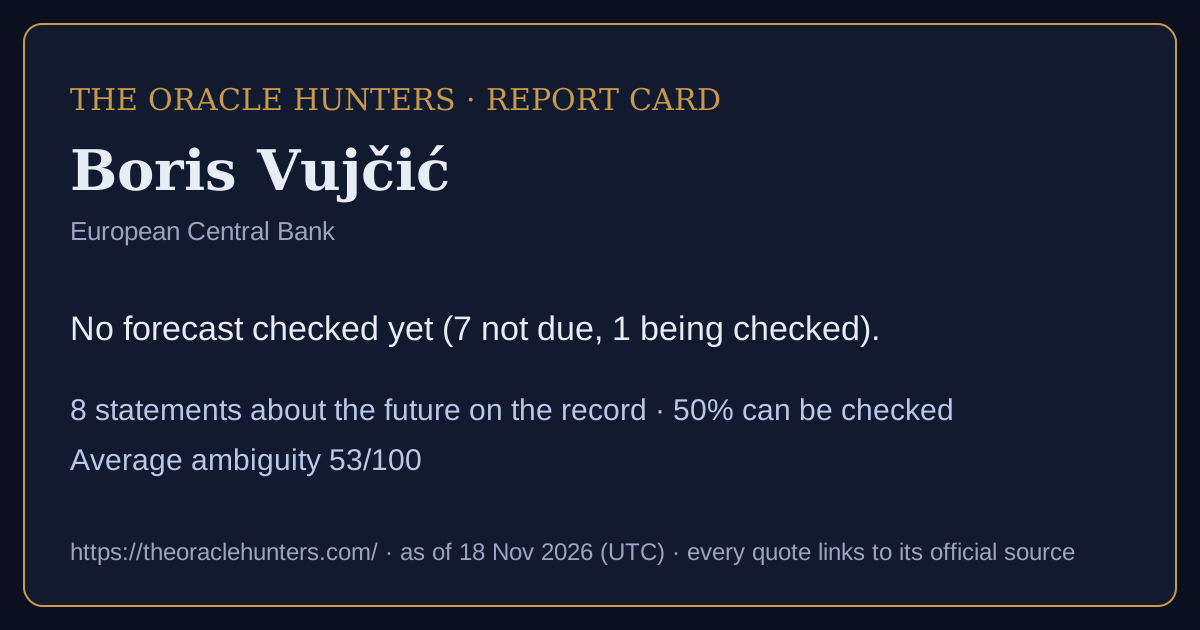
Track record: No forecast checked yet (7 not due, 1 being checked).
8forecasts & commitments on the record
50%can be checked as stated
53average ambiguity (0-100)
0goalpost moves recorded
0confirmed U-turns
Timeline
came true partly did not not due / being checked / too vague
Calibration score: shown after 10 checked forecasts with a stated likelihood (now 0).
How they speak about the future: based on data 5, stated on authority 2, educated guess 1.
Kinds of claim: forecast 6, commitment 1, speculation 1. · Download this report card as a picture
In the nine words
πρόγνωσιςInference from evidence4 · 50%μαντείαInspired knowledge2 · 25%εἰκασίαConjecture1 · 12%προαναγγελίαPublic pre-announcement1 · 12%
How to read this
Each box is one sentence a public figure or institution said about the future, word for word, with a link to the official text. Can be checked means it names what will happen, by when, and how likely - so it can be compared with official figures later. Too vague to check means it does not. Ambiguity (0-100) is how many different ways the sentence can be read. When the date passes, the forecast is compared with official data and marked came true, partly or did not come true. Labels judge the sentence, never the person. Full guide and glossary.On the record (8)
At present however, while the risk of market repricing, rather than abating, has further increased, AI-related risks to system-wide stability now stem from a range of additional factors – the expansion of external funding from equity to debt markets, concentration of exposures, quickening AI adoption and potential cyberattacks.
Borrowing is likely to increase further, as cumulative capital expenditure by major US technology firms is projected to reach USD 5.5 trillion by 2030.
But diversification alone could not shield us when tensions erupted in the Middle East earlier this year.
Reducing internal barriers to goods and services by just 2% could, in the long run, offset the projected impact of higher US tariffs on euro area GDP, estimated at around 0.7 percentage points between 2025 and 2027 (Slide 6).
Expectations of households are generally less well anchored than professional forecasts, but their longer-term expectations tend to be more centred around our 2% inflation target and less sensitive to surprises than the shorter-term expectations. This distinction helps us assess whether movements reflect temporary inflation episodes or deeper credibility risks.
See ECB (2023), “Roses are red/Violets are blue/We will stay the course/And return inflation to 2”, post on X (formerly Twitter), 14 February.
I am delighted that you could join us on this year's Mediterranean Central Banks' conference that Croatia is hosting for the first time in our beautiful city of Split.
The welcomed improvement of efficiency of European banks, as cost-to-income ratio declines from about 60% to about 55%, may prove to be only temporary, if "windfall gains" of rising rates impact negatively focus on cost control.
Also said - not checkable as stated (12 newest)
Remarks about the future with no date, figure or likelihood that could be checked. They are kept on the record and shown here, but not scored.
Overall, recent energy price developments may push inflation higher, while weaker confidence and rising borrowing costs should partially contain this by weighing on growth.
In our assessment a year ago, AI-related vulnerabilities were fundamentally associated with stretched valuations in global stock markets and the risk that market sentiment could shift abruptly.
For example, chipmakers and cloud providers may invest in AI labs that, in turn, commit to purchasing their hardware and services.
At least in the near term, this may shift the balance in favour of attackers, as financial institutions may face higher costs and greater constraints in deploying AI for defence.
Bond and equity prices may come under pressure, while investment funds could face outflows that amplify market movements.2 Banks exposed to affected countries, sectors or markets may experience losses that weigh on capital or raise funding costs, potentially leading them to tighten lending.3
ECB (2026), Financial Stability Review, May;
(2024), “Turbulent times: geopolitical risk and its impact on euro area financial stability”, Financial Stability Review, ECB, May.
Likewise, in retail bank lending markets, the share of cross-border loans to countries outside the euro area remains higher than the share of cross-border loans within the euro area; see ECB (2026), Financial integration and structure in the euro area, ECB, May.
Bond and equity prices may come under pressure, while investment funds could face outflows that amplify market movements. Banks exposed to affected countries, sectors or markets may experience losses that weigh on capital or raise funding costs, potentially leading them to tighten lending.
Simplification, while important, will not on its own substantially boost competitiveness, and we must make sure that it does not weaken resilience.
So today let me make the case for simplification – which can contribute to a prosperous financial sector – and at the same time focus on what will really make banks more competitive, namely financial integration in a truly Single Market which fosters economies of scale.
Simplification At the end of last year, the Governing Council of the ECB put forward a set of high-level recommendations for simplifying the EU’s regulatory, supervisory and reporting frameworks for banks. We identified the main areas where the rules could be made less complex and where legislative action would be required.