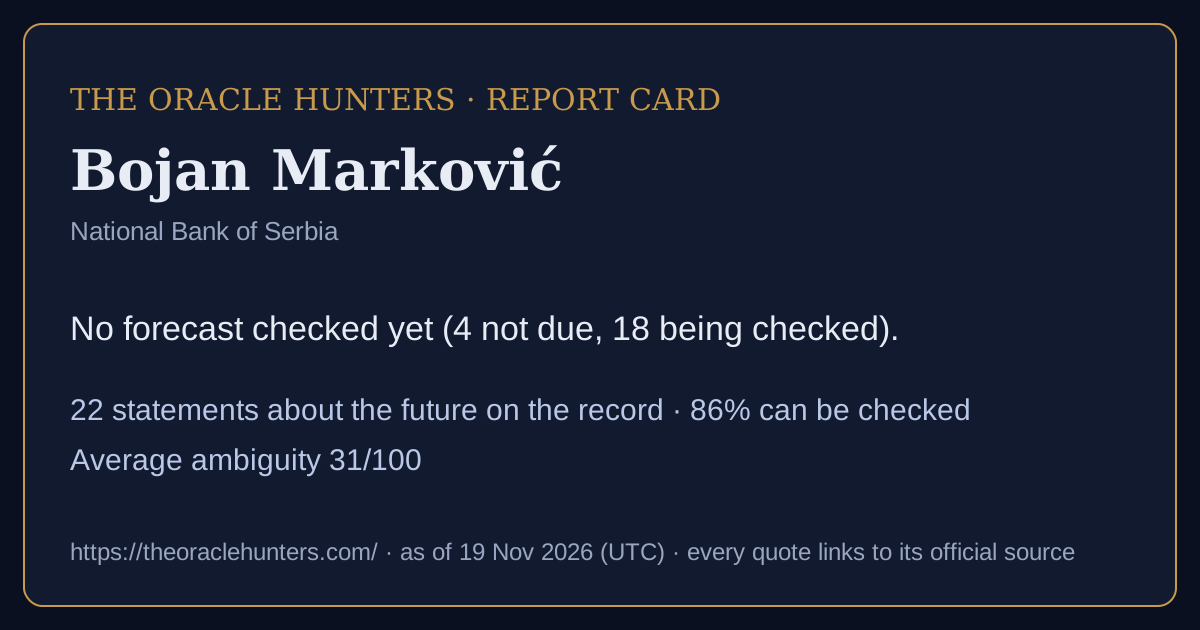
Bojan Marković
National Bank of Serbia
Track record: No forecast checked yet (4 not due, 18 being checked).
22forecasts & commitments on the record
86%can be checked as stated
31average ambiguity (0-100)
0goalpost moves recorded
0confirmed U-turns
Timeline
came true partly did not not due / being checked / too vague
Calibration score: shown after 10 checked forecasts with a stated likelihood (now 0).
How they speak about the future: based on data 12, stated on authority 9, educated guess 1.
Kinds of claim: forecast 20, mixed claim 1, scenario (if… then) 1. · Download this report card as a picture
In the nine words
πρόγνωσιςInference from evidence12 · 55%μαντείαInspired knowledge9 · 41%πρόνοιαPreparing for the future1 · 5%
How to read this
Each box is one sentence a public figure or institution said about the future, word for word, with a link to the official text. Can be checked means it names what will happen, by when, and how likely - so it can be compared with official figures later. Too vague to check means it does not. Ambiguity (0-100) is how many different ways the sentence can be read. When the date passes, the forecast is compared with official data and marked came true, partly or did not come true. Labels judge the sentence, never the person. Full guide and glossary.On the record (22)
However, overall, the coming of the new agricultural season, the past rise in import prices and sharper administered price growth after the formation of the future government will (despite low aggregate demand) lead inflation closer (at a moderate pace) to the upper bound of the target tolerance band by the end of the current and in the first half of …
After reaching their historical high in euros early in the year, global oil prices have been vigorously declining since the beginning of April, and are likely to generate a disinflationary effect over the coming months.
In view of high unemployment and modest economic growth, final consumption is expected to contract this year as well.
But, euro area recession and dented economic growth of Serbia's other foreign trade partners will reflect negatively on demand for Serbian products and the inflow of FDI in the course of this year.
From May, however, we expect inflation to rise at a moderate pace and to move temporarily around the upper bound of the target tolerance band in late 2012 and the first half of 2013, only to return back towards the target thereafter.
With production picking up in the mostly export-oriented automotive industry, a more palpable growth of the Serbian economy of 3% could be expected in 2013.
If caused by a temporary growth in imports of equipment and intermediate goods prompted by higher investment in export-oriented industries, a temporary increase in the current account deficit might be desirable.
Robust growth in imports of equipment and intermediate goods in the fourth quarter was the main reason for the higher than expected current account deficit in 2011, which came at 9.1% of GDP.
Gross domestic product growth picked up mildly in the fourth quarter of 2011, but is likely to slow down in the current year to around 0.5%, mainly due to the prospect of recession in the euro area.
In light of a further decline in inflationary pressures, the downward tendency in inflation expectations is likely to continue this year.
A more visible recovery of Serbian economy may be expected only in 2013, conditioned largely on how the global growth dynamics plays out.
Given the high unemployment rate and modest economic growth forecast, we expect that final consumption will fall this year again.
On account of these factors, in the first half of 2013 year-on-year inflation may temporarily stand at around the upper bound of the target tolerance band, only to return towards the 4±1.5% target thereafter.
A positive contribution is also expected from net exports, whereas that of final consumption will be negative this year.
The National Bank of Serbia's projection is based on the expected stagnant economic activity in the euro area in 2012 and a decline in some of our important export partners.
With downward revisions to growth forecasts for our key trading partners, the National Bank of Serbia revised down its GDP growth projection for Serbia to around 2.0% in 2011 and around 1.5% in 2012.
We expect this downward trend to persist and inflation to retreat within the target tolerance band in the first quarter of 2012.
At the same time, pessimism over global growth prospects intensified, particularly in the euro area prompting us to revise the economic growth forecast for Serbia down to around 2.0% in 2011 and 1.5% in 2012.
Given the still modest growth forecast for the next year, final domestic consumption and, by extension, imports should also show moderate growth.
After calming down during the first months of 2011, the volatility started rising once more in May this year - again after the NBS stopped intervening.
3 Assuming that the real credit volume in the corporate sector will grow at an average annual rate of 20% (the average between 2007 and 2009).
Also, we have already prepared all the necessary infrastructure for such potential move, although we do not expect the need for such a move to arise this year.
Also said - not checkable as stated (12 newest)
Remarks about the future with no date, figure or likelihood that could be checked. They are kept on the record and shown here, but not scored.
According to the National Bank of Serbia's estimates, completion of the investment cycle and the expected growth in exports will lead to a reduction in the share of current account deficit share in GDP as early as of 2012.
Implementing structural changes to improve the business environment for export-oriented and import-substituting sectors is the best possible way forward that will strengthen medium-term productivity and competitiveness of the Serbian economy and gradually remove the current account deficit.
Fiscal policy, may contribute on the side of revenue through tax recomposition, which stimulates production and discourages consumption - for instance, by raising the VAT rate, while at the same time lowering wage taxes.
On the side of expenditure, fiscal policy may contribute to the medium-term narrowing of the current account deficit by shifting the budget from transfers and consumption towards investments that target export-oriented and import-substituting sectors.
Fiscal consolidation may induce a decline in demand in the short run, but has advantages in terms of improving economic activity and growth over the medium run.
'Serbia has set itself apart from other emerging-market economies in creating conditions to attract foreign investment that will fuel growth .' (Nomura Global Research, December 2010).
Alternatively, one could try to give the electorate a bit of a break from further sharp adjustments in the pre-election period.
But, loosening the consumers belt for a year, will not do them much favours in the medium term, and might also trigger a swift negative reaction from international investors at the time when they are particularly sensitive to non-prudent public spending.
The National Bank of Serbia will continue with an effort to stabilize inflation at lower level and maintain sound financial system, which, I firmly believe, is the best way to help the economy in the current circumstances.
And at this point I should like to reiterate the National bank of Serbia's message over the past few years: it is better to have low but sustainable growth than high and unsustainable one.
Ladies and Gentlemen, I should like to assure you that the National Bank of Serbia monitors international developments very carefully, both in the real and financial sectors, and stands ready to do everything and act in order to maintain macroeconomic and financial stability in Serbia.
But we shall carefully measure our actions so to avoid endangering the now dynamic process of structural market development in Serbia.