Bob Neill
Ministry of Housing, Communities & Local Government (2018 to 2021) · GBR
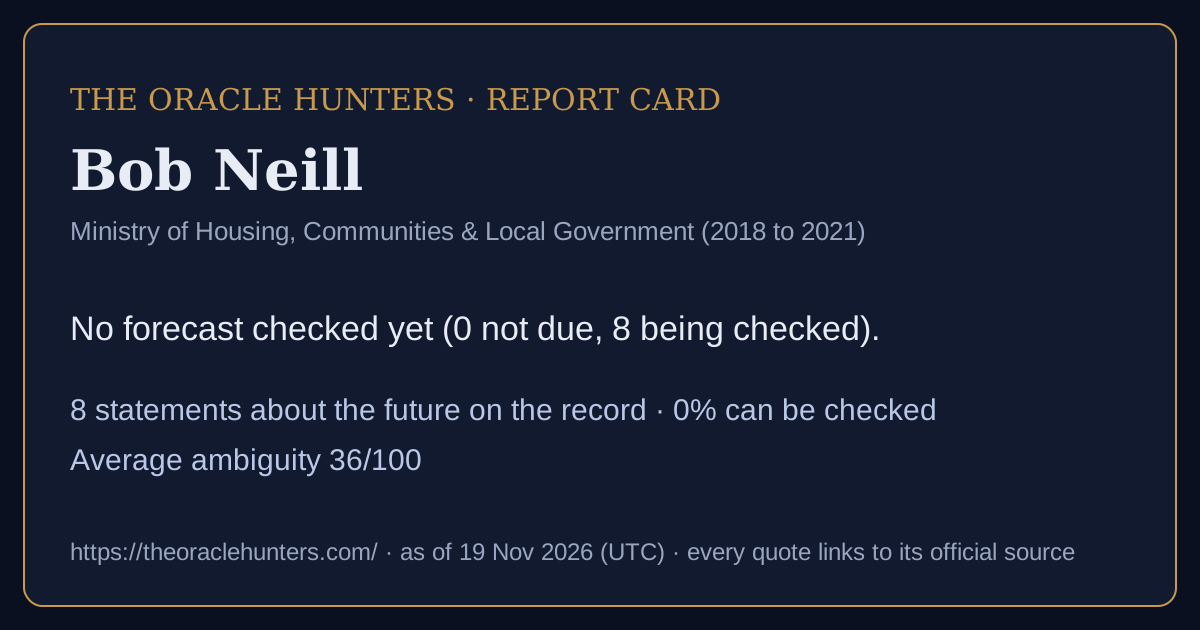
Track record: No forecast checked yet (0 not due, 8 being checked).
8forecasts & commitments on the record
0%can be checked as stated
36average ambiguity (0-100)
0goalpost moves recorded
0confirmed U-turns
Timeline
came true partly did not not due / being checked / too vague
Calibration score: shown after 10 checked forecasts with a stated likelihood (now 0).
How they speak about the future: based on data 6, stated on authority 2.
Kinds of claim: forecast 7, mixed claim 1. · Download this report card as a picture
In the nine words
How to read this
Each box is one sentence a public figure or institution said about the future, word for word, with a link to the official text. Can be checked means it names what will happen, by when, and how likely - so it can be compared with official figures later. Too vague to check means it does not. Ambiguity (0-100) is how many different ways the sentence can be read. When the date passes, the forecast is compared with official data and marked came true, partly or did not come true. Labels judge the sentence, never the person. Full guide and glossary.On the record (8)
You will be able to find the guidance, timelines and related documents on our website by later today and we hope to have concluded the bidding process and made announcements on outcomes by the autumn this year.
I am pleased today to announce the opening of the bidding process for capital grant funding for all fire and rescue authorities for 2013-15 which will support further improvements and efficiencies.
However, subsequent to this, the allocation of capital will be a combination of distribution and bids with a one off bidding round for 2013-15 funds.
Therefore the current pro rata distribution method will remain in place for 2012-13.
Understandably, you all want to know what years three and four will look like for you, and as things stand it won’t be until autumn 2012 before we can tell you.
We’re clear this can be achieved by the approach I have set out and expect to consult on the draft Framework by the end of the year.
Finally Dave and Gerry will be stepping down from their roles in 2012 and in the meantime they are working hard to handover to the new team during the next year.
we will work with local government to deliver a council tax freeze in 2011-12 while protecting vital local services
Also said - not checkable as stated (12 newest)
Remarks about the future with no date, figure or likelihood that could be checked. They are kept on the record and shown here, but not scored.
National resilience remains a priority for government, and we will continue to retain strategic responsibility for ensuring that we are a nation resilient to significant risks.
Of course, government will continue to set the strategic direction, but our approach to national resilience must be based on and drawn from local capability, expertise, knowledge and leadership.
We have stated in the draft Framework that if it is seen that there is a need for building new national resilience capabilities, the case for who should provide the capability and how it should be funded will be considered carefully in line with the new burdens doctrine.
For each authority, their integrated risk management plan will take account of their overall budget and resource to make strategic and operational decisions on the siting of fire stations, the staffing and equipping of such stations, and hours of operation of each station.
We have begun discussing these and we will be working with partners over the coming months to ensure that these arrangements are in place by the time any new framework comes into force.
The Act will also help increase transparency and accountability across Whitehall, local government and fire and rescue authorities, bringing greater visibility and openness to all, providing communities with the information they need to hold their elected representatives accountable.
In the draft framework, we will commit to ensuring that appropriate, agreed strategic governance arrangements are in place to enable fire and rescue authorities to collectively engage with Government on national resilience issues.
However, having freed up fire and rescue authorities from bureaucratic inspection regimes and tick box assessments, we will also be looking for improved scrutiny at the local level and assurance of delivery - both to government and communities.
People working for ordinary businesses all over the country are facing tough times and yet union bosses want a walk out that will hurt the economy to the tune of half a billion pounds and in return for this gesture they expect the public to pay even more in taxes.
Final salary pension pots already built up will be protected, and people will still receive guaranteed, inflation proofed, benefits in retirement.
The victims of industrial action will be the taxpayers who pay public sector wages - the ordinary people of Britain.
There are some key issues that I am sure you will want to consider, including, for example, should single purpose Fire and Rescue Authorities be treated like county councils; be part of the business rates retention scheme, and be able to benefit from growth in business rates?