Bimal Jalan
Reserve Bank of India
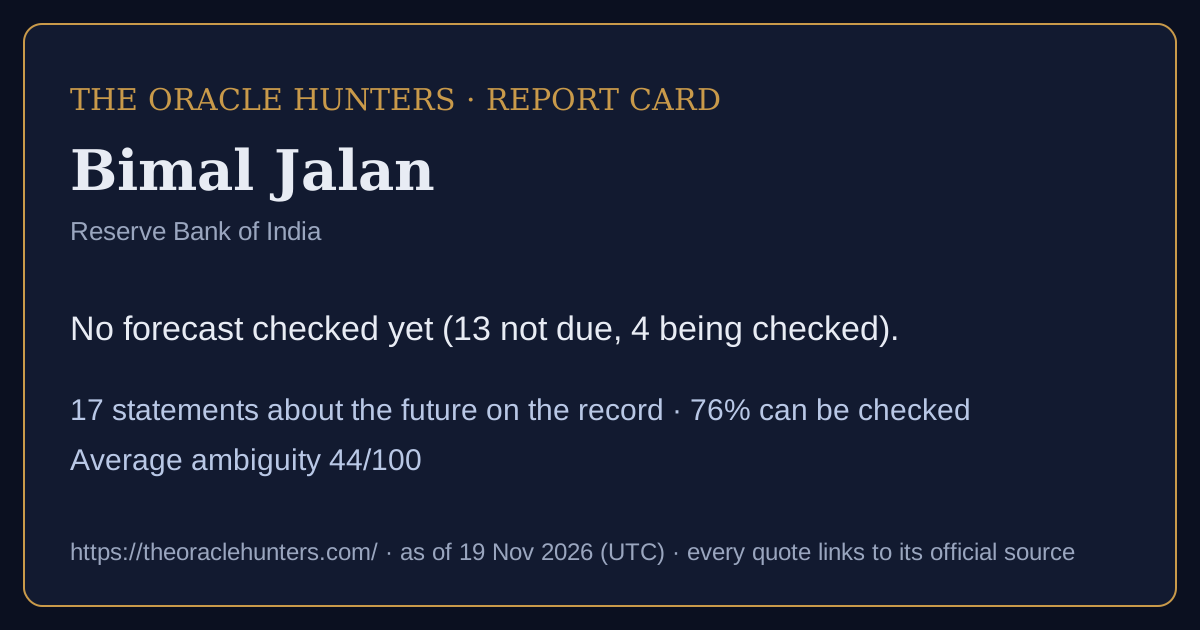
Track record: No forecast checked yet (13 not due, 4 being checked).
17forecasts & commitments on the record
76%can be checked as stated
44average ambiguity (0-100)
0goalpost moves recorded
0confirmed U-turns
Timeline
came true partly did not not due / being checked / too vague
Calibration score: shown after 10 checked forecasts with a stated likelihood (now 0).
How they speak about the future: based on data 16, stated on authority 1.
Kinds of claim: forecast 15, commitment 1, mixed claim 1. · Download this report card as a picture
In the nine words
πρόγνωσιςInference from evidence15 · 88%προαναγγελίαPublic pre-announcement1 · 6%φρόνησιςPractical wisdom1 · 6%
How to read this
Each box is one sentence a public figure or institution said about the future, word for word, with a link to the official text. Can be checked means it names what will happen, by when, and how likely - so it can be compared with official figures later. Too vague to check means it does not. Ambiguity (0-100) is how many different ways the sentence can be read. When the date passes, the forecast is compared with official data and marked came true, partly or did not come true. Labels judge the sentence, never the person. Full guide and glossary.On the record (17)
The Bureau is expected to launch commercial operations in the first quarter of 2003.
The 90-day norm for recognition of loan impairment will come into operation from 2004-05 and this is now applicable for all segments of the financial system.
For the year as a whole, inflation is expected to remain within 4.0 per cent in the current year.
Real GDP in agriculture could decline by about 1.5 per cent for the year as a whole, reflecting mainly the anticipated shortfall in foodgrains production.
By the end of March 2002, 25 out of 27 public sector banks had risk weighted capital adequacy ratios above the prescribed minimum of 9 per cent with 23 in excess of 10 per cent.
I have no doubt that, with your help, India of 2025 will be a very different place, and a much more dominant force in the world economy, than was the case twenty five years ago or at the beginning of the new millennium.
If a map of the world were drawn on the scale of a country's participation in trade, India with a population of more than 1,000 million will occupy a smaller area than Singapore with a population of only 3 million.
We will have islands of prosperity and excellence - IT, beauty parades and media entertainment amidst growing disparity, rising unemployment and immiserisation.
As of now, the consensus of forecasts settles around 2.4 per cent for world GDP growth for 2001.
The Accord could initially apply to internationally active - banks with over 15 per cent of their business in cross-border transactions, as proposed by the Reserve Bank - and significant banks whose domestic market share exceeds 1 per cent - with a simplified standardised approach to be evolved for other banks.
The kharif output is expected to cross a new peak of 105.6 million tonnes and prospects for the rabi crop are also good.
The sharp downturn in global macroeconomic prospects and the continuing sluggishness in domestic industrial activity have necessitated a revision in the forecast for India's real GDP growth in 2001-02 from 6.0-6.5 per cent expected at the time of the April 2001 Monetary and Credit Policy Statement to 5.0-6.0 per cent in the mid-term review of the policy.
World trade volume growth could slow down to around 1.3 per cent and net capital outflows from developing countries may now be larger than anticipated earlier.
Apart from the impact this will have on the creation of an appropriate term deposit market, this will release about Rs.9500 million of lendable resources to banks.
basis of the projected increase in M3, the working estimate of the growth of aggregate deposits of scheduled commercial banks is placed at Rs.800 billion (16.0 per cent).
The real GDP is expected to have grown by 6.8 per cent.
This implies that in the long run a sustained improvement in the growth scenario through monetary financing of the deficit could involve a severe trade-off in terms of inflation - every one per cent additional output growth implies nearly 6 to 6.5 per cent rise in inflation rate in the long run.
Also said - not checkable as stated (12 newest)
Remarks about the future with no date, figure or likelihood that could be checked. They are kept on the record and shown here, but not scored.
Now, increasingly it is felt that reserves should at least be sufficient to cover likely variations in capital flows or the "liquidity-at-risk".
This may be an unlikely possibility today, but it must be factored in while deciding on a long term policy of free convertibility of "stock" of domestic assets.
There must, of course, be a level where these expectations will reverse.
You will recall that, soon after the Asian crisis, the widely accepted theoretical position was that a country had the choice of either giving up monetary independence and setting up a Currency Board or giving up the stable currency objective and letting the exchange rate float freely so that monetary policy could then be directed to the objectives of inflation …
Even after an "adequate" level is reached, reserves may continue to increase if capital inflows are strong and central banks decide to intervene in order to moderate the degree of appreciation.)
Let me now briefly deal with some issues of practical importance in the management of forex markets in India, which have figured prominently in the media and expert commentary. | will first take up 2 or 3 matters which are rather straight-forward and on which our policy stance is also equally "unambiguous" and clear-cut.
I am sure that this meeting, as was the case with all the earlier occasions, will also prove to be a fruitful one and would be an important landmark in the consolidation and further strengthening of the ACU.
The Union could become a strong and non-political forum of central banks in the region to discuss issues relating to economic co-operation among member countries within the ACU mechanism on the one hand, and other areas like exchange rate management and foreign exchange reserve management with a view to evolving appropriate approaches to resolving technical issues on the other.
However, there is need for better volumes of trade amongst the member countries so that the system of ACU could be utilized to the full extent for the maximum benefit of each of them.
The expanded membership will help in better utilization of this important mechanism for the benefit of all the members.
Before proceeding further, I should mention with immense grief that Dr. Mohsen Nourbaksh, the Governor of the Central Bank of the Islamic Republic of Iran is no more with us.
The global financial markets have weakened significantly since end-March 2002, reflecting a downward revision in profit forecasts and concerns about the sustainability of the recovery.