Ben S Bernanke
US Federal Reserve System
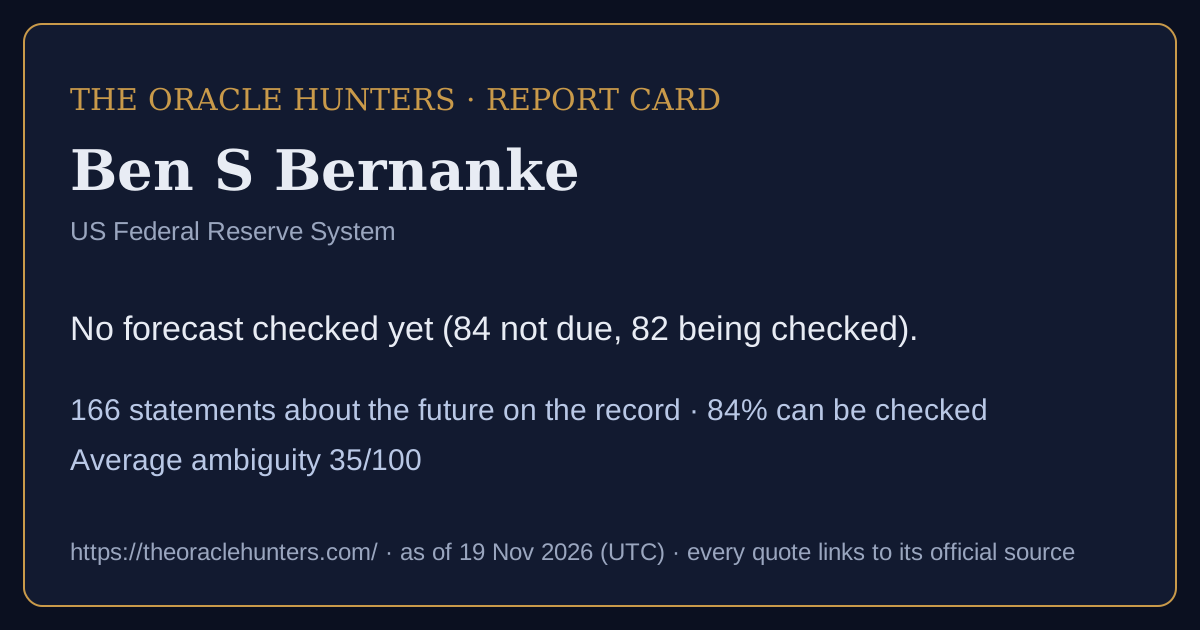
Track record: No forecast checked yet (84 not due, 82 being checked).
166forecasts & commitments on the record
84%can be checked as stated
35average ambiguity (0-100)
0goalpost moves recorded
0confirmed U-turns
Timeline
came true partly did not not due / being checked / too vague
Calibration score: shown after 10 checked forecasts with a stated likelihood (now 0).
How they speak about the future: based on data 101, educated guess 33, stated on authority 32.
Kinds of claim: forecast 100, scenario (if… then) 39, mixed claim 23, commitment 4. · Download this report card as a picture
In the nine words
πρόγνωσιςInference from evidence91 · 55%πρόνοιαPreparing for the future38 · 23%μαντείαInspired knowledge27 · 16%προαναγγελίαPublic pre-announcement4 · 2%εἰκασίαConjecture2 · 1%πρόβλεψιςSeeing the signs2 · 1%φρόνησιςPractical wisdom2 · 1%
How to read this
Each box is one sentence a public figure or institution said about the future, word for word, with a link to the official text. Can be checked means it names what will happen, by when, and how likely - so it can be compared with official figures later. Too vague to check means it does not. Ambiguity (0-100) is how many different ways the sentence can be read. When the date passes, the forecast is compared with official data and marked came true, partly or did not come true. Labels judge the sentence, never the person. Full guide and glossary.On the record (166)
To this end, the Bank will continue to consistently make the utmost contributions as a central bank with a focus on the three points that I have just mentioned: pursuing powerful monetary easing, ensuring financial market stability, and supporting efforts to strengthen the foundations for economic growth.
In any event, as factored into the forecasts presented in the Outlook for Economic Activity and Prices released in April, the Bank has been fully aware that the pace of economic recovery is likely to slow over the second half of fiscal 2010 as inventory restocking runs its course and the effects of policy measures wane.
to expect some pickup in growth in 2011.
The International Monetary Fund forecasts that the global economy will continue to achieve growth rates of over 4 percent in the coming years, projecting growth of 4.6 percent in 2010 and 4.3 percent in 2011.
In the longer term, inflation is expected to be between 1-3/4 and 2 percent, the range that most FOMC participants judge to be consistent with the Federal Reserve's dual mandate of price stability and maximum employment.
In conjunction with the January meeting of the Federal Open Market Committee (FOMC), Board members and Reserve Bank presidents prepared projections for economic growth, unemployment, and inflation for the years 2010 through 2012 and over the longer run.
As the impetus provided by the inventory cycle is temporary, and as the fiscal support for economic growth likely will diminish later this year, a sustained recovery will depend on continued growth in private-sector final demand for goods and services.
Inflation is expected to remain subdued, with consumer prices rising at rates between 1 and 2 percent in 2010 through 2012.
Consistent with moderate economic growth, participants expect the unemployment rate to decline only slowly, to a range of roughly 6-1/2 to 7-1/2 percent by the end of 2012, still well above their estimate of the long-run sustainable rate of about 5 percent.
FOMC participants continue to anticipate a moderate pace of economic recovery, with economic growth of roughly 3 to 3-1/2 percent in 2010 and 3-1/2 to 4-1/2 percent in 2011.
This facility has purchased about $250 billion of commercial paper, allowing many firms to extend significant amounts of funding into next year.
With demand for new homes remaining at a low level and the backlog of unsold homes still sizable, residential construction is likely to continue to contract into next year.
If not reversed, these developments, together with the likelihood that economic activity will fall short of potential for a time, should bring inflation down to levels consistent with price stability.
subsidiaries. 1 (Insurance policyholders and holders of AIG investment products are, however, fully protected.) Interest will accrue on the outstanding balance of the loan at a rate of three-month Libor plus 850 basis points, implying a current interest rate over 11 percent.
The recent indicators of the demand for new and existing homes hint at some stabilization of sales, and lower mortgage rates are likely to provide some support for demand in coming months.
with its subsidiaries. 1 (Insurance policyholders and holders of AIG investment products are, however, fully protected.) Interest will accrue on the outstanding balance of the loan at a rate of three-month Libor plus 850 basis points, implying a current interest rate over 11 percent.
If that were to occur, and those revised expectations were to become embedded in the domestic wage- and price-setting process, we could see an unwelcome rise in actual inflation over the longer term.
However, if financial speculation were pushing oil prices above the levels consistent with the fundamentals of supply and demand, we would expect inventories of crude oil and petroleum products to increase as supply rose and demand fell.
FOMC participants continue to expect inflation to moderate in 2009 and 2010, as slower global growth leads to a cooling of commodity markets, as pressures on resource utilization decline, and as longer-term inflation expectations remain reasonably well anchored.
Growth is projected to pick up gradually over the next two years as residential construction bottoms out and begins a slow recovery and as credit conditions gradually improve.
On balance, most FOMC participants expected that, over the remainder of this year, output would expand at a pace appreciably below its trend rate, primarily because of continued weakness in housing markets, elevated energy prices, and tight credit conditions.
If people expect an increase in inflation to be temporary and do not build it into their longer-term plans for setting wages and prices, then the inflation created by a shock to oil prices will tend to fade relatively quickly.
Much necessary economic and financial adjustment has already taken place, and monetary and fiscal policies are in train that should support a return to growth in the second half of this year and next year.
It now appears likely that real gross domestic product (GDP) will not grow much, if at all, over the first half of 2008 and could even contract slightly.
We expect economic activity to strengthen in the second half of the year, in part as the result of stimulative monetary and fiscal policies; and growth is expected to proceed at or a little above its sustainable pace in 2009, bolstered by a stabilization of housing activity, albeit at low levels, and gradually improving financial conditions.
The unemployment rate edged down in February and remains at a relatively low level; however, in light of the sluggishness of economic activity and other indicators of a softer labor market, I expect it to move somewhat higher in coming months.
They say that if they were to write down the principal and house prices were to fall further, they could feel pressured to write down principal again.
At the national level, the rise in expected foreclosures could add significantly to the inventory of vacant unsold homes - already at more than 2 million units at the end of 2007 - putting further pressure on house prices and housing construction. 4
We estimate that the interest rate on a typical subprime ARM scheduled to reset in the current quarter will increase from just above 8 percent to about 9-1/4 percent, raising the monthly payment by more than 10 percent, to $1,500 on average.
The projections recently submitted by FOMC participants indicate that overall PCE inflation was expected to moderate significantly in 2008, to between 2.1 percent and 2.4 percent (the central tendency of the projections).
By 2010, our most recent projections show output growth picking up to rates close to or a little above its longer-term trend and the unemployment rate edging lower; the improvement reflects the effects of policy stimulus and an anticipated moderation of the contraction in housing and the strains in financial and credit markets.
FOMC participants' projections for the unemployment rate in the fourth quarter of 2008 have a central tendency of 5.2 percent to 5.3 percent, up from the level of about 4-3/4 percent projected last July for the same period.
In particular, the central tendency of the projections was for real GDP to grow between 1.3 percent and 2.0 percent in 2008, down from 2-1/2 percent to 2-3/4 percent projected in our report last July.
A critical task for the Federal Reserve over the course of this year will be to assess whether the stance of monetary policy is properly calibrated to foster our mandated objectives of maximum employment and price stability in an environment of downside risks to growth, stressed financial conditions, and inflation pressures.
The inflation projections submitted by FOMC participants for 2010 - which ranged from 1.5 percent to 2.0 percent for overall PCE inflation - were importantly influenced by participants' judgments about the measured rates of inflation consistent with the Federal Reserve's dual mandate and about the time frame over which policy should aim to attain those rates.
At present, my baseline outlook involves a period of sluggish growth, followed by a somewhat stronger pace of growth starting later this year as the effects of monetary and fiscal stimulus begin to be felt.
A critical task for the Federal Reserve over the course of this year will be to assess whether the stance of monetary policy is properly calibrated to foster our mandated objectives of maximum employment and price stability and, in particular, whether the policy actions taken thus far are having their intended effects.
On the other hand, growth in U.S. exports should continue to provide some offset to the softening in domestic demand, and the recently approved fiscal package should help to support household and business spending during the second half of this year and into the first part of next year.
Stimulus that comes too late will not help support economic activity in the near term, and it could be actively destabilizing if it comes at a time when growth is already improving.
A number of analysts have raised the possibility that fiscal policy actions might usefully complement monetary policy in supporting economic growth over the next year or so.
The slowing in residential construction, which subtracted about 1 percentage point from the growth rate of real gross domestic product in the third quarter of 2007, likely curtailed growth even more in the fourth quarter, and it may continue to be a drag on growth for a good part of this year as well.
The central tendency of FOMC participants' forecasts for core PCE inflation - 2 to 2-1/4 percent for 2007 and 1-3/4 to 2 percent in 2008 - is unchanged from February.
The central tendency of the growth forecasts, which are conditioned on the assumption of appropriate monetary policy, is for real GDP to expand roughly 2-1/4 to 2-1/2 percent this year and 2-1/2 to 2-3/4 percent in 2008.
Overall, the U.S. economy appears likely to expand at a moderate pace over the second half of 2007, with growth then strengthening a bit in 2008 to a rate close to the economy's underlying trend.
The unemployment rate is anticipated to edge up to between 4-1/2 and 4-3/4 percent over the balance of this year and about 4-3/4 percent in 2008, a trajectory about the same as the one expected in February.
By the end of the year, we will propose changes to TILA rules to address concerns about mortgage loan advertisements and solicitations that may be incomplete or misleading and to require lenders to provide mortgage disclosures more quickly so that consumers can get the information they need when it is most useful to them.
However, with long-term inflation expectations contained, futures prices suggesting that investors expect energy and other commodity prices to flatten out, and pressures in both labor and product markets likely to ease modestly, core inflation should edge a bit lower, on net, over the remainder of this year and next year.
In particular, upward pressure on inflation could materialize if final demand were to exceed the underlying productive capacity of the economy for a sustained period.
If energy prices remain near current levels, greater stability in the costs of producing non-energy goods and services will reduce pressure on core inflation over time.
Despite the recent weak readings, we expect business investment in equipment and software to grow at a moderate pace this year, supported by high rates of profitability, strong business balance sheets, relatively low interest rates and credit spreads, and continued expansion of output and sales.
Showing the newest 50 - the ledger has all 166.
Also said - not checkable as stated (12 newest)
Remarks about the future with no date, figure or likelihood that could be checked. They are kept on the record and shown here, but not scored.
The Bank will continue to fulfill its critical role of ensuring financial market stability.
The Bank will continue to carefully consider the outlook for economic activity and prices, and, if it deems it necessary, will take policy actions in a timely and appropriate manner upon considering the effects and side-effects of various policy measures.
Bernanke (2009), "The Supervisory Capital Assessment Program," speech delivered at the Federal Reserve Bank of Atlanta 2009 Financial Markets Conference, held in Jekyll Island, Ga., May 11.
A council could also play useful roles in coordinating responses by member agencies to mitigate emerging systemic risks, in recommending actions to reduce procyclicality in regulatory and supervisory practices, and in identifying financial firms that may deserve designation as systemically important.
While these arrangements can create significant efficiencies and promote transparency in the financial markets, they also may concentrate substantial credit, liquidity, and operational risks, and, absent strong risk controls, may themselves be a source of contagion in times of stress.
Third, a new special resolution process should be created that would allow the government to wind down a failing systemically important financial institution whose disorderly collapse would pose substantial risks to the financial system and the broader economy.
Importantly, this regime should allow the government to impose losses on shareholders and creditors of the firm.
Fourth, all systemically important payment, clearing, and settlement arrangements should be subject to consistent and robust oversight and prudential standards.
In the next few weeks, investors withdrew almost $500 billion from prime money market funds.
Going forward, the ability of the Treasury to use the TARP to inject capital into financial institutions and to take other steps to stabilize the financial system - including any actions that might be needed to prevent the disorderly failure of a systemically important financial institution - will be critical for restoring confidence and promoting the return of credit markets …
Finally, the agencies expect banking organizations to conduct regular reviews of their management compensation policies to ensure that they encourage prudent lending and discourage excessive risk-taking.
The facility contributed importantly to the ability of money funds to meet redemption pressures when they were most intense and remains available as a backstop should such pressures reemerge.