Ben Broadbent
Bank of England
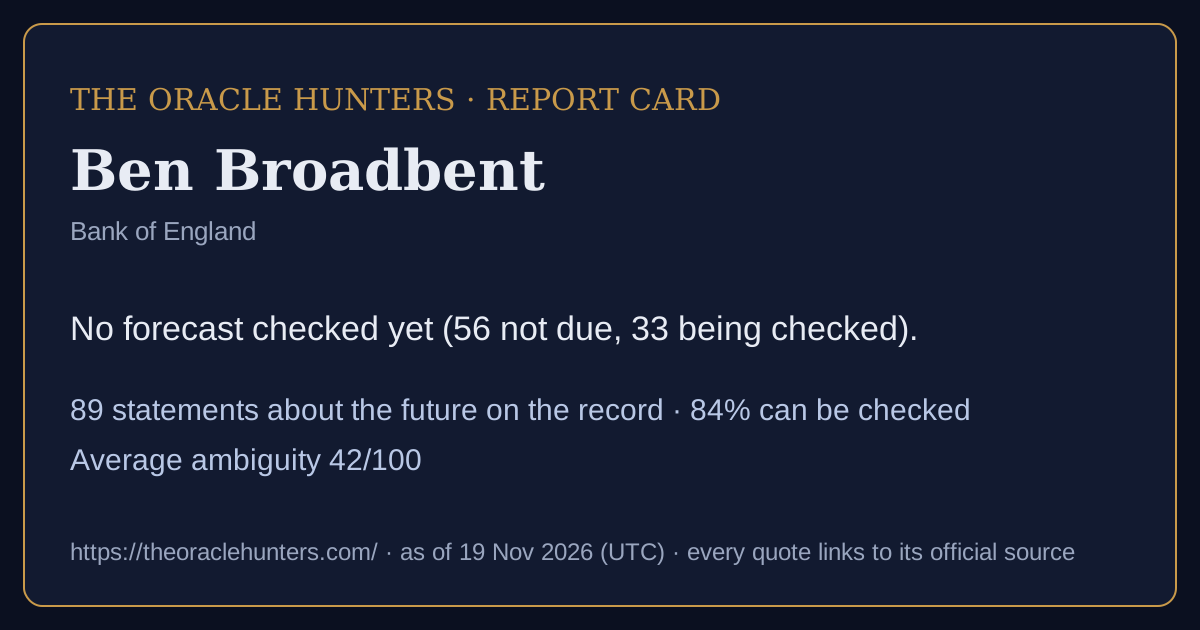
Track record: No forecast checked yet (56 not due, 33 being checked).
89forecasts & commitments on the record
84%can be checked as stated
42average ambiguity (0-100)
0goalpost moves recorded
0confirmed U-turns
Timeline
came true partly did not not due / being checked / too vague
Calibration score: shown after 10 checked forecasts with a stated likelihood (now 0).
How they speak about the future: based on data 55, educated guess 23, stated on authority 11.
Kinds of claim: forecast 49, scenario (if… then) 25, mixed claim 12, commitment 3. · Download this report card as a picture
In the nine words
πρόγνωσιςInference from evidence48 · 54%πρόνοιαPreparing for the future25 · 28%μαντείαInspired knowledge9 · 10%εἰκασίαConjecture3 · 3%προαναγγελίαPublic pre-announcement3 · 3%πρόβλεψιςSeeing the signs1 · 1%
How to read this
Each box is one sentence a public figure or institution said about the future, word for word, with a link to the official text. Can be checked means it names what will happen, by when, and how likely - so it can be compared with official figures later. Too vague to check means it does not. Ambiguity (0-100) is how many different ways the sentence can be read. When the date passes, the forecast is compared with official data and marked came true, partly or did not come true. Labels judge the sentence, never the person. Full guide and glossary.On the record (89)
It's all very well to draw a simple, static heuristic like Chart 8b but, once you're in a dynamic setting, and if people understand the resultant decline in income growth is likely to last for some time, then demand too would fall.
If spending grows too rapidly, tighter monetary policy will help meet both objectives (and vice-versa when it's too weak).
And if the origin of these second-round effects is the squeeze in real incomes in 2022, their recovery this year may matter.
If the process were entirely symmetric then you might expect these effects to unwind relatively quickly, within the next year or so.
Whatever the priors of its individual members the MPC will continue to learn from the incoming data and, if things continue to evolve with its forecasts - forecasts that suggest policy will have to become less restrictive at some point - then it's possible Bank Rate could be cut some time over the summer.
Judging by what the Bank's Agents are telling us about wage growth in 2024 - their forecast would entail almost no convergence to our wage equations through the rest of this year (or therefore any diminution in the aqua line in Chart 7) - that seems right.
In symbols, if (the log of) employment is measured with some serially uncorrelated error error ϵ, such that ̂ = + , where l is the true number, then its growth rate will a moving-average error term: ∆ ̂ = ∆ + ∆ .
And it's evident from all of them that pay growth - and with it other indicators of domestic inflation like the services component of the CPI - has been significantly faster than the sorts of rates that, over time, one might think of as consistent with the 2% inflation target.
And long-dated revisions of the sort we saw in this year's Blue Book, relating to economic growth well over a year ago, won't in any case have much bearing on monetary policy as any effects the additional output might have had on employment and subsequently inflation would already have come through.
But | think it's reasonable to expect a decline in both components of CPI inflation — not just energy but "core" goods as well — over the next few months.
Dotted line is a projection to the end of 2023 consistent with the August 2023 Monetary Policy Report forecast.
If borrowers are (on average) more credit constrained than savers, and therefore more sensitive to changes in cash flow, equal declines in debt interest costs on the one hand, and deposit receipts on the other, will on balance be expansionary.
If a country was prepared to tolerate a slightly higher rate of inflation it could (on this view) generate a permanent rise in its real income.
The path of wholesale energy prices is highly uncertain but here too rates of inflation - annual rates have averaged over 300% in the past six months 7 - are in time likely to fall significantly.
However, by relieving some of the immediate pressure on household finances, the policy would also add significantly to domestic spending over the next year (relative to our last forecast).
Given the path of wholesale gas prices implied by financial markets at the time, OFGEM's price cap was set to rise (in the central forecast) by over 3% of household income by next spring.
It fell sharply during the first half of this year (relative to income) and is likely to have fallen further since then (the dot at the end of Chart 9 is an estimate of the position at the end of Q3, based on recent moves in asset prices).
In the third quarter of this year, UK GDP will probably be only slightly below where it was in the last quarter of 2019, immediately before the pandemic.
Broadly speaking, policy will be contractionary (expansionary) if the official interest rate is higher (lower) than i*.
If there's a risk of deflation but the policy rate is stuck at the lower bound, and QE is for some reason thought to be ineffective, a declaration that policy will remain accommodative, even in the event of more inflationary pressure in the future, can in principle stimulate demand today.
From today's perspective, in the face of a risk of deflation, it would be better if you could persuade people that you will keep policy loose for an extended period, even in the event that inflation rises above target.
In this respect, a credible declaration that you will keep the actual policy rate low, even in the event of a future increase in inflation, does two things.
This 'promise to be irresponsible' won't necessarily be believed because, when the time comes, and if there were subsequently some significant rise in inflationary pressure, the policymaker will be tempted to go back on the earlier promise and respond by raising interest rates.
If you think trend supply growth is pretty stable - and that was generally the view at the time then stronger activity will always mean more pressure on resources, weaker activity less of it.
And even if you took a different view, and thought it was more likely that they'll still be rising at that point, you would also need to judge the extent to which that would depress domestic demand and spending (especially at a time when, on current plans, tighter fiscal policy will be doing the same).
In the third quarter of this year private-sector output grew by a little less than we'd anticipated in August and was still 2% lower than at the end of 2019Q4.
Again supposing all this had been predictable in advance, in the spring of 2020, the policy maker in this simulations might have chosen not to tighten policy quite so aggressively, and to tolerate a degree of above-target inflation at the end of this year, in order to avoid such a steep rise in unemployment.
In the spring of next year, when the next rise in the Ofgem cap on gas and electricity bills comes through, it will probably climb comfortably through 5%, a long way north of the MPC's 2% target.
However, based on the spending plans in the November Budget, the OBR expects overall employment in the public sector to carry on growing, by a further 3% over the next three years.
The aggregate rate of inflation is likely to rise further over the next few months and the chances are that it will comfortably exceed 5% when the Ofgem cap on retail energy prices is next adjusted, in April.
The MPC expects inflation to rise significantly further, to well over 3%, over the next six months.
Quite a bit of the current rise in inflation is actually coming directly from the higher price of oil, something that is likely to fall away through the early part of 2022.
The DMP data are based on realised employment/sales growth over the last two years plus expected growth over the next year.
During the second quarter of this year it's likely that an average of over 2½ million people were furloughed - more than 7% of the workforce.
On a reasonable estimate GDP in the second quarter of this year was probably around 5% higher than in the first and more than 22% higher than a year earlier.
So, while we know it's going to go further over the next few months, I'm not convinced that the current inflation in retail goods prices should in and of itself mean higher inflation 18-24 months ahead, the horizon more relevant for monetary policy.
If orders take time to respond, a cut in prices will initially reduce a firm's profits.
If rates of unemployment were to remain relatively high even two or three years from now, it's likely the saving rate will also be above average.
Come what may, the MPC will continue to set policy in order to achieve the 2% inflation target, in line with its remit, over the medium term.
down (the MPC's central forecast in November was for a peak rate of almost 8%, despite a sharp projected recovery in output as health risks fade) that the appropriate response has been to ease policy significantly.
And despite a very sharp recovery in the summer, as the first lockdown was lifted, it's likely that GDP in the fourth quarter of last year was around 10% lower than at the end of 2019.
It might also tell you something if the central bank eased policy and, at the same time, the authorities introduced restrictions to limit or prevent people from selling the government's debt.
For example, if the central bank is easing policy in the face of clear inflationary pressure that might suggest it's putting weight on some other objective: the joint behaviour of instrument and target can be informative.
If higher inflation and nominal growth pushed up the demand for physical cash the government might make a little more from that source.
Yet, in some ways, one might be surprised that prices didn't rise further (inflation averaged 2% between 1792 and 1815).
inflation as over the previous five years (it averaged 4% in the second half of the 1960s) they might still have expected a cumulative real return of over 50%.
If everyone knew in advance that inflation was about to rise permanently by (say) 1% point you'd expect nominal yields to be 1% point higher, across the curve, than they otherwise would've been.
And if you take seriously the crude estimates we've just been through, you might expect that to have had a significant effect on productivity growth.
Even if low bond yields don't presage rapid growth of house prices, one thing they do suggest is that interest payments on mortgage debt will also remain relatively low.
It also suggests that, after a long period of relatively subdued growth in the purchase price of housing - since 2004 the average rate of increase has been 3% a year - we can expect the same for mortgage debt over the next few years.
Showing the newest 50 - the ledger has all 89.
Also said - not checkable as stated (12 newest)
Remarks about the future with no date, figure or likelihood that could be checked. They are kept on the record and shown here, but not scored.
This should be ready for publication in the spring of next year.
As this happens, one might expect these second-round effects on wage growth and broader domestic inflation to weaken as well, quite independently of the stance of monetary policy.
Second, even what we do get to observe - GDP, employment, wages and the like - may not be perfectly measured.
He explains that although import costs have been declining in recent months, it is likely that monetary policy will have to remain in restrictive territory for some time.
We can expect this to feed through to retail goods inflation over the next few months.
As such, monetary policy may well have to remain in restrictive territory for some time yet.
And whatever the particular shocks to which they might be exposed in the future it's not obvious that private-sector firms involved in these GVCs should somehow be unaware of, or fail to internalise, the risks involved (or, therefore, that there's a prima facie case for government intervention).
By design, the Committee did not embark on QT until the official interest rate reached a certain threshold - a level from which (were the need to arise) it could then be cut.
If the central bank needs to be recapitalised, for example, the government will at some point have to tax the private sector to pay for this (for more on the wealth effects of changes in central bank liabilities see Weil (1989) , Harrison and Thomas (2019) and Buiter (2020) ).
Less ink is spilled on the second question, concerning QT: should the MPC not include in its forecasts some identifiable and separate effects of asset sales on activity and inflation?
So it's not a huge surprise that, having ruled out at the start the conditions that might require it, this model should 'have no place' for money.
That's because, as long as people are free to borrow and lend, demand in these models is fully pinned down by current and (expected) future real interest rates.