Baroness Verma
Department of Energy & Climate Change · GBR
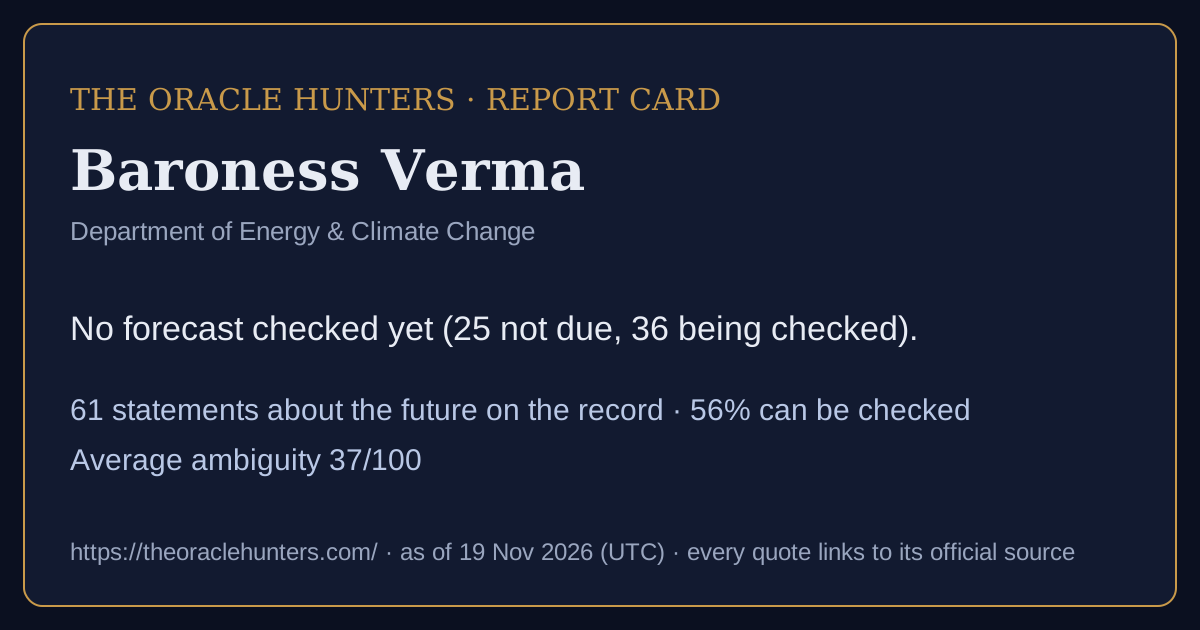
Track record: No forecast checked yet (25 not due, 36 being checked).
61forecasts & commitments on the record
56%can be checked as stated
37average ambiguity (0-100)
0goalpost moves recorded
0confirmed U-turns
Timeline
came true partly did not not due / being checked / too vague
Calibration score: shown after 10 checked forecasts with a stated likelihood (now 0).
How they speak about the future: based on data 54, stated on authority 6, educated guess 1.
Kinds of claim: forecast 51, mixed claim 9, commitment 1. · Download this report card as a picture
In the nine words
πρόγνωσιςInference from evidence53 · 87%μαντείαInspired knowledge5 · 8%προαναγγελίαPublic pre-announcement1 · 2%πρόβλεψιςSeeing the signs1 · 2%εἰκασίαConjecture1 · 2%
How to read this
Each box is one sentence a public figure or institution said about the future, word for word, with a link to the official text. Can be checked means it names what will happen, by when, and how likely - so it can be compared with official figures later. Too vague to check means it does not. Ambiguity (0-100) is how many different ways the sentence can be read. When the date passes, the forecast is compared with official data and marked came true, partly or did not come true. Labels judge the sentence, never the person. Full guide and glossary.On the record (61)
After all, this year alone there will be another 10 million reasons why that matters.
By 2020 this will result in 24 million additional women and girls using modern voluntary contraception.
Through this Framework, we will strengthen our work on inclusive economic growth to ensure that people with disabilities can access skills and jobs.
Next, the UK will champion the Roadmap to Action to Protect Women and Girls in Emergencies - and help secure positive outcomes for women and girls at next year’s World Humanitarian Summit.
The UK will ensure that, by September 2016, all our early warning and joint conflict analysis and assessment tools are fully gender-sensitive.
Second, the UK will contribute $1 million of start-up funding to the Global Acceleration Instrument to help address the global deficit on funding for the implementation of the resolution.
We strongly support the recommendations for the United Nations on Women, Peace and Security set out in the three major reviews this year and will work with others to ensure these are implemented.
By November 2016, all UK troops deployed on overseas missions will receive training on Women, Peace and Security and Preventing Sexual Violence.
We will also provide additional funding of over $800,000 each year for two years to support new research at the Centre for Women, Peace and Security at the London School of Economics - bringing the total UK Government funding for the Centre to over $3 million.
The Smart Metering Programme involves installing over 50 million smart electricity and gas meters by the end of 2020 impacting every home in Great Britain and over 2 million smaller non-domestic sites.
If all goes to plan, we stand on the verge of the largest expansion of the civil nuclear industry in generations. 16 gigawatts of new nuclear power will help to meet the UK’s energy needs by 2030.
The latest estimates suggest that we will need to expand the workforce involved in the nuclear industry from 70,000 now to 98,000 by 2021, when demand for skills at the various new nuclear sites will peak.
Britain needs up to £100 billion investment in new electricity infrastructure by the end of the decade.
It involves installing over 50 million smart electricity and gas meters by the end of 2020.
Furthermore, Horizon Nuclear Power has completed step 2 and begun step 3 of the Generic Design Assessment for the Advanced Boiling Water Reactor (ABWR) reactor which Hitachi and Horizon have proposed for their sites at Wylfa and Oldbury with completion of the process expected in 2017.
This is a major milestone towards building Moorside’s three reactors, which are expected to come online from 2024.
There’s still some way to go before construction can formally start in Somerset, but it will mean £16bn of investment coming into the country and the creation of 25,000 jobs, which is brilliant news for the South West and for the country as a whole.
Since 2004 Salix has invested just over £300m in English energy efficiency projects, supporting 12,080 individual projects.
We are improving the energy efficiency of 1 million homes by the end of this Parliament.
And Climate Change Agreements (CCAs) with eligible energy intensive industries will provide significant discounts worth up to £300m a year on the Climate Change Levy in return for meeting energy efficiency targets.
We’re committed to building on the success of the scheme, and improving it further, such as introducing a new solid wall minimum threshold which will take effect from next year.
By 2020, products policy is expected to save £850m, and reduce carbon emissions by 7MtCO2e.
By 2020 bills will be around £166 lower than had we left ourselves to global price shocks.
The rebate we negotiated with the energy companies last year will be reaching people’s bills next month.
By 2020 annual net savings to the UK economy from energy efficiency standards and labelling will be over £850m a year reducing greenhouse gas emissions by 7 million tonnes per year.
I’m aware that competition in the labour market is already fierce and ONR will need to rise to this challenge if it is maintain and increase its workforce.
Regulators announced on 6th January that they are progressing to the next phase of Generic Design Assessment of the UK ABWR and I understand that they expect to complete GDA by 2017.
In addition it is estimated that around 25,000 jobs will be created during construction with a massive investment by EDF Group and its fellow investors of around £16 billion to build the plant.
The full 16GW of new build capacity planned by industry could support an estimated 29,000-41,000 jobs across the nuclear supply chain at the peak of construction activity, with industry investment equating to around £60 billion.
Nuclear is an important part of the £110bn of investment in our electricity sector that is required over the next decade so the Government has prepared the ground for new nuclear power stations in the UK through a package of reforms and regulatory measures that remove barriers to investment and give developers the confidence to take forward projects that will …
UP to 2050, DECC’s innovation programme could save the UK up to £160 billion in energy costs.
Over the next 40 years, the Energy Technologies Institute’s Energy Systems Modeling Environment suggests that savings to the UK economy could be up to £600 billion.
To date, we have awarded some £25 million to 50 projects since the Fund was launched in 2012, and we expect to launch another funding Call early next year.
In a global market forecast to be worth £4 trillion by 2015, we need to continue to innovate to maintain our competitive advantage.
Our Carbon Plan suggests that to meet these carbon target’s around 60 to 80 Gigawatts of new electricity generating capacity will need to be built by 2030, and that around 40 to 70 Giga Watts of this will need to come from low carbon technologies.
Together we will provide 1 billion pounds between 2011 and 2015 to directly support energy innovation.
The Data and Communications Company will be responsible for linking 53 million smart electricity and gas meters in homes and small businesses with energy suppliers, network operators and energy service companies.
In December, The Central Delivery Body will publish its Consumer Engagement Plan, which will set out exactly how it plans to engage consumers in 2014 and beyond.
2 million households will get help under the Warm Home Discount - included amongst this group are well over a million of the poorest pensioners who will receive £135 off their electricity bill.
By autumn 2015 we expect all major energy suppliers to offer smart metering services to both credit and pre-payment consumers and use the shared infrastructure provided by the smart Data and Communications Company, to support the completion of the roll-out by 2020.
For example, 230,000 homes will be warmer this year by getting energy efficiency measures installed under the element of the Energy Company Obligation that is designed to support vulnerable households and households in deprived areas.
As you are all aware, we will see 30 million homes and small businesses receive new smart meters by 2020.
By 2030 the International Atomic Energy Authority estimates that 145 reactors will have been decommissioned at a cost of £250bn with the total liability for reactors, fuel cycle facilities and research activities over the next 50 years estimated at approximately $1000 billion.
This will be a key milestone in the delivery of smart meters, and will set out a range of activities which will be undertaken in 2014 to further engage consumers.
2 million households will get help under the Warm Home Discount, included amongst this group are well over a million of the poorest pensioners who will receive £135 off their electricity bill.
The implementation phase will see responsibility for delivery lie with many parties, including many different industry partners who will be vital in ensuring we are ready to start mass roll out in Autumn 2015.
Such is the importance of innovation that we expect to invest in excess of £1 billion, in this spending review period, to directly support innovation in a broad portfolio of low carbon technologies.
And the Green Deal is supporting jobs, with up to 60,000 expected in the insulation sector alone by 2015 – that’s more than double the 26,000 employed in 2012.
By 2020, 15% of our energy generation will be from renewable sources.
As a result, a total of 500,000 poor women will benefit from lower health risks from indoor air pollution and reduced drudgery, and 2.5m people will benefit from new or sustained access to modern, clean energy either for cooking or lighting needs.
Showing the newest 50 - the ledger has all 61.
Also said - not checkable as stated (12 newest)
Remarks about the future with no date, figure or likelihood that could be checked. They are kept on the record and shown here, but not scored.
So it’s clear that if we’re to achieve Agenda 2030, and live up to our promise to leave no one behind, we need to do more to prevent conflict and build, resilient, peaceful societies.
The real test will be delivery at country level, and improvements to the quality of lives for people on the frontline – so the focus on Delivering as One, strengthening the Resident Coordinator system and underpinning frameworks is absolutely critical.
Delivering as One goes hand in hand with effective leadership: resident and humanitarian coordinators, often the heads of the UN in country, must be individuals that can deliver strong leadership that responds to both short and longer-term needs.
We will deliver on the ambitious commitment of our Prime Minister.
And why, in humanitarian crises, DFID’s calls for proposals will now require the sexual and reproductive health and rights of women and girls to be considered.
No girl should live with the fear of being cut, the fear of being married too young, the fear of carrying a child too young, the fear of giving birth when her body is not ready, the fear of the potential risks of this – of haemorrhage, of being left with a leaky bladder thanks to obstetric fistula, the real …
We remain committed to supporting progress across the continuum of care, prioritising maternal and newborn health, and addressing HIV, particularly for key populations.
We will also continue to prioritise our commitment to become an authority on disability data.
As part of this we will be asking all partners to disaggregate their programme data by disability status where they can.
The barbaric practice of chaining or shackling people with mental health impairments quite simply has to stop.
So from October 2015 biomass boilers owners will need to demonstrate that their fuel is sourced sustainably.
we will be running a series of heat pump roadshows in the summer, including one focusing specifically on those looking to install water source heat pumps.