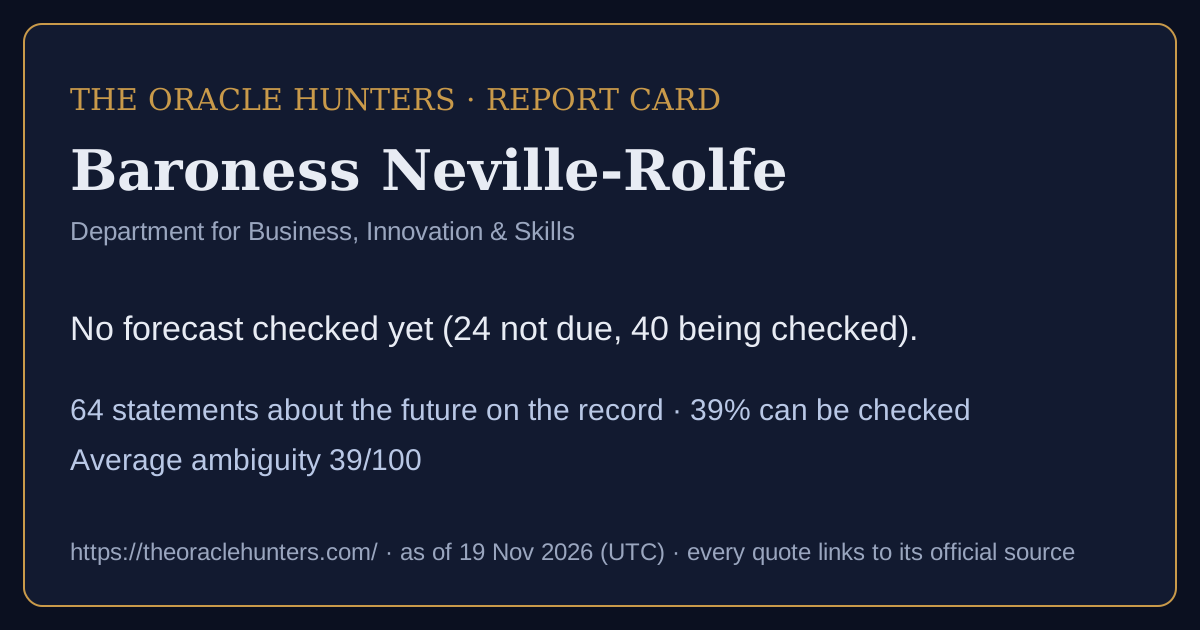
Baroness Neville-Rolfe
Department for Business, Innovation & Skills · GBR
Track record: No forecast checked yet (24 not due, 40 being checked).
64forecasts & commitments on the record
39%can be checked as stated
39average ambiguity (0-100)
0goalpost moves recorded
0confirmed U-turns
Timeline
came true partly did not not due / being checked / too vague
Calibration score: shown after 10 checked forecasts with a stated likelihood (now 0).
How they speak about the future: based on data 41, stated on authority 18, educated guess 5.
Kinds of claim: forecast 43, mixed claim 12, commitment 7, scenario (if… then) 2. · Download this report card as a picture
In the nine words
πρόγνωσιςInference from evidence38 · 59%μαντείαInspired knowledge14 · 22%προαναγγελίαPublic pre-announcement7 · 11%εἰκασίαConjecture3 · 5%πρόνοιαPreparing for the future2 · 3%
How to read this
Each box is one sentence a public figure or institution said about the future, word for word, with a link to the official text. Can be checked means it names what will happen, by when, and how likely - so it can be compared with official figures later. Too vague to check means it does not. Ambiguity (0-100) is how many different ways the sentence can be read. When the date passes, the forecast is compared with official data and marked came true, partly or did not come true. Labels judge the sentence, never the person. Full guide and glossary.On the record (64)
It means they must take steps to mitigate the risks posed by online fraud and scams, if they don’t they could see their services blocked in the UK or fines of up to £18 million or ten per cent of annual turnover.
These Demonstrators will start being trialled early next year at specific parts of the border.
All of the changes I’ve described today will be introduced steadily throughout 2024.
With a budget of almost £1 billion, it will, for example, help develop regional cyber strategies and training…
If we do not address this threat to our public services with ambition, realism and rigour, we will be undermining the trust British citizens have put in us to grow the economy and reduce debt so that we can improve public services.
That’s why we are investing in what I trust will be clear guidance, but also a significant training programme for contracting authorities ahead of implementation in 2024.
This will combine with our efforts to give many more people the chance to do quality apprenticeships from April this year.
And from next year, our new Mayors will have control over adult education budgets.
They will be publishing their report by the end of the year.
By the end of 2020, we expect every home in Britain to have a smart meter – putting consumers in control of their energy usage.
It will open its doors to students this coming September – aiming to train 7,000 people by 2020 alone.
Around half of homes (10 million across England) could reduce this cost through relatively simple and low cost improvements in energy efficiency costing under £500.
Our plans on heat will feature in the Emissions Reduction Plan next year.
The new energy efficiency regulations which come into force in April 2018 will help tackle this for the worst performing premises by requiring landlords to make improvements to these properties.
We recently announced the National College for Nuclear, which is set to open its doors next year and aims to train 7,000 people by 2020 who we hope will go on to become next generation of nuclear innovators.
Once completed, Hinkley Point C will provide up to 7 percent of the UK’s electricity needs and bring benefits to both the local and global supply chain.
I am pleased to announce today that we will make a further contribution of at least £5.5 million before the end of March 2017 to continue to ensure this important work.
This has been set up with funding from government and industry and will create two hub campuses in Cumbria and the South West, with the first intake of students in September 2017.
When completed, Hinkley Point will provide 7% of the UK’s electricity needs using continuous, reliable and secure low carbon energy.
We are talking to you and we will continue to talk to listen to your needs, so that we can work together to achieve stability in the short-term and growth beyond that.
You will, I’m sure, have seen the Prime Minister’s announcement last week at the CBI Annual Conference, that the Government will increase its investment in R&D – providing an additional £2 billion investment per year for research and development by the end of this Parliament, to keep Britain at the forefront of science and technology, disciplines that are clearly key …
And I believe that if these companies are supported in this way, we will see British suppliers growing their exports to the international nuclear market.
The government will need your support to help realise the benefits of this project but we’re moving forward and are planning to launch the siting process for the GDF next year.
And as you will all know, in March of this year, we launched the first phase of our SMR competition.
Now, with two hub campuses based in Cumbria and Bridgwater, it will start welcoming its first students from September 2017, aiming to train 7,000 people by 2020.
The Prime Minister wants to see every part of the country working – and encouraging local growth and development is a core part of our Industrial Strategy, a strategy which I will be able to say more on in the coming weeks.
In March this year we announced that this would fall to £105 for projects generating in 2021 – already a 25% reduction.
It is estimated this will save over 27 million tonnes of carbon and save bill-payers around £7.6 billion over the lifetime of the measures.
In particular we have set increased standards of energy efficiency for privately rented buildings, which will prevent buildings being let out after April 2018 unless they meet a minimum efficiency standard.
There are other advantages to the deal: EDF expects around 64% of the value of construction to be spent in the UK and Hinkley will deliver 26,000 high quality jobs and apprenticeships for people in Somerset and across the UK.
Many of you will be aware that Hinkley is expected to provide 7% of UK’s power in a non-intermittent and low carbon manner.
I believe there is a lot of potential for us to capitalise on the growth in smart technologies like storage, smart meters and demand-side response - put simply we will be able to offer customers a much better price for electricity outside of peak times when these changes work through.
Take as an example Rolls Royce who, in their factory in Bristol, have instigated ‘Project Sunshine’, installing solar panels which will play an important part in their 50 per cent emissions reduction, as well as powering their facilities.
And up to 18GW of storage could – according to the National Grid’s Future Energy Scenarios – be connected to our energy system by 2040.
In our IP Enforcement Strategy 2020 I set out my belief that guiding consumers to legal content when they search will help ensure that the vast appetite that exists for new and creative content benefits the legitimate creators, and not those criminals who cynically exploit the hard work of others.
The UK IPO and SIPO will hold joint workshops on global patent topics such as grace periods and IP valuation during our heads-of-office meeting in China later this year.
The UK will become an official user of SIPO’s Cloud Patent Examination System, or CPES, by the end of 2016; and
But whatever happens over the coming months in Europe, Hong Kong will remain an important partner for the UK.
As matters stood and perhaps still stand, it was expected to take effect in the UK by 25 May 2018.
If political events were less exciting I could have waxed lyrical and long about the Internet of Things, how we are going to see exponential growth of ordinary objects and devices connected to the internet.
We are committed to supporting collaboration between businesses and universities to stimulate innovation and economic growth.
Indeed, this year we will be launching an updated Lambert Toolkit, which provides model collaboration agreements as a starting point for negotiations around the ownership of any IP generated during a joint university-business project.
British Retail Consortium’s (BRC) recently published report ‘Retail 2020’ (PDF, 919 KB) has described the changes that can be expected to the retail landscape in the future.
That’s why we will be publishing our Digital Strategy this year, setting out what we will do to ensure that the benefits of digital are felt throughout the economy.
Corporation tax has been cut to the lowest level of any major economy and will be cut further to 17% in 2020, benefitting over a million companies.
When adopted Member States will need to give effect to the regulation in domestic legislation within two years of adoption, so we are looking at Spring 2018 for UK implementation.
In last week’s government response, there was strong support for the proposal and we will now continue with our plans to join towards the end of this year.
If we get this right, then consumers will enjoy greater choice, lower prices, more mobility and better public services, while businesses will thrive, innovate, drive growth and create jobs.
The good news here however is that things are getting better and by the end of 2017 superfast broadband will be available to 95% of homes and businesses in the UK.
The Chancellor, in his speech at GCHQ last week, announced that government provision for cyber security will rise from £860 million to nearly £2 billion.
Showing the newest 50 - the ledger has all 64.
Also said - not checkable as stated (12 newest)
Remarks about the future with no date, figure or likelihood that could be checked. They are kept on the record and shown here, but not scored.
The Government continues to support this industry by providing over £1 billion in competitive tax reliefs to give the sector the security it needs to unleash innovation.
Examples of work begun under the CSSF that we will build on under the ISF:
Let me describe some examples of work begun under the CSSF that we will build on under the ISF:
This is being carried out in countries such as Thailand and under the ISF we will be extending it to the Philippines.
I have also heard that a year can be too short a time to deliver results in a cost-effective way so we will try to tip the balance more in favour of longer, multi-year projects whilst maintaining some flexibility to deal with crises and new priorities that arise.
I hope I have set out clearly that we will retain the Fund’s distinct identity.
As a consequence over medium term I expect defence and security spending will increase significantly here and elsewhere.
We will also continue to reach beyond the public sector, collaborating with industry to make the most of cutting edge developments.
It is only if we are all supporting each other, that we will tackle public sector fraud.
Think Fraud Campaign and next month the first ever Global Fraud Summit.
Those committing fraud will always try to find gaps to exploit the cracks in our defences.
For instance, low risk goods - like tinned salmon - will not need to have health certificates or routine border checks.