Baroness Kramer
Department for Transport · GBR
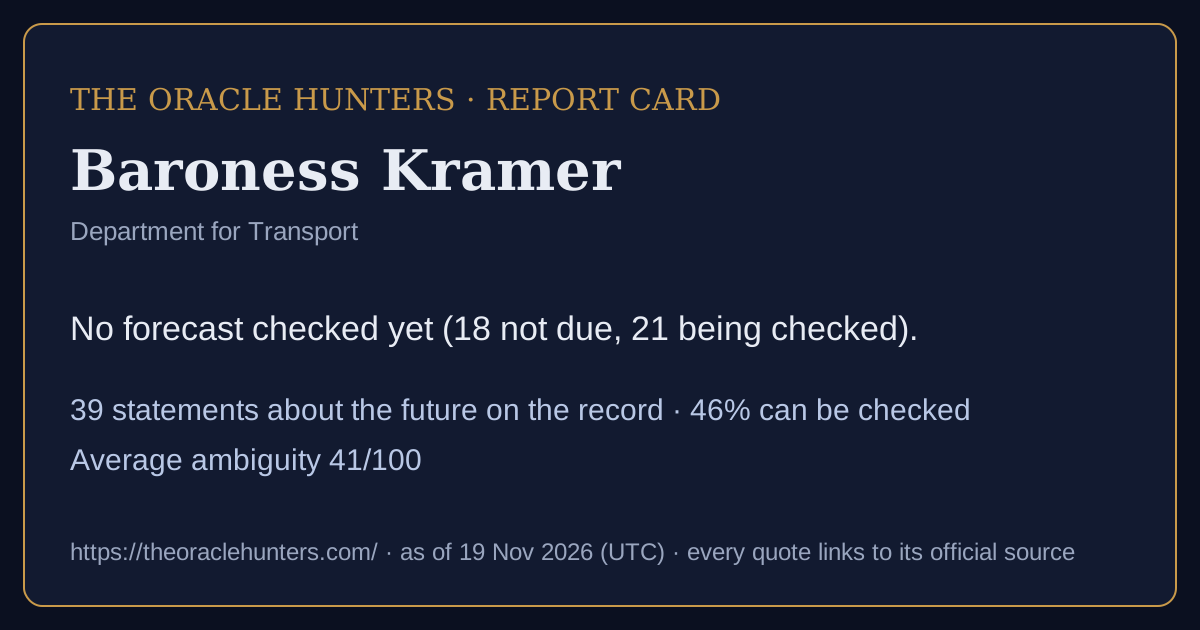
Track record: No forecast checked yet (18 not due, 21 being checked).
39forecasts & commitments on the record
46%can be checked as stated
41average ambiguity (0-100)
0goalpost moves recorded
0confirmed U-turns
Timeline
came true partly did not not due / being checked / too vague
Calibration score: shown after 10 checked forecasts with a stated likelihood (now 0).
How they speak about the future: based on data 32, stated on authority 7.
Kinds of claim: forecast 21, commitment 10, mixed claim 8. · Download this report card as a picture
In the nine words
πρόγνωσιςInference from evidence25 · 64%προαναγγελίαPublic pre-announcement10 · 26%μαντείαInspired knowledge4 · 10%
How to read this
Each box is one sentence a public figure or institution said about the future, word for word, with a link to the official text. Can be checked means it names what will happen, by when, and how likely - so it can be compared with official figures later. Too vague to check means it does not. Ambiguity (0-100) is how many different ways the sentence can be read. When the date passes, the forecast is compared with official data and marked came true, partly or did not come true. Labels judge the sentence, never the person. Full guide and glossary.On the record (39)
It was a privilege to be able to announce an extra £160 million for the Access for All programme, meaning that by the end of this year, 150 stations across the network will have been upgraded.
So I shall be meeting up with operators and the cities again next month to reinforce that message.
This year, we will fund nearly £1 billion of spending on concessionary travel.
And that the building of Phase One between London and Birmingham will begin in 2017.
By the end of this year, there will be rapid chargepoints in every motorway service station in England, taking as little as 20 minutes to charge up a car.
We will also be investing to support the development of low emission trucks, and increasing the number of gas refuelling stations, to cut emissions and costs in our vital freight sector.
Third, we will be backing British businesses by providing at least £100 million for research and development - money that will be more than matched by industry when bidding for projects.
We will invest £200 million to extend the plug-in grant, which cut the up-front cost of an ultra-low emission vehicle by up to £5,000, making the choice to go green cheaper in the showroom as well as on the road.
The company will lead a programme that will ultimately create 14,000 jobs, provide space for 2,000 new homes, and contribute up to £1.3 billion a year to the local economy.
The UK is expected to grow faster than any other G7 country this year.
And we will be investing £30 million to boost the market for low emission buses like those produced by Alexander Dennis, Optare and the Wright group.
We will also be investing to support the development of low emission trucks and increasing the number of gas refuelling stations, helping our vital freight sector cut emissions and cut costs.
And, third, we will be backing British businesses by providing at least £100 million for research and development.
We will invest £200 million to cut the up-front cost of an ultra-low emission vehicle.
I’d like to take the opportunity this morning to set out why we will be investing £500 million to support the development of low emission vehicles and why I think partnership is important if we are going to get the best return on that investment.
And London is expected to boom to almost 10 million residents by 2030.
That’s why over the next 5 years we will be investing £38 billion to improve and expand our rail network.
From our programme to electrify over 850 miles of track and from the £5.7 billion Intercity Express Programme which will deliver 122 new trains built at a state-of-the-art facility in the North-East, using components sourced from across the supply chain.
From 2017, the college will teach some of the brightest engineering and construction students in Britain, providing them with the specialised training and qualifications they need to work on HS2 and other infrastructure projects.
With co-funding this will create a programme worth £250 million to deliver the next generation of railway operations and improve the UK export opportunities for rail.
Of course the industry is also benefiting from major schemes like Crossrail, Thameslink and Northern Hub, from our programme to electrify over 850 miles of track and from the £5.7 billion InterCity Express Programme which will deliver 122 new trains built at a state-of-the-art facility in the North-East, using components sourced from across the supply chain.
By 2020 it is estimated a further 400 million rail journeys will be made in Britain.
From 2017, the college will teach some of the brightest engineering and construction students in Britain providing them with the specialised training and qualifications they need to work on HS2 and other infrastructure projects.
As you know there will be a referendum taking place in Scotland later this year.
That’s why between 2014 and 2019, Network Rail will spend over £38 billion running and expanding our railway.
That’s why between 2015 and 2020 we will invest £70 billion in our transport infrastructure.
Major routes like the West Coast line will be swamped by 2025 if we fail to act.
I know progress has been made to ensuring stations are accessible to all and that all rail vehicles will be accessible by 2020.
In London Crossrail, which will open in 2018, will boost London’s rail capacity by 10%.
Between 2014 and 2019, Network Rail will spend over £38 billion running and expanding our railway.
I can confirm that this will happen before the end of the year.
I can also confirm today that the department will be publishing guidance for revenue funding bids for the 2015 to 2016 Local Sustainable Transport fund in December.
The Northern Hub will add around £4 billion to the economy and help support 20,000 to 30,000 new jobs.
I can also announce today (4 December 2013) that we will provide £5 million of new funding required for the rail replacement works for the Sheffield Super Tram.
These will shape the allocation of the £6 billion that we are investing through Local Growth Deals from 2015 until 2021.
So early next year we will be also launching a comprehensive consumer information campaign - joint funded by OLEV and 5 vehicle manufacturers - to dispel some myths about green motoring, and to help inform potential buyers.
We will work to resolve any market failures or barriers to growth.
Forecasts suggest rail freight could double in this country between 2008 and 2030.
Later this year we will publish a new cost benefit analysis as part of the wider strategic case - and it will be positive.
Also said - not checkable as stated (12 newest)
Remarks about the future with no date, figure or likelihood that could be checked. They are kept on the record and shown here, but not scored.
We don’t know if, or when, we will suffer another terrorist attack against our transport network.
And although the decision on how the railway is policed in Scotland will be up to the Scottish government, we will continue to press the Scottish government to ensure that support for your vital policing work is maintained.
We must now prepare for this devolution to happen, and for the necessary legislation to be put before Parliament after the general election.
The UK government, the BTP Federation, the BTP Authority and the Scottish government must now work together to achieve that safety and security.
But I hope Manchester doesn’t have to wait for devolution, because I want to see all the major cities in England have a smart, multi-operator bus ticket in place by the end of 2015.
The data they will provide could lead to a real step forward in developing cleaner bus technologies, because we will be sharing the performance data across the UK and across Europe.
If the proposals are agreed to, train operators will have to remove misleading references to criminal sanctions in letters chasing payment of penalty fares.
And that’s a challenge that will need to be met through the franchising programme, so I’m looking forward to seeing the industry’s rolling stock strategy when it’s out at the end of the month.
And it’s by putting the passenger at the heart of everything you do that the railway will flourish in future, and will in turn secure economic growth for the country.
One example is in the Solent, where local transport infrastructure will link with a new junction on the M27 to support new housing developments and connect people with jobs.
We will shortly be putting a summary of responses on the government’s website.
The importance of buses is only going to go up.