Baroness Blackwood
Department of Health and Social Care · GBR
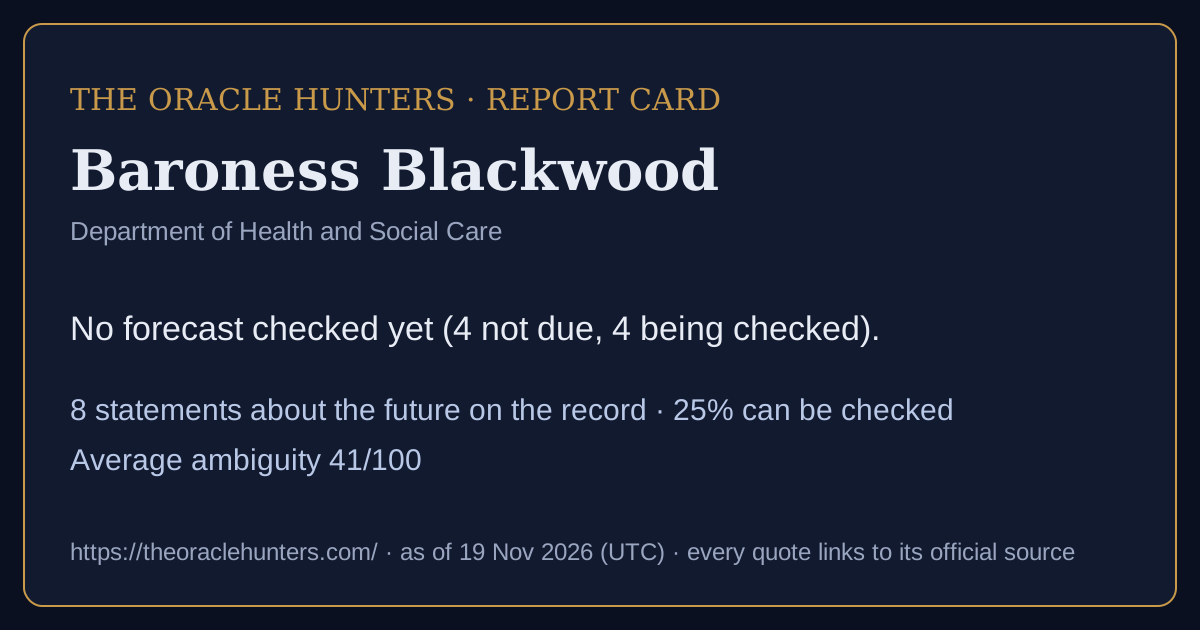
Track record: No forecast checked yet (4 not due, 4 being checked).
8forecasts & commitments on the record
25%can be checked as stated
41average ambiguity (0-100)
0goalpost moves recorded
0confirmed U-turns
Timeline
came true partly did not not due / being checked / too vague
Calibration score: shown after 10 checked forecasts with a stated likelihood (now 0).
How they speak about the future: based on data 5, educated guess 3.
Kinds of claim: mixed claim 4, forecast 3, scenario (if… then) 1. · Download this report card as a picture
In the nine words
πρόγνωσιςInference from evidence5 · 62%εἰκασίαConjecture2 · 25%πρόνοιαPreparing for the future1 · 12%
How to read this
Each box is one sentence a public figure or institution said about the future, word for word, with a link to the official text. Can be checked means it names what will happen, by when, and how likely - so it can be compared with official figures later. Too vague to check means it does not. Ambiguity (0-100) is how many different ways the sentence can be read. When the date passes, the forecast is compared with official data and marked came true, partly or did not come true. Labels judge the sentence, never the person. Full guide and glossary.On the record (8)
If the UK does not remain competitive, you will move to Boston or Singapore, and we will lose jobs and investment.
But, as the percentage of our population living with chronic and complex illness rises inexorably, we must also face the fact that, while NHS care will save your life, it will also consume your life if you have a long-term condition.
In the next year, we have agreed that the AAC will make progress on delivering the following 6 key priorities:
If we do not think about issues such as transparency, explicability, and bias, it is also possible that the increasing use of digital technologies within the health and care system could cause unintended consequences.
Through our £37.5 million investment, we will make the NHS’s data assets radically more accessible and usable by researchers and innovators.
I can reassure you that, post 2020, there will be an overarching framework to improve the lives of all those living with rare conditions.
By March 2018, 37 individual rare diseases had been adopted and by 2022 we expect this number to have increased to 100.
As we work hard on what our future relationship with the EU will look like, I am also aware that we need to work hard on what the future of the UK Strategy for Rare Diseases post 2020 will look like.
Also said - not checkable as stated (12 newest)
Remarks about the future with no date, figure or likelihood that could be checked. They are kept on the record and shown here, but not scored.
We will be working with patient organisations and experts to develop a mechanism for capturing honest views on your experience.
And here’s the important part – seriously ill children who are likely to have a rare genetic disorder will be offered whole genome sequencing under the GMS.
I have met with NHS England just this week, who have assured me that the insert has been included and will be monitored through the Quality Surveillance Systems, with trusts reporting on it for the first time this September.
Finally, the provider must ensure that every child has an active transition to an appropriate adult service, even if that adult service is not the commissioning responsibility of NHS England.
The Medicines and Healthcare products Regulatory Agency (MHRA) has a global reputation for innovation and leadership, and we are determined that this will be maintained in the year ahead.
We will also shortly be announcing the appointment of a very exciting new chief executive to take over from the excellent Ian Hudson.
Now, the AAC may sound like just another bureaucratic acronym, but I believe that through acting as a single umbrella organisation across the UK health innovation eco-system, it will genuinely drive change in the NHS.
The combination of a healthtech funding mandate and a globally leading testing infrastructure will ensure the best new innovations get into the NHS, and to patients, faster.
You may have seen the recent media coverage on the increased NHS support to make pre-eclampsia tests more widely available.
Companies like DrDoctor and others have already helped hugely but we will go further to deliver the NHS Long Term Plan commitments for digital-first primary care and redesigning outpatient care and, of course, the embedding of AI for diagnostics.
We know patients will still need specialists with expert knowledge, but the patient and specialist don’t need to be in the same space at the same time.
To ensure the ethical and fair use of health data by researchers and commercial partners, last December we published 5 guiding principles for the use of NHS data, along with plans to establish a national centre of expertise that will provide NHS organisations with high-quality commercial and legal expertise.