Arthur Yuen
Hong Kong Monetary Authority
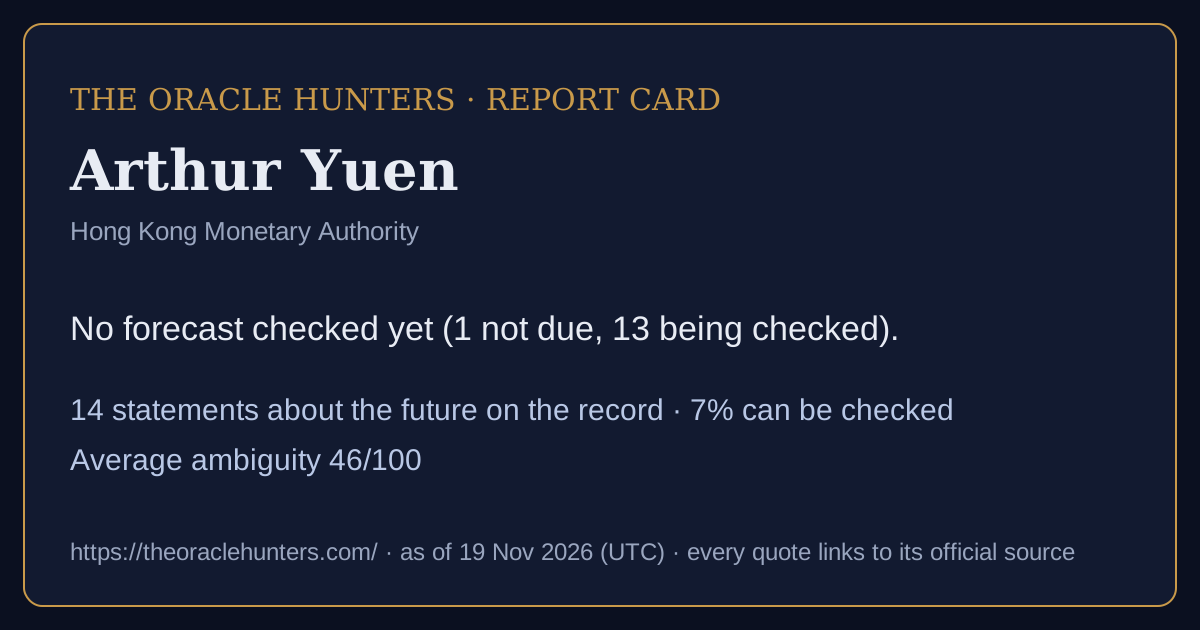
Track record: No forecast checked yet (1 not due, 13 being checked).
14forecasts & commitments on the record
7%can be checked as stated
46average ambiguity (0-100)
0goalpost moves recorded
0confirmed U-turns
Timeline
came true partly did not not due / being checked / too vague
Calibration score: shown after 10 checked forecasts with a stated likelihood (now 0).
How they speak about the future: based on data 8, stated on authority 6.
Kinds of claim: forecast 11, mixed claim 3. · Download this report card as a picture
In the nine words
How to read this
Each box is one sentence a public figure or institution said about the future, word for word, with a link to the official text. Can be checked means it names what will happen, by when, and how likely - so it can be compared with official figures later. Too vague to check means it does not. Ambiguity (0-100) is how many different ways the sentence can be read. When the date passes, the forecast is compared with official data and marked came true, partly or did not come true. Labels judge the sentence, never the person. Full guide and glossary.On the record (14)
We have been building that common language step by step - Phase 1 in May 2024, Phase 2A in January this year.
Some scientists have recently announced that 2023 is the hottest year on record and they expect 2024 to be even warmer. 1
this year and we will issue the first version of the framework very soon.
Phase 1 of the Scheme covering senior positions will formally start in May 2023.
And it is encouraging to see that the MRC Scheme was nalised in May this year.
The rst intake under this Banking Graduate Trainee Programme will commence in September this year.
We have received many useful comments during the consultation exercise, including those from ASIFMA, and we have issued the consultation conclusions in May this year to set out the operational framework for what we call 'Mandatory Reference Check' - in short the 'MRC', Scheme.
Given the scale and breadth of the Focused Review, the exercise is expected to complete around early next year.
But we will only achieve our Regtech 2025 vision if the Regtech ecosystem works together towards the same goal.
And then looking ahead to the second half of 2021, we expect to set up the 'Regtech Knowledge Hub'.
And this will involve us working hand-in-hand with banks and the Regtech community, in order to realise our vision for Regtech 2025.
Also in the first half of 2021, we will be announcing details of our first Regtech challenge.
We expect to start granting licences to virtual banks around the end of this year or early next year.
With the huge financing gap for infrastructure development standing at $8 trillion in the decade to 2020, AIIB will be looking to play a major role in bridging the shortfall.
Also said - not checkable as stated (12 newest)
Remarks about the future with no date, figure or likelihood that could be checked. They are kept on the record and shown here, but not scored.
As key facilitator of capital flows, banks need to understand not only what climate change means for themselves and their clients today, but also how these exposures may evolve over time.
The transition planning guidelines, which have just been finalised, will help banks manage climate-related risks and identify opportunities to support their clients’ transition.
Together with the steadily increasing climate disclosures from corporates, these efforts will support better-informed sustainable finance decisions and foster trust in the market.
They must be matched with awareness of climate-related risks and opportunities.
Climate risk unfolds over long, uncertain horizons, so banks need to understand not only what climate change means for their clients today, but how that exposure will evolve.
We will reinforce this further by embedding the transition planning efforts of banks into our Supervisory Review Process.
Both the bank and the market need to see well in order to manage risks well.
A taxonomy that finances only what is already green will not get Asia to net zero; it must finance the enablers and the hard cases alike.
As markets move, policies advance, and technologies mature, we will keep the Taxonomy evolving to keep pace.
We will continue to participate in, and contribute to, international efforts to enhance taxonomy interoperability and adoption, so that the common language we are building here is spoken and trusted across markets, and the Taxonomy remains a tool that the market can grow with, and grow on.
- Third, tomorrow's professional will need to work fluently across two interfaces: with other people, and with intelligent systems.
They will need to ask better questions, challenge outputs, explain decisions and know when not to rely on the machine.