Anne Milton
Department for Education · GBR
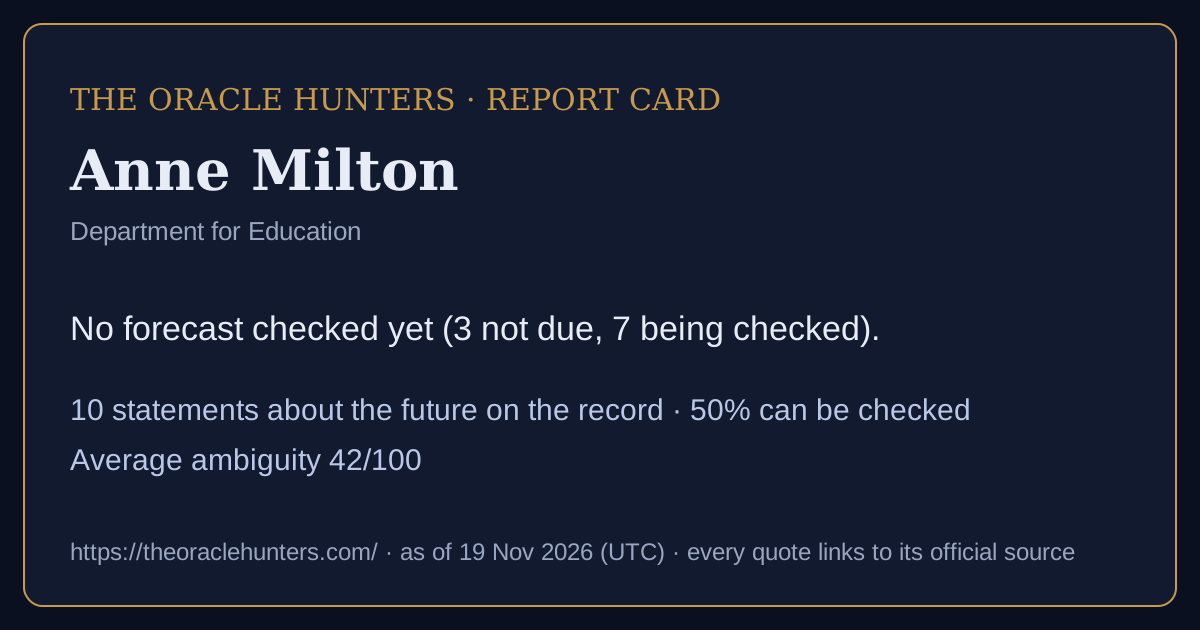
Track record: No forecast checked yet (3 not due, 7 being checked).
10forecasts & commitments on the record
50%can be checked as stated
42average ambiguity (0-100)
0goalpost moves recorded
0confirmed U-turns
Timeline
came true partly did not not due / being checked / too vague
Calibration score: shown after 10 checked forecasts with a stated likelihood (now 0).
How they speak about the future: based on data 8, stated on authority 2.
Kinds of claim: forecast 8, commitment 1, mixed claim 1. · Download this report card as a picture
In the nine words
πρόγνωσιςInference from evidence7 · 70%μαντείαInspired knowledge2 · 20%προαναγγελίαPublic pre-announcement1 · 10%
How to read this
Each box is one sentence a public figure or institution said about the future, word for word, with a link to the official text. Can be checked means it names what will happen, by when, and how likely - so it can be compared with official figures later. Too vague to check means it does not. Ambiguity (0-100) is how many different ways the sentence can be read. When the date passes, the forecast is compared with official data and marked came true, partly or did not come true. Labels judge the sentence, never the person. Full guide and glossary.On the record (10)
The first teams will be operational by the end of this year.
They will be rolled out gradually over the next five years to one-fifth and a quarter of the country by the end of 2022-23.
We are now considering the final applications for the Restructuring Facility - and we expect the final figure for restructuring funding to rise significantly before the programme ends next year.
We are providing £38 million in capital to support the initial roll-out of T Levels from September 2020 which will be used to improve the quality of facilities and equipment that will be used to deliver T Levels.
In the Autumn Budget, we announced that will invest £30 million to test the use of AI and innovative EdTech in online digital skills courses so that adult learners can benefit from this emerging technology, wherever they are in the country.
In last year’s Spring Budget, we allocated an additional £500 million per year for T levels, which will help us to match the excellence of our world-leading higher education system.
The target is that 50% of these students will be women and 50% will be from low-income households by 2021.
This is why I am delighted to confirm that we will introduce full funding for basic digital training for adults from 2020.
The Careers & Enterprise Company has already invested £1million in the first 6 Opportunity Areas and we will be allocating a further £1million to support the second wave of Opportunity Areas.
There have been 1.1 million apprenticeship starts since May 2015 and we aim to reach 3 million by 2020.
Also said - not checkable as stated (12 newest)
Remarks about the future with no date, figure or likelihood that could be checked. They are kept on the record and shown here, but not scored.
And while the response to the challenges that colleges face has to be a local response to local circumstances – building relationships with your local police, health and social services are important, and there may be things that we can do nationally to make that easier for you.
We are discussing how best we can do this with the AoC and others, and we will continue to do that.
As he says – we will strive for a good outcome.
We will have an external review to look at the systems within the DfE, so that problems with financial management are identified at the earliest possible stage.
There is still room for improvement though and we will be rolling this out to apprentices as well.
We will be announcing changes to the operation of the register of apprenticeship training providers.
This will be vital training to build on the expertise we have currently, so we are ready for the future.
It is important to me, as I’m sure it is to you, and I hope you will take advantage of it.
T levels will sit alongside apprenticeships as technical study programmes for entry into skilled employment.
However my job will always be as a champion in government, lobbying for the important role of colleges to be reflected in the decisions that are taken.
Whilst our global reputation for digital technology is richly deserved, we will work hard to keep up.
So we are determined that the new specialist institutions will play an essential role in training the digital leaders of tomorrow.