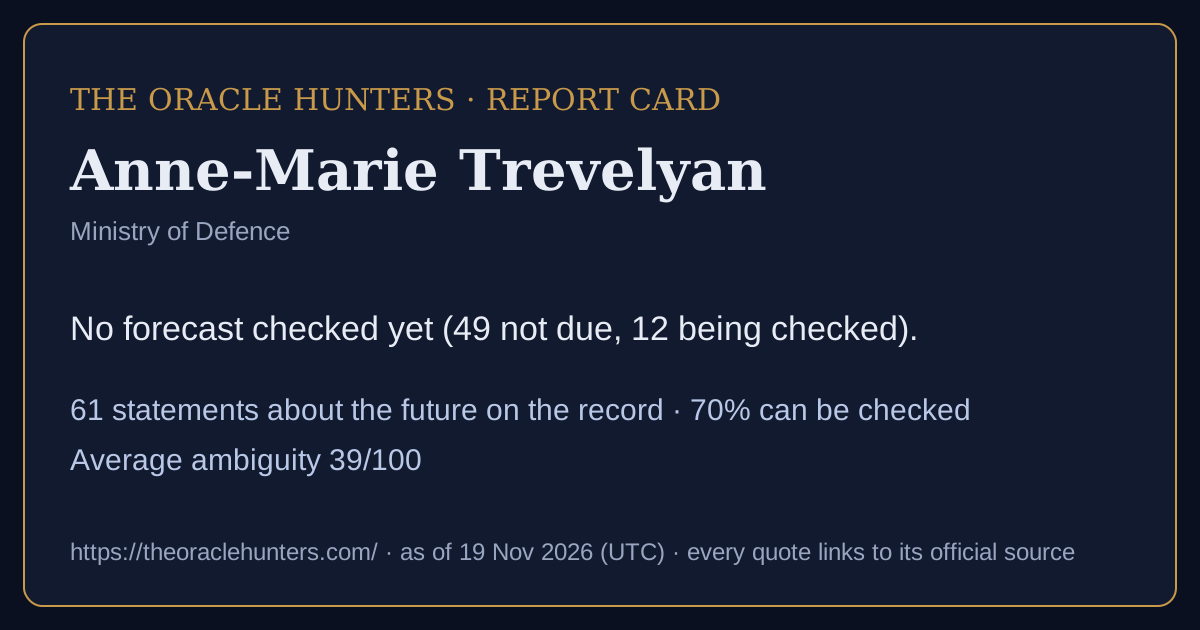
Anne-Marie Trevelyan
Ministry of Defence · GBR
Track record: No forecast checked yet (49 not due, 12 being checked).
61forecasts & commitments on the record
70%can be checked as stated
39average ambiguity (0-100)
0goalpost moves recorded
0confirmed U-turns
Timeline
came true partly did not not due / being checked / too vague
Calibration score: shown after 10 checked forecasts with a stated likelihood (now 0).
How they speak about the future: based on data 48, stated on authority 12, educated guess 1.
Kinds of claim: forecast 44, commitment 9, mixed claim 8. · Download this report card as a picture
In the nine words
πρόγνωσιςInference from evidence46 · 75%προαναγγελίαPublic pre-announcement9 · 15%μαντείαInspired knowledge5 · 8%εἰκασίαConjecture1 · 2%
How to read this
Each box is one sentence a public figure or institution said about the future, word for word, with a link to the official text. Can be checked means it names what will happen, by when, and how likely - so it can be compared with official figures later. Too vague to check means it does not. Ambiguity (0-100) is how many different ways the sentence can be read. When the date passes, the forecast is compared with official data and marked came true, partly or did not come true. Labels judge the sentence, never the person. Full guide and glossary.On the record (61)
The UK will commit at least £3 billion a year for military support to Ukraine – building on more than £7bn to date.
Next year will also bring CSG25 (maybe I can hitch a lift on that first, maybe that’s a solution).
So I know you all agree that it was great to hear the Prime Minister’s announcement on 2.5% of GDP for defence spending, and a first picture from the defence Secretary yesterday on what this might look like for the Royal Navy.
As part of that effort, from next year, the UK, US, and Japan will hold regular trilateral military exercises – this will build on the continuous deployment of HMS Spey and HMS Tamar in the Indo-Pacific, and is part of the commitment we have made with the USA in the Atlantic Declaration and Japan in the Hiroshima Accord.
Later this year we will conduct trilateral maritime autonomy exercises.
And in May we announced the expansion of British International Investments (BII as it’s known) to the Indo-Pacific, which is going to invest up to £500 million of climate finance.
As you mentioned we have got elections in 60 countries, over 2 billion people going to the polls.
We will accelerate the development of quantum technologies for positioning, navigation, and timing in military capabilities.
Furthermore, to sustain the South China Sea’s vital role as a provider for fish and livelihoods, this year the UK announced funding of £2.5 million on Illegal, Unreported and Unregulated Fishing – another key priority of the ASEAN Maritime Outlook.
And – following HMS Queen Elizabeth, our 5th generation aircraft carrier and her strike group’s visits in 2021 – we will be sending another Carrier Strike Group to the Indo-Pacific in 2025.
We will deploy a Littoral Response Group to the region next year to add further support and depth to the UK’s commitment.
Together with the US and Australia, we are going to build a new global and interoperable nuclear-powered submarine capability, that will not only support a free and open Indo-Pacific, but will also strengthen UK contribution to NATO in Europe.
Beyond the present dependencies, more than half of global growth is projected to come from the Indo -Pacific by 2050, so we need to ensure the UK is right at the heart of the region’s successful future – so we must be alive to the threats, working with allies to counter them, so that in concert our businesses and people …
The opportunity is huge; agricultural innovation can unlock growth worth an additional $1.7 trillion to GDP in the Global South, and indeed could reduce global food prices by 16%.
UK climate change partnerships are mobilising billions of pounds in green finance, including the UK’s Climate Action for a Resilient Asia Programme, which will support up to 14 million people to adapt to climate change.
This will not only give us access to a partnership with a joint GDP of £9 trillion, and remove tariffs on 95% of all goods traded, but we will also be able to share our legal expertise and our other professional services to help shape future trading rules.
As 60% of global shipping passes through the Indo-Pacific, and more than half of global growth is projected to come from the region by 2050 – though perhaps the report will tell me something even more impressive than that – the UK must have her strategic focus facing the region.
So we will be working even more closely with them and with other partners to accelerate global action on climate change.
Today, I am also announcing the winners from the second round of the competition, allocating over £12 million to 31 different projects, including 3 green shipping corridors which can help lead decarbonisation solutions.
We consider how we will comprehensively tackle cyber security, defending the global supply chain at a time of increased automation and evolving cyber technologies.
And we will continue to stand alongside our Ukrainian friends, strengthening their hand to finish this war on their terms.
We will continue to work with international partners to implement an oil price cap and ban on maritime insurance for Russian oil later this year.
This could boost intra African trade by over 50% and lift 100 million people out of poverty.
The Free Trade Area will connect 1.3 billion people and economies with a combined GDP of $3.4 trillion, through a single set of trading rules.
In Mozambique, UK company Globeleq, has invested £20 million in solar energy and will soon develop a wind energy plant too.
If we take full advantage of this opportunity, I have every confidence that we will together, not only increase prosperity and create new growth.
In fact, according to our analysis, Africa’s import markets are forecast to undergo exponential growth – expanding more than five-fold from nearly $700 billion in 2019, to $3.9 trillion by 2050.
At October’s Global Investment Summit that we hosted here in London, we secured almost £10 billion-worth of pledges from international backers for environmentally-friendly projects - some of which are already translating into green jobs across the UK.
Pilgrim’s Lamb, a firm based in Hampshire and Powys in Wales, believes overcoming the barrier with China would boost its business substantially, while the Scotch Whisky Association tells us that removing a 100 percent tax levied on spirits over 30 percent alcohol by volume in Hong Kong could unleash the potential of the market for UK producers.
Remove them and we could open import markets worth a combined £4 billion a year.
So I want us to go further: it’s my ambition to ignite a bonfire of barriers, which could result in over £20 billion of export opportunities for our economy.
So we want to help firms take advantage of these enormous economic benefits here too: the global market for low-carbon exports is expected to be worth £2 trillion by 2030.
So, we will support countries to increase exports, build stronger supply chains and tackle market distorting practices.
One great example is their collaboration with BEIS to secure Britishvolt’s £2 billion injection into a Gigafactory in Northumberland that will create around 3,000 jobs.
Since the Global Investment Summit last autumn, leading Australian businesses have also announced they will commit £28.5 billion into clean energy, technology and infrastructure projects across the UK.
While in North Wales, Turkish firm, Eren Paper, is investing £500 million into building a new corrugated cardboard factory, which will save millions of trees, through using paper waste and creating 500 new jobs.
By 2030, it’s projected to be worth almost £2 trillion.
By 2030, low-carbon industries could generate up to £170 billion of UK exports.
In fact, by 2050, over 1.2 million people could be directly employed in low carbon goods and services sectors, a six-fold increase from today.
We are on course to accede to the £8 billion CPTPP this year, which is going to create a plethora of opportunities for you across eleven dynamic markets.
Shipping currently accounts for around 2.5% of global emissions, but this share could more than treble by 2050.
OECD analysis has estimated that substantial liberalisation of market access barriers by the G20 countries alone could boost UK exports by around £75 billion a year.
In particular of course, a big focus will be our plans to join the Comprehensive and Progressive Agreement for Trans-Pacific Partnership, the CPTPP, a huge free trade area with a combined GDP of £8.4 trillion, including the Pacific region’s most dynamic economies.
Working with strategic partners across Asia and beyond to make the global trading system fit for the 21st century, we will strengthen our trading relationships and build better, greener and more resilient global supply chains.
Next year will be a five-star year for the UK’s trade agenda, as we look to begin formal negotiations on deals with Canada, with Mexico, the Gulf Cooperation Council and India.
By 2030, ASEAN’s digital economy alone is projected to hit a colossal $1 trillion.
The trade partnership the Prime Minister announced in May has the ambition to double our bilateral trade by 2030 – already £24 billion before the pandemic struck.
That is why we are determined that Global Britain, the home of Adam Smith and David Ricardo, remains an unapologetic champion of free trade and enterprise.
Almost £10 billion was invested in green projects that will reduce emissions, create thousands of jobs, and spur our mission to level up the entire country.
And India is projected to be the world’s third largest economy by 2050.
Showing the newest 50 - the ledger has all 61.
Also said - not checkable as stated (12 newest)
Remarks about the future with no date, figure or likelihood that could be checked. They are kept on the record and shown here, but not scored.
What is going to be vital is that the new integrated procurement model which we have set out, must turn government’s relationship with industry into a true strategic partnership – the 2.5% commitment will allow long term planning on shipbuilding, for instance, which will be vital to our ability to get the next generation of ships and submarines into service …
We must, however, continue to make it absolutely clear: there is no possible defence for Russia’s behaviour.
Secondly, we must stand with Ukraine and stand up for human rights.
So we will build on the AI Safety Summit and continue to spur collective international action to navigate both the opportunities and the risks of this new frontier.
Therefore, 2024 also needs to be a year of patient diplomacy, as we continue to put in place these long term frameworks that will build the range of partnerships required to protect UK prosperity and security and to support global efforts to tackle those shared challenges.
We will encourage and work with our brilliant businesses, our investors, our entrepreneurs and their counterparts across the region to maximise these opportunities, for 2024, and for the long-term.
I think what I’ve heard time and again from my counterparts, in spite of their very diverse interests, was a desire for the kind of stable world order that will support economic growth and genuinely allow sustainable development.
Because we must keep at the front of our minds at all times why we are doing this – we have a responsibility together to provide defence capabilities which will be capable of maintaining a free and open Indo-Pacific – not just for our trading and security interests, but for our neighbours, friends and allies.
So, may I just first of all thank Senator Linda Reynolds for asking whether I would support this – of course I will, you only have to ask - a really important focus!; and to Gordon Flake and the US Asia Centre and Business News for making this opportunity a reality.
We will be collaborating on the Deep Space Advanced Radar Capability programme, which will use sites in all three countries to help identify emerging threats in space.
Its positive impact will be felt in the region, in our relationships with 2 of our oldest and closest allies – but also across defence, industry and academia in all 3 partner countries.
Last week, the AUKUS Defence Ministers, meeting in the US, made a series of major announcements on Pillar Two that will build our mutual deterrence posture to make us stronger and create lots of opportunities for our defence industries.