Anna Sweeney
Bank of England
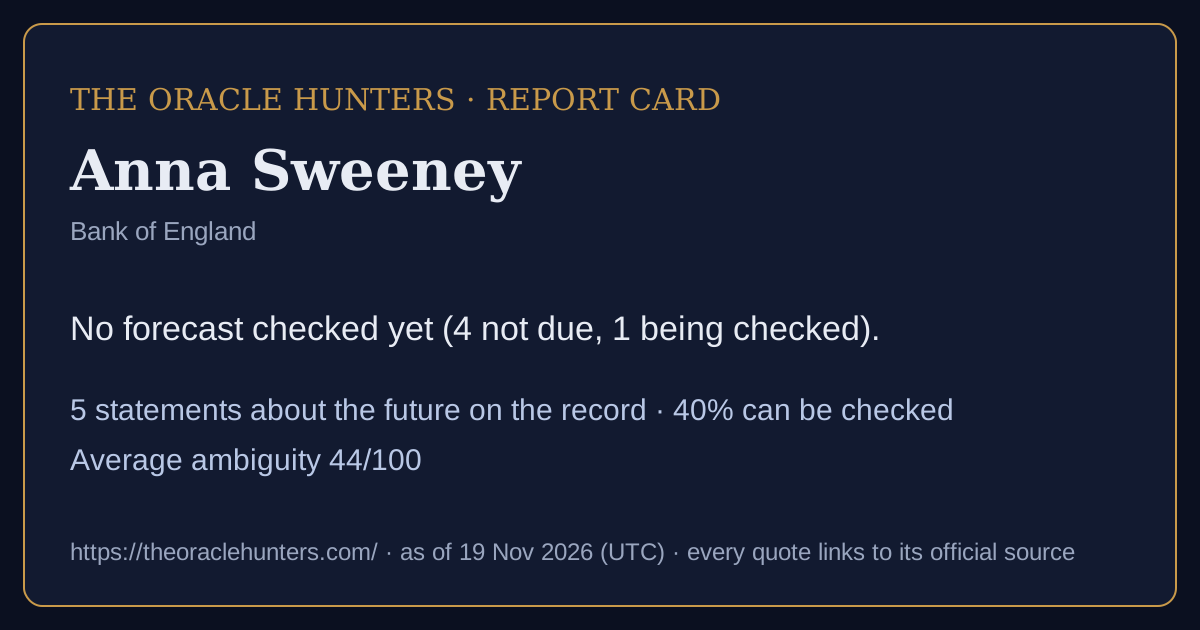
Track record: No forecast checked yet (4 not due, 1 being checked).
5forecasts & commitments on the record
40%can be checked as stated
44average ambiguity (0-100)
0goalpost moves recorded
0confirmed U-turns
Timeline
came true partly did not not due / being checked / too vague
Calibration score: shown after 10 checked forecasts with a stated likelihood (now 0).
How they speak about the future: based on data 5.
Kinds of claim: mixed claim 2, forecast 2, scenario (if… then) 1. · Download this report card as a picture
In the nine words
How to read this
Each box is one sentence a public figure or institution said about the future, word for word, with a link to the official text. Can be checked means it names what will happen, by when, and how likely - so it can be compared with official figures later. Too vague to check means it does not. Ambiguity (0-100) is how many different ways the sentence can be read. When the date passes, the forecast is compared with official data and marked came true, partly or did not come true. Labels judge the sentence, never the person. Full guide and glossary.On the record (5)
And we should expect the aggregate impact of individual firms' decisions in a sector that at the end of 2019 held assets in the region of £2 trillion - a figure broadly equivalent to UK GDP in the same year - to be an important influence on speed of recovery and adaptation.
To put this into numbers, if today's UK flood 100 year event industry loss is in the order of £7bn; then in the future, that figure might more than double.
(2020). 'we estimate that the direct effect of the pandemic-driven response will be negligible, with a cooling of around 0.01 ± 0.005 °C by 2030 compared to a baseline scenario that follows current national policies.'
The Government has already announced its intention for the UK to produce net zero CO2 emissions by 2050 and that will require considerable changes to the way we currently work and live.
Moreover, the UN climate conference, COP26 (Conference of the Parties), is due to take place between 1 and 12 November 2021 in Glasgow, in partnership with Italy. 5 As hosts, the UK will continue to work with our Italian partners to increase climate action, build resilience and lower emissions.
Also said - not checkable as stated (12 newest)
Remarks about the future with no date, figure or likelihood that could be checked. They are kept on the record and shown here, but not scored.
And they have to hold reserves not only to meet their likely commitments, but to allow the business to be transferred to a third party.
And these mechanisms are all linked: if the capital and reserves firms hold are not adequate, the FSCS backstop needs to be used, the residual cost of which is paid for by surviving firms who in turn may pass the cost to their policyholders or shareholders.
To the extent that there might be some wider benefits to reduced levels of protection, we would need to weigh these carefully against the costs to policyholders and the wider economy - especially when considered over the long terms for which many insurance promises persist.
We will be asking for high-quality data from a wide range of firms covering different parts of the framework, and in a relatively short period of time - three months or so.
So through the QIS we will be gathering data around how the MA could be calculated, so that we can be sure that the reformed MA provides adequate protection given the wide range of assets annuity writers hold.
In preparation for the QIS, we will shortly be releasing an information request to firms which use the MA.
The less confident we are that the firm can exit in an orderly way, the more remote we need to make the prospect of failure and the larger the cushion of financial resources we will need to see at the point of intervention.
Arguments about the level of capital need to be rooted in these factors: it is not enough to assert that, if only we didn't have to hold so much capital, our policies could be so much cheaper, we could supply so many more of them, and we could expand our investments.
The ladder of intervention is critical to preventing gambling for resurrection: it formalizes and defines the power to intervene before the interests of shareholders and policyholders diverge, in the same way that debt covenants protect creditors by giving them the ability to intervene in clearly defined circumstances under which their interests will diverge from those of the providers of equity …
So if a protection gap were to emerge through the reactions of insurers and insured to what they have learned about contract uncertainty, we should worry about the wider impact that that might have on economic recovery.
We expect the calibration of the framework will need to be more granular than it currently is and will need the flexibility to respond prudently when firms expand into further new asset classes with novel risk characteristics.
Firms should take early steps to assess what this could mean for their current business models.