Anna Seim
Sveriges Riksbank
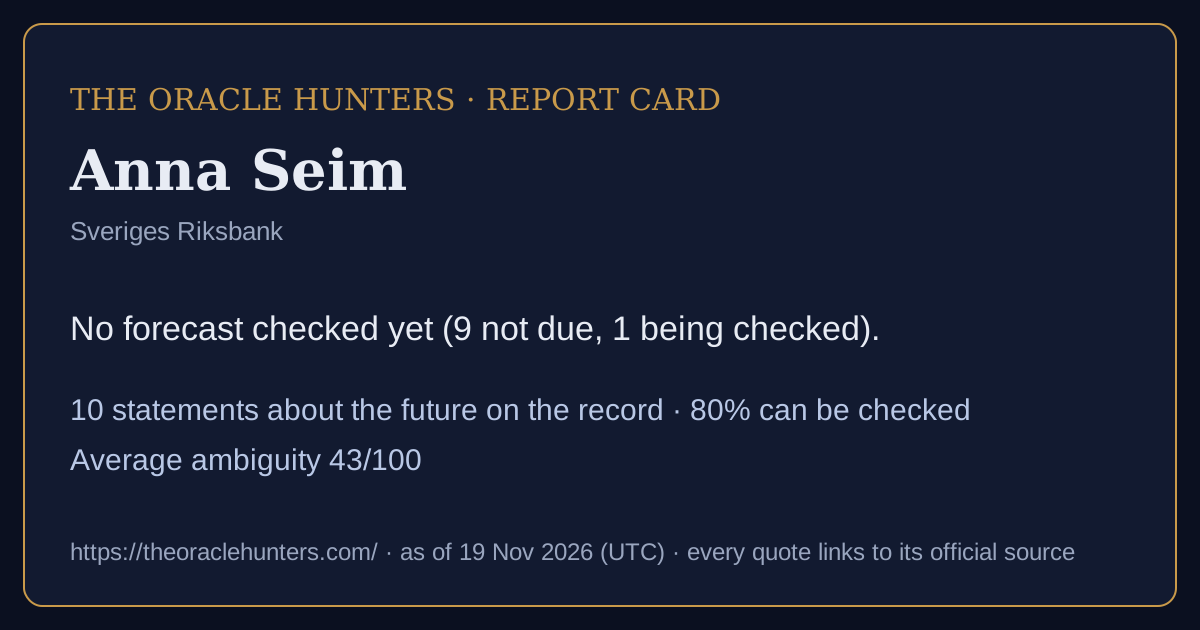
Track record: No forecast checked yet (9 not due, 1 being checked).
10forecasts & commitments on the record
80%can be checked as stated
43average ambiguity (0-100)
0goalpost moves recorded
0confirmed U-turns
Timeline
came true partly did not not due / being checked / too vague
Calibration score: shown after 10 checked forecasts with a stated likelihood (now 0).
How they speak about the future: based on data 5, educated guess 4, stated on authority 1.
Kinds of claim: scenario (if… then) 5, forecast 3, mixed claim 1, commitment 1. · Download this report card as a picture
In the nine words
πρόνοιαPreparing for the future5 · 50%πρόγνωσιςInference from evidence4 · 40%προαναγγελίαPublic pre-announcement1 · 10%
How to read this
Each box is one sentence a public figure or institution said about the future, word for word, with a link to the official text. Can be checked means it names what will happen, by when, and how likely - so it can be compared with official figures later. Too vague to check means it does not. Ambiguity (0-100) is how many different ways the sentence can be read. When the date passes, the forecast is compared with official data and marked came true, partly or did not come true. Labels judge the sentence, never the person. Full guide and glossary.On the record (10)
Many private banks issued their own banknotes, but their value depended, in principle, on the extent to which people trusted the bank backing them. 25 26 A banknote from a stable bank could be accepted at face value, whilst a banknote from an unreliable bank could be traded at a discount, as it risked becoming worthless if the bank went …
But if prices rise rapidly because the banks have lent out large amounts of money, well, then one could actually say that the money is, to some extent, created out of thin air -or rather, turns into thin air -as it merely leads to higher prices and erodes purchasing power.
If we manage to keep prices stable, there will be no major problems if the banks increase their lending.
This means that if the central bank increases its lending, deposits will increase by the same amount.
We shall contribute to a well-functioning economy by ensuring that inflation -the general rate of increase in prices in the economy -remains low and stable, that the financial system is stable and efficient, and that payments can be made both in normal times and during crises and periods of heightened alert.
If the policy rate is higher than the neutral rate, the effect is instead tightening, i.e. demand will be low, as will inflation.
Based on our analysis, we assess that the long-term neutral interest rate, and thus the long-term normal policy rate, is probably between 1.5 and 3 per cent.
In an article in the Monetary Policy Report in February 2017, the Riksbank assessed that the repo rate, the then equivalent of the current policy rate, could be expected to be between 2.5 and 4 per cent in the long term. 19 This assessment thus refers to the long-term definition of the neutral interest rate, the trend in Figure 1.
Analysis presented in the March Monetary Policy Report this year suggests that the structural factors that had caused the neutral interest rate to fall have not changed significantly in recent years and that any changes in the neutral interest rate are likely to be small, relative to the trend decline that has already taken place. 20
If the policy rate is normally somewhere between 1.5 and 3 per cent, one cannot rule out the possibility that it may need to be reduced to zero or even negative levels again.
Also said - not checkable as stated (12 newest)
Remarks about the future with no date, figure or likelihood that could be checked. They are kept on the record and shown here, but not scored.
What the future of payments might and should look like is an important and complex issue that we will have to save for another seminar.
consider two investments that are deemed equally liquid and equally risky, the theory of interest rate parity states that if interest rates are lower in Sweden than in the United States, an investor must expect an appreciation of the krona to be indifferent to the choice of investing in a Swedish or in a US asset.
In the long run, the krona will therefore have to weaken if parity is to be restored.
2 See the article in the Monetary Policy Report September 2023, 'The krona will strengthen in the medium term'.
The solid line represents outcomes and the dashed line represents the Riksbank's forecast from the September Monetary Policy Report.
The interest rate parity condition is not entirely intuitive as it states that a higher interest rate in Sweden is consistent with an expected depreciation of the krona.
Sveriges Riksbank (2023), 'The krona will strengthen in the medium term', article in Monetary Policy Report, September 2023.
To this end, we aim to convey the Executive Board's reaction function by publishing (i) a policy rate forecast (since 2007), (ii) alternative scenarios capturing perceived risks and how monetary policy will respond to different developments, and (iii) attributed minutes shortly after each policy decision. 2
In my remarks today, I will briefly comment on our policy rate path but focus on our work with alternative scenarios in the Monetary Policy Report.
We are one of few central banks publishing a forecast for the policy rate that reflects the majority view of the Executive Board.
Since the only thing we can be sure of is that the future will not unfold as we expect, we complement the policy rate path with alternative scenarios.
Each scenario produces a path of monetary policy that signals that this is how we are likely to react if the events described would occur.