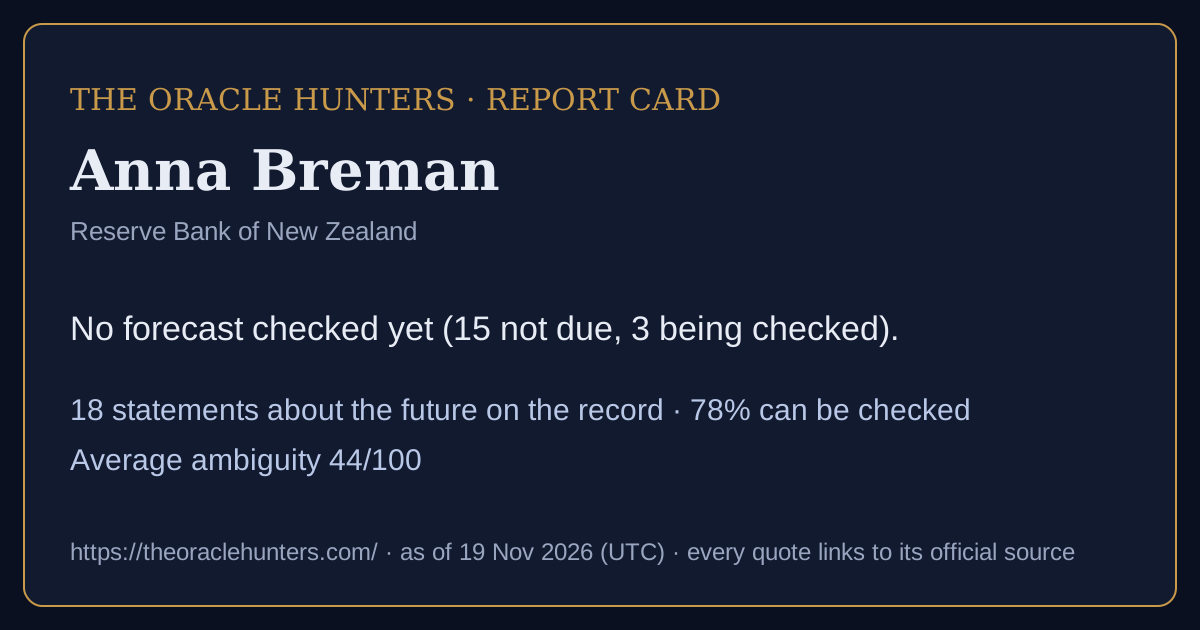
Anna Breman
Reserve Bank of New Zealand
Track record: No forecast checked yet (15 not due, 3 being checked).
18forecasts & commitments on the record
78%can be checked as stated
44average ambiguity (0-100)
0goalpost moves recorded
0confirmed U-turns
Timeline
came true partly did not not due / being checked / too vague
Calibration score: shown after 10 checked forecasts with a stated likelihood (now 0).
How they speak about the future: based on data 12, educated guess 4, stated on authority 2.
Kinds of claim: forecast 11, scenario (if… then) 4, mixed claim 2, commitment 1. · Download this report card as a picture
In the nine words
πρόγνωσιςInference from evidence12 · 67%πρόνοιαPreparing for the future4 · 22%μαντείαInspired knowledge1 · 6%προαναγγελίαPublic pre-announcement1 · 6%
How to read this
Each box is one sentence a public figure or institution said about the future, word for word, with a link to the official text. Can be checked means it names what will happen, by when, and how likely - so it can be compared with official figures later. Too vague to check means it does not. Ambiguity (0-100) is how many different ways the sentence can be read. When the date passes, the forecast is compared with official data and marked came true, partly or did not come true. Labels judge the sentence, never the person. Full guide and glossary.On the record (18)
We would need tighter monetary policy to make sure inflation expectations remained well-anchored at 2 percent, and that inflation remains within our target band of 1 to 3 percent over the medium term.
If there are effects on medium-term inflation or inflation expectations, the appropriate policy response could be to increase interest rates to prevent these second round effects.
Our primary mandate is to keep future annual inflation between 1 and 3 percent over the medium term.
On monetary policy, we have the tools to ensure that inflation remains at our 2 percent target midpoint over the medium term.
The conflict in the Middle East will mean higher near-term inflation in New Zealand -primarily through higher petrol and diesel prices, which make up about 4 percent of our Consumers Price Index (CPI).
For monetary policy, it is essential that we understand the net impact on inflation and growth over the coming months from disruptions coming through these channels.
It is, however, difficult to assess causality as market participants react in advance of a monetary policy meeting, often anticipating when a rate hike or rate cut will be delivered, even if it was not fully forecasted in the policy rate path.
We did not see this scenario as particularly likely, but at the beginning of the year inflation still rose to just below 3 per cent. 11 At the time, some observers wondered whether we should not raise interest rates in line with this scenario.
There is also a risk, if trade barriers escalate, that this could lead to higher inflationary pressures in the medium term, also in Sweden.
Since May last year, the Riksbank has implemented six interest rate cuts totalling 1.75 percentage points.
The forecast indicates an unchanged policy rate going forward, but at the same time we are prepared to both raise and lower the policy rate if the outlook changes.
If one member leans towards the option of cutting the policy rate by 0.25 percentage points, but all other members prefer an unchanged rate, conformity may cause the member to also vote in favour of an unchanged rate - against their own convictions.
If prices and wages rose too much in relation to the rest of the world, it was expected that problems with cost crises and rising unemployment would be solved by writing down the value of the krona, that is, through devaluation.
Within the forecast period, a 5 per cent policy rate is unlikely, but I hope that this brief historical review shows that we cannot exclude the possibility of a policy rate in line with historical averages over the next 30 years.
After a second crisis package at the end of the month, the interest rate could be cut further, to 24 per cent.
I studied the science programme at upper secondary school and thought I was good at maths, and an interest rate of 500% was something no one could pay.
The policy rate path indicates that the policy rate will be raised to slightly over 2 per cent in early 2023.
The policy-rate path was also left unchanged and indicates that the rate will remain at zero per cent for the whole of 2020 and 2021.
Also said - not checkable as stated (12 newest)
Remarks about the future with no date, figure or likelihood that could be checked. They are kept on the record and shown here, but not scored.
But there are nevertheless good reasons to be prepared for the fact that monetary policy may need to be conducted and communicated in a politically and economically more uncertain world in the future.
Whether the names of the members should appear in the monetary policy minutes is probably a choice that the central bank can often make itself.
A high degree of transparency means showing forecasts that may need to be substantially revised later on, and exposing nuances across committee members that may be seen as division within a committee.
3 In a recommendation to the Federal Reserve, Ben Bernanke (2025) suggests that the Fed should start publishing a quarterly Economic Review, forecasting key macro variables, including the policy rate.
It is likely that we will continue to receive conflicting statements from the United States on economic policy, not least with regard to their trade policy.
We will have more information about the economic outlook ahead of the next monetary policy meeting, including one further month of inflation outcome.
But monetary policy must act if there is a risk of inflation lastingly overshooting or undershooting the target.
But, we should have taken better account of the special circumstances that prevailed after the pandemic, just as we always need to recognise that, going forward, historical correlations will not always be a good guide in a changing world. 18 These are examples of the lessons learnt from the pandemic, a topic extensively discussed at the Executive Board.
We should have changed the policy rate path to reflect the changed risks to the inflation outlook.
To achieve price stability, we need to understand climate-related risks in order to make accurate forecasts going forward.
Groupthink could arise from the committee becoming very close-knit, ignoring dissenting views both inside and outside the central bank.
There was also uncertainty about how long the pandemic would last, and if and when any vaccines might become available.