Anna Bjerde
World Bank Group
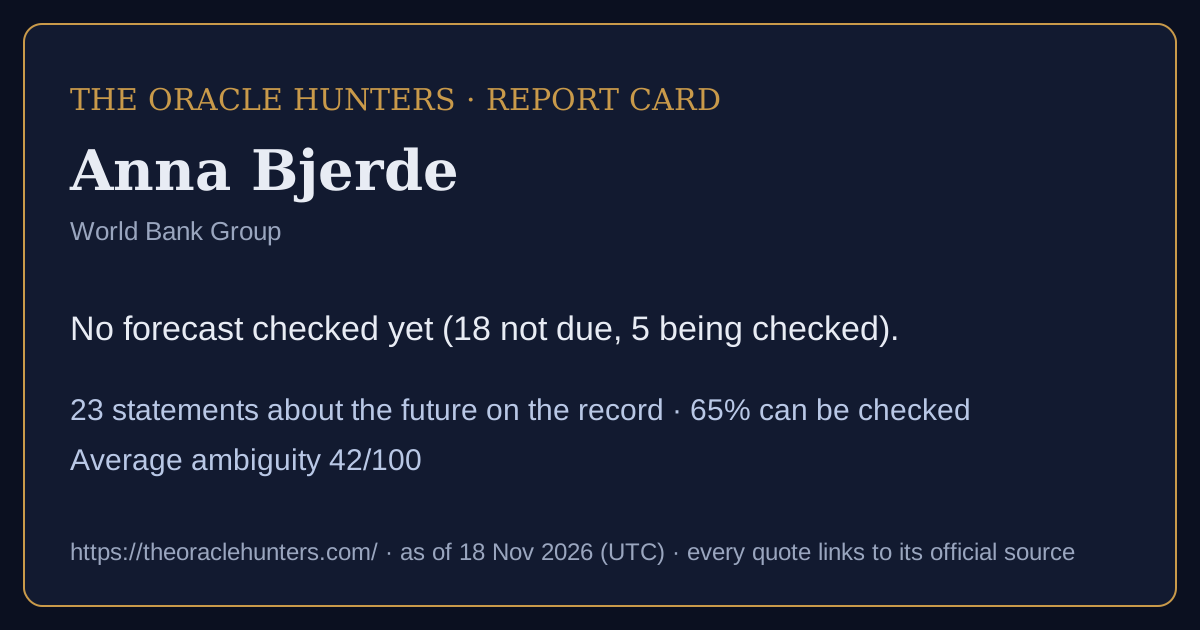
Track record: No forecast checked yet (18 not due, 5 being checked).
23forecasts & commitments on the record
65%can be checked as stated
42average ambiguity (0-100)
0goalpost moves recorded
0confirmed U-turns
Timeline
came true partly did not not due / being checked / too vague
Calibration score: shown after 10 checked forecasts with a stated likelihood (now 0).
How they speak about the future: based on data 20, stated on authority 3.
Kinds of claim: forecast 17, commitment 3, mixed claim 2, scenario (if… then) 1. · Download this report card as a picture
In the nine words
πρόγνωσιςInference from evidence18 · 78%προαναγγελίαPublic pre-announcement3 · 13%πρόνοιαPreparing for the future1 · 4%μαντείαInspired knowledge1 · 4%
How to read this
Each box is one sentence a public figure or institution said about the future, word for word, with a link to the official text. Can be checked means it names what will happen, by when, and how likely - so it can be compared with official figures later. Too vague to check means it does not. Ambiguity (0-100) is how many different ways the sentence can be read. When the date passes, the forecast is compared with official data and marked came true, partly or did not come true. Labels judge the sentence, never the person. Full guide and glossary.On the record (23)
For example, East Asia’s Regional Comprehensive Economic Partnership could boost trade among its members by as much as 12%.
In developing economies alone, 1.2 billion young people will enter the workforce by 2035, but current trends suggest only 400 million jobs will be created.
Growth will barely reach 2.3 percent this year, the weakest in fifteen years outside of a crisis.
Expanding their participation could increase long-term GDP per capita by 22 percent.
Global growth is projected to fall to 2.3 percent in 2025, the slowest rate since 2008 apart from the COVID-19 pandemic.
On job-creating growth, we will explore how we support hard and soft infrastructure to enable private sector growth and job creation, keeping in mind the dispersed geography, small markets, and the need for healthy, affordable diets and food security.
We stand ready to work with partners to support Ukraine in unlocking the drivers of new sources of growth and advancing the reform agenda, including for a new and lasting social contract.
According to the latest Rapid Damage and Needs Assessment, Ukraine will require $524 billion over the next decade to recover and rebuild.
For example, we know that the destruction of the Kakhovka reservoir alone led to a 13% drop in irrigated land and a projected 36% decline in irrigated crop output.
It means that 22 million more people may be looking for jobs—and good jobs, too—every year over the next five years.
Studies show that if women were employed at the same rate as men, global income per capita could increase by nearly 20 percent over the long term.
As a matter of fact, Korea—set to host the APEC Summit next year—will be hosting IDA’s 21st final replenishment meeting in December.
Together with the Government, we are committed to expanding access to over 17 million unserved and underserved rural Nigerians through distributed renewable energy solutions.
We estimate that with about $30 billion in IDA support through 2030 (about $5 billion/year), the World Bank Group could faciliate access to about 300 million people by the end of the decade across Africa, including 100 million in Western and Central Africa.
Yet, despite significant investments and progress, at the current pace, close to 600 million Africans are likely to remain without electricity by 2030 with two-third of these living in countries currently classified as fragile and conflict-affected.
In the coming months, there is an opportunity discuss and design tax reforms that can: Contribute to closing the fiscal gap during the war, and Enable a more efficient, equitable and competitive tax system to support post-war growth.
Since then, at the World Bank, we have invested over US$13 billion in more than 70 projects across key sectors such as health, education, urban, environment, water supply, transport, energy and agriculture.
This means another $30 billion will be needed between now and December, if the war lasts that long.
Finally, depending on how long the war lasts, we estimate that poverty—the percentage of people living below the subsistence level—could rise from 18 percent in 2020 to more than 70 percent by the end of this year.
In June, the World Bank published its global economic outlook where we estimated the global economy would expand by 5.6 percent in 2021.
Our initial projection in the World Bank, for example, was that the economy would contract by nearly 8 percent in 2020; the actual decline was half that.
We know from our work that a child born in Ukraine today will be only 63 percent as productive when she grows up as she would be if she enjoyed complete education and full health.
Transfers going to the poorest one-fifth of the population are rising significantly—from just 37 percent in 2019 to 50 percent this year and are projected to reach 55 percent in 2023.
Also said - not checkable as stated (12 newest)
Remarks about the future with no date, figure or likelihood that could be checked. They are kept on the record and shown here, but not scored.
We need to strengthen local businesses so they can compete, which will unlock jobs where people actually live.
That combination could mean millions of new jobs in services, manufacturing, and creative industries.
From September 1, 2025, companies working on World Bank-funded projects must include a minimum total cost for local labor in international civil works contracts.
And we will help bring others—partners, financiers, and the private sector—alongside you.
This project, which supports the Pacific Islands Forum’s Regional Trade Facilitation Strategy, will reduce the time required for trading and increase the number of firms benefiting from improved trade facilitation by simplifying customs procedures and reducing red tape.
We are working across the World Bank Group—including the International Finance Corporation (IFC) and the Multilateral Investment Guarantee Agency (MIGA)—to mobilize private capital, as it is the private sector that will fuel the recovery.
Second, the war has led to substantial macroeconomic imbalances, particularly large fiscal deficits, and closing them will be difficult.
It will be challenging for Ukraine to do this alone.
And lastly, the need to move away from Ukraine’s old, undynamic economic model of a large shadow economy and heavy state footprint.
Let me highlight three specific ways in which we stand to support Ukraine in this pivotal sector: First, we will help provide analytical and advisory services to support informed policy choices.
Second, we will help build institutions and capacities.
Third, we will help support investments—both public and private—that accelerate alignment with EU standards and strengthen resilience.