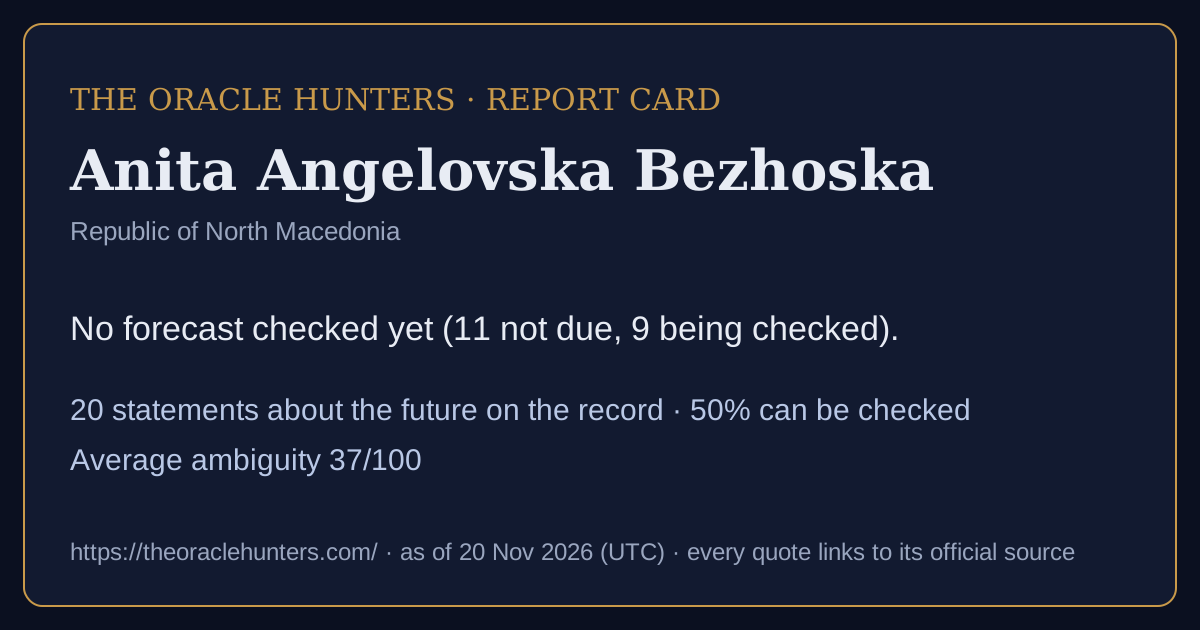
Anita Angelovska Bezhoska
Republic of North Macedonia
Track record: No forecast checked yet (11 not due, 9 being checked).
20forecasts & commitments on the record
50%can be checked as stated
37average ambiguity (0-100)
0goalpost moves recorded
0confirmed U-turns
Timeline
came true partly did not not due / being checked / too vague
Calibration score: shown after 10 checked forecasts with a stated likelihood (now 0).
How they speak about the future: based on data 14, stated on authority 5, educated guess 1.
Kinds of claim: forecast 18, commitment 1, scenario (if… then) 1. · Download this report card as a picture
In the nine words
πρόγνωσιςInference from evidence14 · 70%μαντείαInspired knowledge4 · 20%πρόνοιαPreparing for the future1 · 5%προαναγγελίαPublic pre-announcement1 · 5%
How to read this
Each box is one sentence a public figure or institution said about the future, word for word, with a link to the official text. Can be checked means it names what will happen, by when, and how likely - so it can be compared with official figures later. Too vague to check means it does not. Ambiguity (0-100) is how many different ways the sentence can be read. When the date passes, the forecast is compared with official data and marked came true, partly or did not come true. Labels judge the sentence, never the person. Full guide and glossary.On the record (20)
Some estimates show that this initiative, through increased harmonization, could add 10% to the GDP of the economies in the region . 5
In fact, a Common Regional Market initiative is one of the key pillars of the Growth Plan and is expected to be a catalyst for the deeper integration of 18 million people.
It is a fact that the potential growth of the EU economy has declined as well, but less than ours (2.9% to 1.8%), pointing that future convergence may be even more challenging.
The banking sector is expected to work diligently to ensure full readiness for integration with SEPA payment systems by October 2025, determined as SEPA first possible entrance date for payment service providers from the Western Balkan countries being SEPA members.
Interest rate risk may be even more relevant for companies as they mostly borrow at a relatively short maturity and with floating interest rates. shows that in IMF analysis 4 emerging economies, the (debt of companies with interest coverage ratio debt at risk <4) has increased to for the large firms and 70-80% for the SMEs.
And that is not all, as medium-term forecasts point to a further slowing down of the growth dynamics, which is expected to remain well below the historical average of the two decades preceding the pandemic (3.8%).
We are facing with decelerating growth and probably long-term growth potential, on the one hand, and surging inflation, on the other, which although on a downward trajectory, is projected to remain above target in about 90% of the economies with inflation targeting even next year .
One of the contributing institutions is certainly the Green for Growth Fund 6 , which has been present in our country ever since its inception, investing more than EUR 50 million so far, alongside 26 dedicated technical assistance projects for local financial institutions.
Although according to the recent EIB Surveys banks expected deterioration of credit quality, NPL ratios have remained low (below 4%).
As interest rates hikes are taking hold, with easing supply pressures and stabilizing commodities prices, forecasts indicate that inflation will soften this year, both in advanced and developing economies.
For example, the risk of financial disintermediation as households and businesses can chose between holding accounts with commercial banks or central bank, or the increased run risk in case of distress, as there will be readily available safe assets, hence endangering the financial and monetary stability.
A recent BIS survey of central banks found that 86% were actively researching the potential for CBDCs, 60% were experimenting with the technology and 14% were already deploying pilot projects.
could be maintained at a higher level next year, compared to the period before the COVID-19 crisis.
Unfortunately, the Western Balkan countries are not in this small group of countries, i.e. according to the IMF negative growth rates are expected in the region ranging from 2.5% in Serbia to 12% in Montenegro.
The project activities will be aimed to further improving of the quality of this statistics, especially given that its first release is scheduled for next year.
According to the research by PricewaterhouseCoopers , banks have very firmly moved from viewing open banking as a compliance exercise to an opportunity to compete, innovate, and deliver value and more than 33m people are expected to have signed up to open banking driven services by 2022.
Notwithstanding all the efforts, challenges remain ahead and we will continue to address them with an aim to increase the stability and resilience of the banking system, as the key pillar of the financial system and thus contribute to stronger, but sustainable financial support of the real sector.
We especially welcome the initiative for organizing the European Money Quiz for the youth of our country, which will be organized for the first time this year, hoping that it will become a traditional one.
I am glad to see you in greater numbers this year, which is confirmation of your interest in the topics that will be the focus of today's event.
This year's conference focuses on digital transformation , a process that is heavily penetrating across all segments of our business and private lives and will take even greater significance in the years to come.
Also said - not checkable as stated (12 newest)
Remarks about the future with no date, figure or likelihood that could be checked. They are kept on the record and shown here, but not scored.
Keynote address by Ms Anita Angelovska Bezhoska, Governor of the National Bank of the Republic of North Macedonia, at the Balkan Alumni Summit, Skopje, 27 May 2025.
We will continue to provide guidance, technical support, and regulatory oversight to ensure a smooth and efficient integration process.
Additionally, we will work closely with the international partners that are genuinely committed to address any challenges.
This simplification will lead to more efficient, cost-effective, and faster cross-border payments.
Individuals will benefit from reduced fees on cross-border payments, including for remittances.
By meeting this target, the economies could save approximately half a billion euros according to World Bank calculations." 5 Furthermore, SEPA membership will accelerate the digital transformation of our financial By reducing reliance on cash transactions and promoting digital payment sector. methods, it will support the development of a more modern, secure, resilient and financial ecosystem. inclusive
This also includes challenges in adequately calibrating or even redesigning macroeconomic policies that might have to deal with permanently changing economic relationships, implying that we might be entering a new world rather than returning to the old one.
Furthermore, these scenarios do not reflect the profound effects that deglobalisation and climate risks may have.
Still, there as transition to higher-for-longer interest rate is no room for complacency environment could certainly expose some vulnerabilities of the financial systems, and test their resilience again down the road.
Our green finance statistics show rising financial support, but also a need to strive further. , more than doubled for the last four years, and Banks' green loans their share in the overall portfolio increased to 4.1% in June this year.
It can therefore be expected that climate-related policies could have significant effects on these sectors and consequently on banks, though further analysis is needed to assess the relevance and materiality of the transition risks.
This is related to the geographical and climatic profile of the country, which exposes the country to the risks of natural disasters and extreme weather events (such as droughts, torrential rains, floods, and heat waves), which, driven by climate change, may further intensify in the next period.