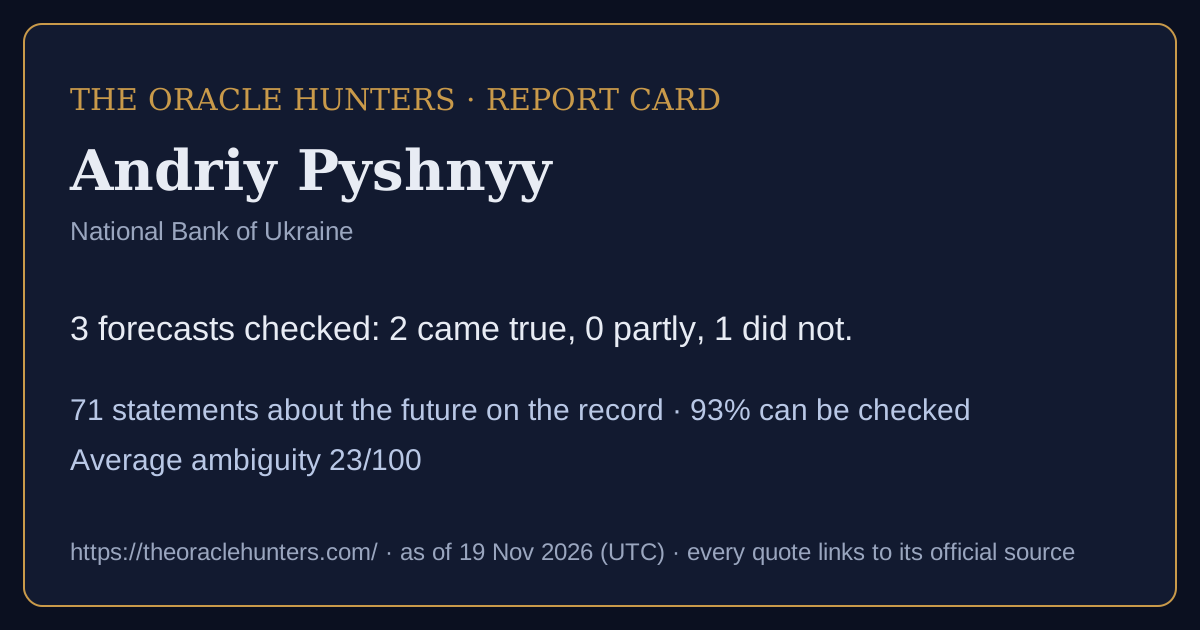
Andriy Pyshnyy
National Bank of Ukraine
Track record: 3 forecasts checked: 2 came true, 0 partly, 1 did not.
71forecasts & commitments on the record
93%can be checked as stated
23average ambiguity (0-100)
0goalpost moves recorded
0confirmed U-turns
Timeline
came true partly did not not due / being checked / too vague
Calibration score: shown after 10 checked forecasts with a stated likelihood (now 2).
How they speak about the future: based on data 57, stated on authority 10, educated guess 4.
Kinds of claim: forecast 64, scenario (if… then) 4, commitment 2, mixed claim 1. · Download this report card as a picture
In the nine words
πρόγνωσιςInference from evidence56 · 79%μαντείαInspired knowledge8 · 11%πρόνοιαPreparing for the future4 · 6%προαναγγελίαPublic pre-announcement2 · 3%φρόνησιςPractical wisdom1 · 1%
How to read this
Each box is one sentence a public figure or institution said about the future, word for word, with a link to the official text. Can be checked means it names what will happen, by when, and how likely - so it can be compared with official figures later. Too vague to check means it does not. Ambiguity (0-100) is how many different ways the sentence can be read. When the date passes, the forecast is compared with official data and marked came true, partly or did not come true. Labels judge the sentence, never the person. Full guide and glossary.Checked
Taking this into consideration, the NBU forecasts real GDP growth at 3.5% in 2024 and 6.8% in 2025.
Came true. Said: economic growth around 3.5% in 2024. Official figure for Ukraine: 3.2% (World Bank open data). On target. Off by 0.2 points. official data · checked 14 Nov 2026 · automatic check against official data (rules v3)
The disinflation trend will continue in the coming years: inflation will decline to 8.5% in 2024 and to 6% in 2025.
Did not come true. Said: inflation around 8.5% in 2024. Official figure for Ukraine: 6.5% (World Bank open data). Missed. Off by 2.0 points. official data · checked 14 Nov 2026 · automatic check against official data (rules v3)
Already this year, the economy will return to growth, which will accelerate in the coming years on the back of a decrease in security risks assumed by the forecast
Came true. Said: economic growth would rise in 2023. Official figures for Ukraine: -28.8% in 2022, 5.5% in 2023 (World Bank open data). official data · checked 14 Nov 2026 · automatic check against official data (rules v3)
On the record (71)
The NBU forecast envisages maintaining the key policy rate at the current level until Q2 2027.
Inflation will return to a decline in 2027 as effects of higher fuel prices wane and thanks to the NBU's monetary policy measures
In 2028, economic growth will speed up to 2.2% as security risks subside.
If the NBU’s technical assumption about the improvement in logistics in mid-2027 materializes, real GDP may grow by 0.4% next year.
As before, inflation is expected to return to the 5% target in 2028.
Inflation will slow to 7.3% yoy in 2027.
Second, the inflow of part of the foreign exchange into international reserves will increase them to nearly USD 70 billion by the end of the year.
The forecast envisages further acceleration to 10% and 9.2%, respectively, by the end of 2026.
### Inflation will accelerate during H2 2026, but will return to a downward trajectory in 2027, including as a result of the NBU's measures
The Board of the National Bank of Ukraine has decided to raise the key policy rate to 15.5% in view of the persistent heightening of underlying inflationary pressures and a more significant acceleration of headline inflation by the end of the year.
In 2027-2028, economic growth will accelerate to around 3%, driven by increased investment in expanding production capacity, particularly in the defense industrial base, the gradual stabilization of the energy sector, as well as further increases in harvests and the preservation of robust consumer demand.
According to the NBU's forecast, inflation will begin to decline in 2027 (to 6.9%) and will reach the 5% target by the end of 2028.
If significant inflationary risks persists, the NBU will refrain from interest rate policy easing.
If risks to price dynamics persist, the NBU will refrain from easing its interest rate policy further.
As a result, the inflation trajectory in the coming months is highly likely to be somewhat above the NBU's January forecast.
This decision will support the attractiveness of hryvnia instruments, the sustainability of the FX market, and the controllability of expectations in order to ensure moderate inflation this year and bring it to its 5% target over the policy horizon.
If inflationary risks persist or intensify, particularly due to uncertainty regarding external financing, the NBU will be ready to refrain from easing its interest rate policy, and take additional measures if necessary.
The NBU's decision to keep the key policy rate unchanged in December will support these trends, while also contributing to the further decline in inflation to its 5% target over the policy horizon.
By the end of the year, another USD 5 billion is expected to arrive.
Inflation is expected to slow gradually in the coming months.
Core inflation decelerated as well, to 11.4% yoy, which was close to the forecast.
This will enable the central bank to further maintain proper monetary conditions necessary for sustainability of the FX market and controllability of expectations, as well as for bringing inflation to the 5% target.
The baseline scenario of the NBU's macroeconomic forecast envisages receiving USD 35 billion in international assistance in 2026 and USD 30 billion in 2027.
The baseline scenario of the NBU's forecast envisages that the economy will gradually return to normal functioning and the economy will grow by 2%-3% in 2026-2027.
## Inflation will decline significantly by the end of this year, and it is expected to be brought to the target in 2027
Expected volumes of international support will be sufficient to finance the budget deficit without resorting to monetary financing, and to maintain the appropriate level of international reserves (USD 45 billion in 2026-2027, according to the NBU's forecast).
As for the remaining USD 30 billion, the largest inflows are expected under ERA Loans (USD 18 billion until the end of the year) and Ukraine Facility (USD 8 billion).
Inflation is expected to decelerate to 9.7% in 2025, 6.6% in 2026, and the 5% target in 2027.
In addition, if inflationary risks continue to rise, the NBU will not hesitate to tighten its interest rate policy further.
Inflation will decline to the 5% target over the policy horizon.
The NBU's measures will help bring inflation down to its 5% target over the policy horizon
These decisions aim to support the attractiveness of hryvnia savings, maintain the sustainability of the FX market, and keep inflation expectations in check, which will allow bringing back the steady disinflation trajectory toward the 5% target.
Inflation will rise in the coming months due to continued effects of last year's lower harvests and increases in businesses' production costs.
This year, the significance of international support and the consolidation of efforts will not diminish; it will only intensify.
We are returning to normality, and I remain hopeful that we will continue on this path, despite the ongoing war.
In 2025, it will return to its target range, slowing to 5.8% as of the end of the year.
## Despite the expected acceleration of inflation in 2024, it will remain moderate and will return to the target range in 2025
In 2025-2026, economic growth will accelerate to 4%-6% per year, thanks to a decline in security risks, which is the main assumption of the NBU's forecast, an improvement in consumer and investment sentiments, and the implementation of European integration reforms.
In 2026, inflation will meet the target of 5%.
Inflation is expected to reach 8.6% as of the end of the year.
Taking into account the balance of risks, the need to safeguard exchange rate sustainability and to maintain moderate inflation in 2024, which in 2025 will be brought to its target range, the NBU Board decided to keep its key policy rate and other interest rates on its operations unchanged
According to the IMF projections, global inflation is expected to decelerate to 6.9% in 2023 from 8.7% in 2022, further dropping to 5.8% in the following year.
The anticipation is that most central banks will achieve their inflation targets by 2025.
The NBU's new forecast is based on the assumption that security risks will decline considerably in mid-2024.
International assistance is expected to reach USD 42 billion as of the end of this year.
Taking this into consideration, the NBU forecasts real GDP growth at 3.5% in 2024 and 6.8% in 2025.
Came true. Said: economic growth around 3.5% in 2024. Official figure for Ukraine: 3.2% (World Bank open data). On target. Off by 0.2 points. official data · checked 14 Nov 2026 · automatic check against official data (rules v3)
In the coming years, economic growth will accelerate, based on the NBU's forecast assumption about a decline in security risks in mid-2024.
Considering the still high expenditures on defense, financing the budget deficit in 2024 will require no less than USD 37 billion.
The disinflation trend will continue in the coming years: inflation will decline to 8.5% in 2024 and to 6% in 2025.
Did not come true. Said: inflation around 8.5% in 2024. Official figure for Ukraine: 6.5% (World Bank open data). Missed. Off by 2.0 points. official data · checked 14 Nov 2026 · automatic check against official data (rules v3)
Inflation will decelerate to 14.8% in 2023 and will return to a single-digit level in the next years
Showing the newest 50 - the ledger has all 71.
Also said - not checkable as stated (12 newest)
Remarks about the future with no date, figure or likelihood that could be checked. They are kept on the record and shown here, but not scored.
### At the start of the year, inflation remained close to the NBU's forecast, but households' inflation expectations worsened
Prices for fuel, services, and raw foods grew somewhat faster than expected, whereas processed food prices rose more slowly.
Inflation is declining somewhat faster than the NBU forecast, but inflation expectations remain high.
Effects from the arrival of new harvests will contribute to a further decrease in growth rates of food prices.
Such decline in headline inflation was somewhat faster than the NBU had forecast.
Inflation is expected to continue declining.
The NBU's July macroeconomic forecast envisages the start of a key policy rate easing cycle in Q4 2025.
The National Bank will be closely monitoring the situation.
Thanks to the NBU's measures and the gradually waning effects of temporary drivers of price growth, inflation should return to the downward trajectory in H2 and decline to single digits at the end of the year.
I could tell a lot about the NBU's experience and our mandate at the times of war.
Even during the darkest and coldest winter days, people could conduct cash transactions or just charge their phones and find warmth in these bank branches.
Our POWER BANKING protocols comprehensively address these scenarios, and you will agree that they can happen anywhere.