Andrew Sentance
Bank of England
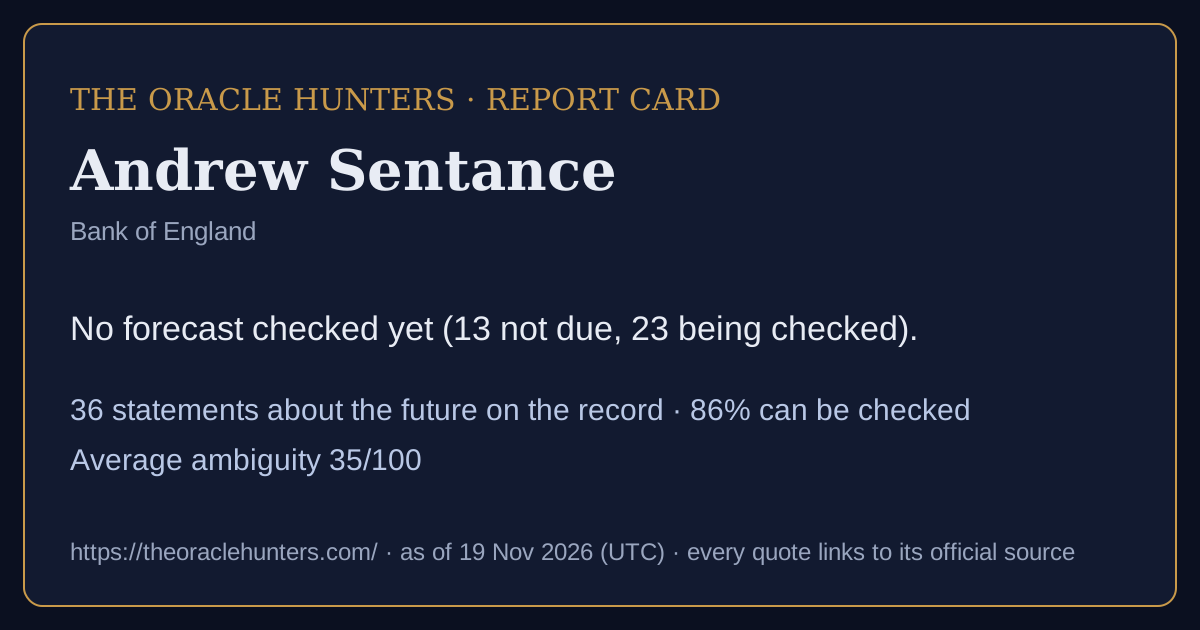
Track record: No forecast checked yet (13 not due, 23 being checked).
36forecasts & commitments on the record
86%can be checked as stated
35average ambiguity (0-100)
0goalpost moves recorded
0confirmed U-turns
Timeline
came true partly did not not due / being checked / too vague
Calibration score: shown after 10 checked forecasts with a stated likelihood (now 0).
How they speak about the future: based on data 31, stated on authority 3, educated guess 2.
Kinds of claim: forecast 29, mixed claim 7. · Download this report card as a picture
In the nine words
How to read this
Each box is one sentence a public figure or institution said about the future, word for word, with a link to the official text. Can be checked means it names what will happen, by when, and how likely - so it can be compared with official figures later. Too vague to check means it does not. Ambiguity (0-100) is how many different ways the sentence can be read. When the date passes, the forecast is compared with official data and marked came true, partly or did not come true. Labels judge the sentence, never the person. Full guide and glossary.On the record (36)
Chart 4 shows recent projections from the Asian Development Bank which point to the Asian share of world output rising to around 50% by 2050, much closer to its population share.
For example, in its recent World Economic Outlook, the IMF published an analysis suggesting that current trends in the oil market - with supply unable to keep up with strong demand - could lead to a further 200% rise in oil prices from current levels over the next 20 years. 5 Of course, there is great uncertainty around such predictions.
To achieve this will require average GDP growth rates for Asia of 5-6% in the next twenty years and 4-5% in the period 2030-2050.
That is what we appear to be seeing at the moment, with the historic relationship shown in Chart 6 suggesting that UK inflation could run 1 to 2 percentage points above euro area inflation for a considerable while unless there is some noticeable appreciation in the value of the pound.
According to the forecasts produced by the IMF and other major forecasting organisations, this relatively strong growth is set to continue through 2011 and 2012 and the Bank of England's own Inflation Report forecasts also reflect the pattern of continuing strong world growth.
Yet the current level of inflation is 4% and the most likely scenario is that it will rise further as we move through this year.
And as I prepare to leave the Committee at the end of next month, I do worry that the MPC's credibility and commitment to the inflation target may already have been eroded by not adjusting policy settings soon enough - as the challenge for monetary policy has shifted from preventing deflation to curbing inflation and from halting recession to managing …
But if the MPC waits until they are flashing red, and if other pressures continue to push up UK inflation in the meantime, the Committee could face a very difficult situation later this year or next.
For this reason, I would caution against putting too much weight on the initial estimate of GDP growth for the first quarter of this year which we will receive tomorrow.
As Chart 4 shows, the growth of the UK economy follows quite closely the trade-weighted average of our major trading partners and the IMF and other economic forecasters are projecting the continuation of relatively strong growth across the world economy this year and next.
With consumer price inflation remaining high, this pattern is likely to continue through this year.
We have heard the news today that CPI inflation has risen again - to 4.4% - and it could easily rise above 5% later this year.
The latest consensus forecast is for average earnings growth to pick up to 3% by 2012 from the current underlying rate of increase of 2.3%.
The latest CBI forecast, for example, predicts growth of 1.8% this year and 2.3% next year and these figures are very close to the current Consensus Forecasts of growth for this year and next - 1.9% in 2011 and 2.1% in 2012.
We would have to wait until April for the next quarter's GDP data, but even when this arrives it will be a very provisional estimate.
13 For example, the average forecast for 1994 real GDP growth made by the Treasury 'Panel of Wise Men' in October 1993 was 2.7%, over 1.5% below the out-turn of 4.3%.
Public borrowing fell by over 8 percentage points of GDP between 1993/4 and 1998/9, compared with a 9 percentage point fall projected over the next five years in the coalition government 2010 Budget. 10
There are significant upside risks to the forecast recently published in the Bank's Inflation Report which could sustain the period of above-target inflation into 2012 and 2013.
It is also not consistent with the forecasts made throughout last year by the MPC which suggested that inflation would we below 2% by now (see Chart 6) and would continue below target through 2011.
The global economy has bounced back strongly, with the IMF now projecting world growth of 4.8% this year and 4.2% next year.
Instead, the Governor has had to write four letters this year to explain why inflation is over 3%, and he may well have to write another four next year as well, as the latest Inflation Report forecast suggests that inflation is set to rise further in the early part of next year and not be back close to the 2% …
4 The IMF World Economic Outlook forecast projected world GDP growth of 1.9% in April 2009.
And it is possible that another one is in prospect when higher VAT comes into effect early next year, particularly if this is accompanied by a continuation of the recent surge in energy and commodity prices.
Using the broadest measure, Total Management Expenditure - which captures all areas of public spending, the Budget projects an average spending increase of 1.7% per annum in the five years to 2015/16.
Should inflation remain at around the 2% level over the next five years, that would imply that government spending in aggregate is likely to be broadly flat in real terms.
Though the IMF expects growth to slip back to 4.2% in 2011, this is still above the average global growth rate in the 2000s prior to the recession.
According to the IMF, global growth this year is now projected to be nearly 5%, compared to a projected growth rate of less than 2% just eighteen months ago. 4 As Chart 4 shows, this is a return to the strong growth rates seen in the mid-2000s, which was regarded at the time as a period of robust growth across …
At the equivalent stage of the cycle following the previous two recessions, unemployment was already over 10% of the labour force. 5 The evidence from the Bank of England's Agents and recent employment surveys is that the labour market in the UK has stabilised and that labour demand in the private sector may have already started to pick up.
4 The current IMF forecast of world GDP growth of 4.6% in 2010 compares with their April 2009 forecast of 1.9%.
Chart 1: Improving growth outlook for 2010 Percentage increase in GDP projected by Consensus Forecasts
The latest IMF projections are now for world growth of 4.6% in 2010 and 4.3% in 2011.
The central projection in both Inflation Reports we produced last summer suggested inflation would fall to around 1% or just above in the first half of 2011 and to struggle to return to the target after that.
The US economy is now projected to grow by over 3% this year, and GDP in Japan is also projected to rise at a similar rate - very strong by comparison with its recent poor growth performance.
As Chart 4 shows, forecasts for growth this year and next in the major Asian markets - and in developing and emerging market economies as a whole - are for a continuation of the healthy growth rates seen in these economies throughout the past decade.
That should give us grounds for encouragement that continued growth in the global economy will provide a supportive backdrop for recovery in the UK - even if some of our important markets, such as the economies of the euro area, may be turning around more slowly.
For example, the IMF forecast of GDP growth across the world economy this year has risen from 1.9% in April 2009 to 3.9% in its latest World Economic Outlook (January 2010).
Also said - not checkable as stated (6 newest)
Remarks about the future with no date, figure or likelihood that could be checked. They are kept on the record and shown here, but not scored.
As a result, economies which are very open to international trade and business like the UK are likely to have to live with more economic volatility than we would ideally like. 6
One reaction to my analysis could be that we have to accept a lot more volatility in growth and inflation, and simply grin and bear it.
And even though monetary policy will affect the growth of the economy in the short-term, the overall objective for UK monetary policy is and should remain price stability.
But to ensure sustainable public finances over the medium-term, these budget gaps will need to be closed over the recovery.
And in the absence of further shocks to the global economic system, we should expect confidence among firms and households to continue to recover, supporting the growth of private sector spending and helping the recovery to build momentum.
In my view this is not a flash in the pan, but a structural feature of the world economy that we are now living in, and we should expect a continuing impetus to global growth from this direction.