Andrew Hauser
Reserve Bank of Australia
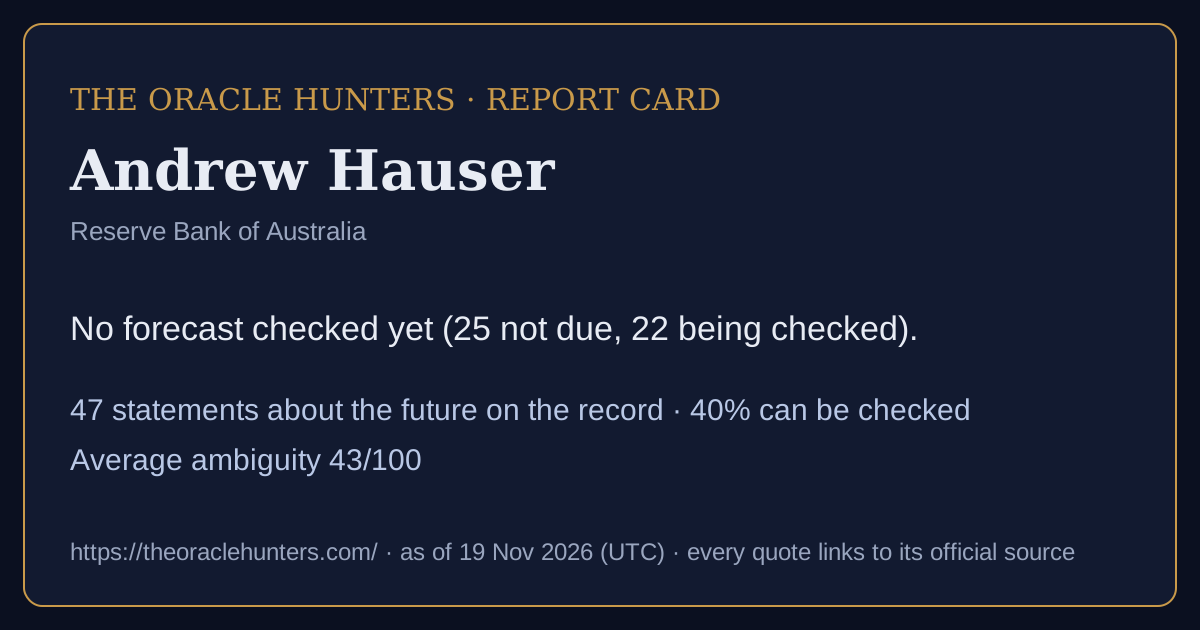
Track record: No forecast checked yet (25 not due, 22 being checked).
47forecasts & commitments on the record
40%can be checked as stated
43average ambiguity (0-100)
0goalpost moves recorded
0confirmed U-turns
Timeline
came true partly did not not due / being checked / too vague
Calibration score: shown after 10 checked forecasts with a stated likelihood (now 0).
How they speak about the future: based on data 36, stated on authority 7, educated guess 4.
Kinds of claim: forecast 36, scenario (if… then) 5, mixed claim 5, commitment 1. · Download this report card as a picture
In the nine words
πρόγνωσιςInference from evidence34 · 72%μαντείαInspired knowledge7 · 15%πρόνοιαPreparing for the future5 · 11%προαναγγελίαPublic pre-announcement1 · 2%
How to read this
Each box is one sentence a public figure or institution said about the future, word for word, with a link to the official text. Can be checked means it names what will happen, by when, and how likely - so it can be compared with official figures later. Too vague to check means it does not. Ambiguity (0-100) is how many different ways the sentence can be read. When the date passes, the forecast is compared with official data and marked came true, partly or did not come true. Labels judge the sentence, never the person. Full guide and glossary.On the record (47)
Indeed, Robert Lucas and Thomas Sargent went on to argue that might hold even in the short run if expectations are formed rationally and prices are flexible.
Research from the US suggests that supply constraints may have accounted for as much as 2 percentage points of the pick-up in inflation following Covid.
Our latest projections show inflation settling very slightly above the midpoint of the 2-3 per cent target range if the cash rate follows a market-derived path of one more 25 basis point cut (Graph 11).
Those challenges were highlighted by the latest data, which showed underlying inflation rising to 3 per cent in the year to September — 2 percentage point higher than expected in our August forecasts — at the same time as unemployment also rose to 4.5 per cent in September.
- Difference in growth outcomes between November SMP forecast and a counterfactual scenario produced with MARTIN where interest rates are held steady at 4.35% from 2025:Q1 to the end of the forecast horizon; the impact of cash rate cuts is relative to a scenario where policy is restrictive and would have slowed the economy.
Second, underlying inflation remained well above the 2-3 per cent range, something the Board judged required it to maintain a clearly restrictive stance until it could be confident that inflation would settle sustainably at target. '?!
To make that last point explicit, our estimate for potential output growth fell from 22 per cent a year in the decade before the pandemic to 11% per cent in 2020-2025; and we expect it to pick up only a little to around 2 per cent in each of the next two years (Graph 8).
But it may also reflect a growing recognition that, if companies and households come to conclude that trade policy uncertainty has moved on from classical Uncertainty ('carry on till the fog lifts') to genuine Ambiguity ('almost anything could happen'), they may choose to batten down the hatches - postponing planned spending, particularly on longer term capital investment, until things become …
To see that, the red swathe in Graph 17 shows an illustrative range of projections for underlying inflation at the time of the February forecast under the alternative assumption of an unchanged cash rate target of 4.35 per cent.
Year-ended trimmed mean inflation, our preferred measure of underlying price pressures, fell to 3.2 per cent in the December quarter, 0.2 percentage points lower than expected in November.
But the complexity of most central banking communications at that time meant they could reach at most only 10 per cent of the public. !7!
But it seems likely that the current 60/40 odds quoted in favour of NSW reflect excessive confidence that whoever won in 2024 will win in 2025 too, rather than any clear-eyed assessment - a variant of the certainty bias.
Who knows on what, as-yet unimagined, events next year's series will turn.
At first sight, Question 3 - 'Who will win the State of Origin rugby league series in 2025?' - seems similar to Question 2.
Who will win the 2025 State of Origin rugby league series?
- -Increasing the resilience of sterling Money Market Funds (MMFs) where a consultation on possible reforms will be issued later this year; and
A more interesting case could arise if the central bank chooses instead to back persistently higher demand with more long-lasting assets, for example to reduce rollover risk.
Indeed, an illustrative scenario published by the Bank of England in 2021 suggested that the steady state impact could be quite modest, with lending rates rising only slightly, and credit provision falling by a little over 1% - though varying the assumptions can generate somewhat larger results (Chart 5).
The UK will publish a consultation on this issue later this year.
But the implications for the size of the Bank's balance sheet could be significant: an illustrative scenario in the Bank's June Discussion Paper, for example, considered a world in which a fifth of household and corporate deposits, worth upwards of £400bn 10 , transferred to a new digital currency.
The UK's Covid Corporate Financing Facility, for example, closed to new lending in March 2021, and will liquidate completely early next year.
9 Cut global emissions by 7.6 percent every year for next decade to meet 1.5°C Paris target - UN report (unep.org)
But 2050 is well beyond the likely lifespan of the CBPS.
Last year, as a result of all of that turmoil - air travel down by two thirds; 6 road miles halved 7 global fossil CO2 emissions fell by 7%. 8 That may not sound like much.
In the UK alone, spending on low-carbon technologies and infrastructure will need to rise five-fold, from £10bn to £50bn a year ( Chart 4 ), or 2½% of GDP.
- -First, move all your new business off LIBOR as soon as possible next year - and by the end of March for sterling;
Where those contracts are expected to remain outstanding, the best chance of avoiding those risks lies in active conversion to another rate before the end of 2021.
Few can still harbour that illusion after the announcements of recent weeks. 3 Subject to the outcome of IBA's consultation launched last Friday, 4 the LIBOR panels for sterling, yen, Swiss Franc, euro and the less heavily traded dollar tenors will cease at the end of 2021.
To stand a chance of controlling your destiny, you need to know what your exposures are, and how you're going to deal with them over the course of next year.
And, although the panels for more heavily used US dollar settings will stick around for a short while longer, to support legacy business, the US and UK authorities have been absolutely clear that new use of these rates must stop at the end of 2021, 5 in line with everywhere else.
Today, after a long and comprehensive process, I'm pleased to announce that the Alternative Liquidity Facility will be open for business from the first quarter of 2021.
Firms should expect to commence this work from January 2021.
labelled green bonds aligned with CBI's Climate Bonds Taxonomy and with at least 95% use of proceeds financing or refinancing green/environmental projects) and Bank calculations.
The UN Environment Programme estimates that global greenhouse gas emissions must be cut by 7.6% in each and every year from now until 2030 to meet a 1.5°C temperature goal. 4 To put that number in context, it's roughly the decrease the International Energy Agency expects to see this year as a result of Covid-19. 5 Repeating that reduction every …
- o The Working Group will also be taking forward a programme of engagement with your sector into the end of this year, to help you with transition.
Something that is unsafe today will become lethal at the end of next year.
Table 1 and Chart 15 summarise the scale of the Bank's recent balance sheet operations: a balance sheet that has expanded by almost a third in three months, and will reach nearly 40% of annual UK GDP by mid-year.
With the economic outlook worsening sharply, and gilt market conditions in freefall, the Monetary Policy Committee voted on 19 March less than 24 hours after the onset of critical market stress - to purchase an additional £200bn of gilts and sterling corporate bonds 'as soon as operationally possible'.
The FCA has set out how it will exercise its powers of life and death over LIBOR, including the critical judgment on representativeness. 6 And the Bank's Financial Policy Committee (FPC) has said that it will consider using other policy and supervisory tools to encourage transition if progress is too slow. 7
That is especially true for UK firms, which will fall under the Senior Managers Regime from the end of 2019.
- -First, the MPC does not intend to begin QT until Bank Rate has risen to a level from which it could be cut materially if required.
The revenue-generating stars of the future will not be the big swingers of the past: McKinsey 10 argue that half of the value-added in wholesale banking will be created by just 10% of the future workforce, but none of those roles sit on today's senior teams.
As 2021 approaches, that will be increasingly difficult to do for some classes of collateral referencing LIBOR.
That risk is material - and will only grow as 2021 approaches.
- Fourth, from the end of 2019, when the Senior Managers Regime comes into force in the UK for FCA-regulated asset managers, behaving in accordance with a recognised market Code will help Senior Managers demonstrate they are observing 'proper standards of market conduct' - a key requirement of the regime 9 .
We are seeking feedback on these proposals by 7 November, and will publish a final blueprint in early 2017.
- -Third, we will continue to act as a catalyst for change - through our research work on the policy and technical questions raised by the distributed ledger and central bank digital currencies 9 ; and working with innovative firms on applications of new and existing technology to central banking topics through our new Fintech Accelerator 10 .
Also said - not checkable as stated (12 newest)
Remarks about the future with no date, figure or likelihood that could be checked. They are kept on the record and shown here, but not scored.
And that trust, in turn, relies on confidence that central banks will keep prices stable.
That means inflation is more likely to be pushed off target; economic forecasts are more likely to be wrong; and policy trade-offs get uglier.
But if vacancies are high when unemployment is low, firms may need to offer higher wages to attract workers.
A decade later, for example, economists are still debating the cause of the apparent flattening in the Phillips curve over the 2010s - and I suspect we will still be debating the relative contribution of supply and demand shocks to the post-Covid inflation surge in a decade's time.
- From Phillips' 1958 paper: 'When the demand for labour is high and there are very few unemployed we should expect employers to bid wage rates up quite rapidly, each firm and each industry being continually tempted to offer a little above the prevailing rates to attract the most suitable labour from other firms and industries.
But, second, the details matter: it's not enough to know the curve is nonlinear - we need to know how steep, what position, under what conditions it might shift or steepen, and how this interacts with policy.
Aboriginal and Torres Strait Islander peoples should be aware that this website may contain the names, images and voices of people who are now deceased.
Moody's also cut their US credit rating from AAA in May 2025.
Second, the shift to equity suggests at least the possibility that we might be moving on from the world of 'exorbitant privilege', in which the United States was able to run a persistent current account deficit without running up a particularly large negative Net International Investment Position (NIIP).
For more on this topic, see Hauser A (2025), 'A Hedge Between Keeps Friendship Green: Could Global Fragmentation Change the Way Australian Investors Think About Currency Risk?', Remarks for a function hosted by CLS Bank International and NAB, Sydney, 16 September.
But monetary policy must be set not through the rearview mirror but in anticipation of where the economy is going in the future.
- And, third, how will these and other structural shifts change the sorts of shocks that stabilisation policy, including monetary policy, needs to respond to?