Andrew Griffith
HM Treasury · GBR
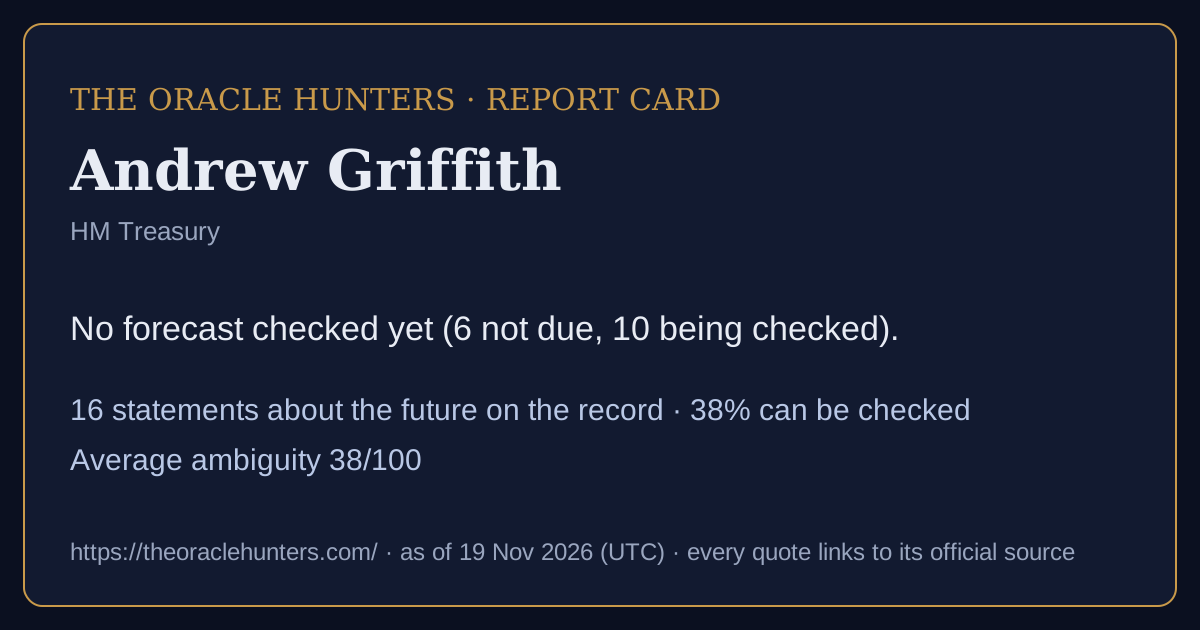
Track record: No forecast checked yet (6 not due, 10 being checked).
16forecasts & commitments on the record
38%can be checked as stated
38average ambiguity (0-100)
0goalpost moves recorded
0confirmed U-turns
Timeline
came true partly did not not due / being checked / too vague
Calibration score: shown after 10 checked forecasts with a stated likelihood (now 0).
How they speak about the future: based on data 8, stated on authority 8.
Kinds of claim: forecast 12, commitment 3, mixed claim 1. · Download this report card as a picture
In the nine words
πρόγνωσιςInference from evidence7 · 44%μαντείαInspired knowledge6 · 38%προαναγγελίαPublic pre-announcement3 · 19%
How to read this
Each box is one sentence a public figure or institution said about the future, word for word, with a link to the official text. Can be checked means it names what will happen, by when, and how likely - so it can be compared with official figures later. Too vague to check means it does not. Ambiguity (0-100) is how many different ways the sentence can be read. When the date passes, the forecast is compared with official data and marked came true, partly or did not come true. Labels judge the sentence, never the person. Full guide and glossary.On the record (16)
By Q3 this year, there will be tangible progress across the board, on key themes such as mitigating the risks of financial crime and promoting new services, including variable recurring payments.
Importantly, the Government will reflect on the submissions to the Payment Services Call for Evidence and introduce an agile regulatory framework for payments and e-money that promotes growth and supports an internationally competitive payments sector.
McKinsey estimate that opening up financial data could boost UK GDP by a useful 1.5% by 2030 so CFIT has my full support as they go after that opportunity.
That is why, for the first time since the ancient Celts began minting coins in the British Isles, this year will see communities benefit from a right of access to cash, enshrined in law via the Financial Services and Markets Bill currently going through Parliament.
I’m looking forward to supporting their National Numeracy Day on the 17 May and I am delighted that they are part of the Lord Mayor’s Appeal this year.
Originally signed in 2012, I’m pleased to say it will be renewed this year to continue supporting older consumers.
The Chancellor has committed to move rapidly to review retained EU law over the next year to identify reforms which have the greatest potential to unlock growth in key areas, including in financial services.
I know we will work closely as we continue to promote growth and enable a competitive, thriving financial services sector.
The Financial Services and Markets Bill already enables us to establish a framework for regulating cryptoassets and stablecoins in the UK, and we will be consulting on a world-leading regime for the rest of the cryptoasset market later this year.
The first FMI Sandbox will be up and running this year.
The Bill will allow the Treasury and the FCA to put a framework in place to facilitate the development of a consolidated tape by 2024.
We are committed to turbocharging the growth of the UK fintech sector with the new Centre for Finance, Innovation, and Technology – CFIT.
That is why, for the first time since the ancient Kelts began minting coins in the British Isles, this year will see communities’ benefit from new laws to protect access to cash.
You don’t need telling that one of the macro trends we’re likely to see continue this year is a move from cash to electronic payments.
It will allow the insurance sector to play an ever-greater role in providing opportunity to left behind communities and our transition to Net Zero, with the industry expecting to invest more than £100 billion over the next decade.
One of the most tangible examples - one that will unlock over £100 billion of pounds for productive investment, creating jobs and prosperity – is reforming Solvency II.
Also said - not checkable as stated (12 newest)
Remarks about the future with no date, figure or likelihood that could be checked. They are kept on the record and shown here, but not scored.
We in government must work together – such as in the agreement the UK has today signed with Saudi Arabia – and by doing so we can support bigger, better, bolder science than we could ever do alone – and take on and solve the challenges that will define the future.
To achieve this, we will move Open Banking on to a sustainable regulatory framework, which the Government intends to develop through the Data Protection and Digital Identity Bill which has its second reading in Parliament today.
And, in order to make it a useful and actionable data set, we will repeat the Census annually.
Open Banking will also transition to a new entity, with a broad-based, equitable funding model and high standards of corporate governance.
We will shortly be consulting on how we can simplify to make it even better and reach more people.
However, we will not leave behind rural communities, the elderly or those who use cash as a way to manage their personal finances.
So, it is important that we do everything possible to ensure no one is excluded – whether through lack of understanding or lack of access – from financial products which could help them succeed in life.
In just 80 days’ time we will celebrate the Coronation of His Majesty the King.
Reducing the risk margin will unlock currently unproductive capital, opening up the potential of lower product prices and higher annuity yields.
Broadening matching adjustment eligibility will make it easier to invest for the long term in projects even when there is a construction phase - whether building housing, wind farms or town centre regeneration.
Sound money must come first but our ambition is to have nothing less than the most competitive tax regime of any major country.
To maintain our international competitiveness, the UK must embrace the potential of these shifts and focus our attention on growth and innovation in the sector.