Andrew Gracie
Bank of England
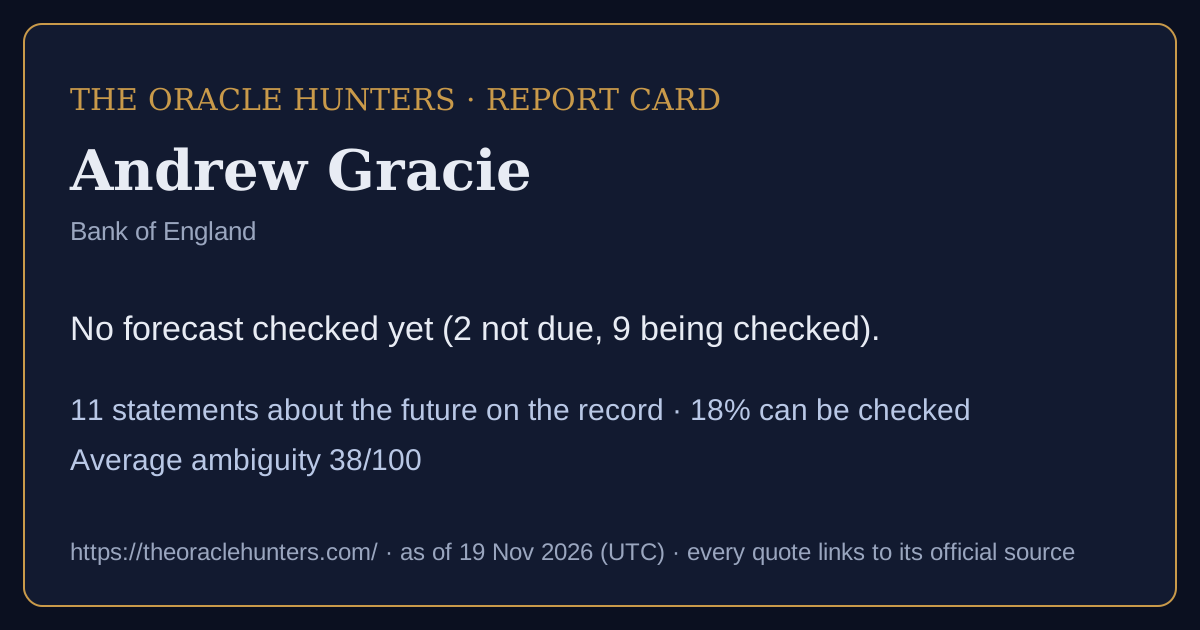
Track record: No forecast checked yet (2 not due, 9 being checked).
11forecasts & commitments on the record
18%can be checked as stated
38average ambiguity (0-100)
0goalpost moves recorded
0confirmed U-turns
Timeline
came true partly did not not due / being checked / too vague
Calibration score: shown after 10 checked forecasts with a stated likelihood (now 0).
How they speak about the future: based on data 7, stated on authority 3, educated guess 1.
Kinds of claim: forecast 5, mixed claim 5, scenario (if… then) 1. · Download this report card as a picture
In the nine words
πρόγνωσιςInference from evidence7 · 64%μαντείαInspired knowledge3 · 27%πρόνοιαPreparing for the future1 · 9%
How to read this
Each box is one sentence a public figure or institution said about the future, word for word, with a link to the official text. Can be checked means it names what will happen, by when, and how likely - so it can be compared with official figures later. Too vague to check means it does not. Ambiguity (0-100) is how many different ways the sentence can be read. When the date passes, the forecast is compared with official data and marked came true, partly or did not come true. Labels judge the sentence, never the person. Full guide and glossary.On the record (11)
11 Our starting point for calibrating internal MREL for ring-fenced bank sub-groups would be 90%, with the possibility that this could be scaled down if there are sufficient readily deployable resources.
UK banks have been given indicative MREL requirement to meet by 2020; they will have operational continuity arrangements in place in 2019 (alongside the implementation of ring-fencing); and they are already trading on protocol terms with
We will do this after the start of 2019 when ring-fencing, the first level of TLAC requirements and operational continuity in resolution arrangements are in place.
And so, we are clear that such instruments should not count as MREL beyond 31 December 2021 and if not matured by then we will work with firms to remove them if they represent a barrier to the resolution strategy.
We expect to say more about surplus MREL and the form it should be held in to be readily available when we come to finalise our internal MREL policy next year.
Host regulators will still want subsidiaries to hold adequate capital and potentially additional buffers if these entities are systemically important to the domestic economy.
By the end of this year, the remaining advanced economy G-SIBs will also have adhered.
Making TLAC consistent with bail-in also led to clarification in the Term Sheet that after 2022 all TLAC should be issued out of resolution entities: debt issued out of SPVs and, in groups subject to SPE strategies, Tier 2 subordinated debt issued to the market out of operating companies will no longer count as TLAC.
Beyond proposing a conformance date of 2019 at the earliest, it does not describe how the standard will be implemented and what will happen in transition.
Finalisation of the TLAC proposal this year and joint decisions on MREL in resolution colleges for EU firms in early 2016 will clear the way for banks to engage investors on their capital planning and debt issuance for the year ahead.
And, as was announced last week, a joint testing programme between US and UK governments and authorities will start this year.
Also said - not checkable as stated (12 newest)
Remarks about the future with no date, figure or likelihood that could be checked. They are kept on the record and shown here, but not scored.
We want debt investors to be able to price risk effectively by being clear about where they rank in the creditor hierarchy and to give them confidence that we can stick to the hierarchy in applying losses and that we will not be picking winners and losers within a class.
Rather, come Monday morning, we will announce, first the universe of debt that has been immobilised (and thus the solvency we can put back into the balance sheet of the bank in resolution); and second the independent valuation process that will ensue.
In a cross-border setting, coordination around resources and availability of backstops will depend on the resolution strategy - in an MPE strategy responsibilities will sit locally with the authorities of each resolution entity; in an SPE strategy the home authority will need to play a stronger coordinating role.
We will need to continue to ensure that these contacts are maintained and deepened.
Given these valuation challenges, I suspect there will need to be careful further consideration given to the formulation and practical application of the NCWO safeguard; we must end up with a safeguard that is sufficiently certain and capable of estimation in advance that both creditors and resolution authorities are able to make sensible decisions before, during and after resolution.
As private, profit-making enterprises CCPs must be allowed to fail, but, given their systemic importance, many will need to be allowed to do so in a manner that maintains the continuity of their critical functions.
The Financial Stability Board (FSB) issued a consultation document 2 on a minimum standard for Total Loss Absorbing Capacity (TLAC) last November and is committed to producing a final standard ahead of the G20 summit next month in Antalya.
Ongoing work to raise the prudential standards for banks on capital and liquidity, among other areas, should greatly reduce the risk of CCPs having to deal with a failing clearing member.
If we do, resolution should offer a continuing benefit in helping to incentivise recovery by removing expectations that the taxpayer will be compelled to step in.
That assessment of LAC will need to consider the extent to which unfunded commitments from members can be relied upon given the procyclicality of calling for them in stressed circumstances.
For European G-SIBs, MREL requirements will need to be set consistently with the FSB's Total Loss-Absorbing Capacity (TLAC) standard.
And as such will need to be addressed as part of the resolution planning process for a particular firm.