Andrew Bailey
Bank of England
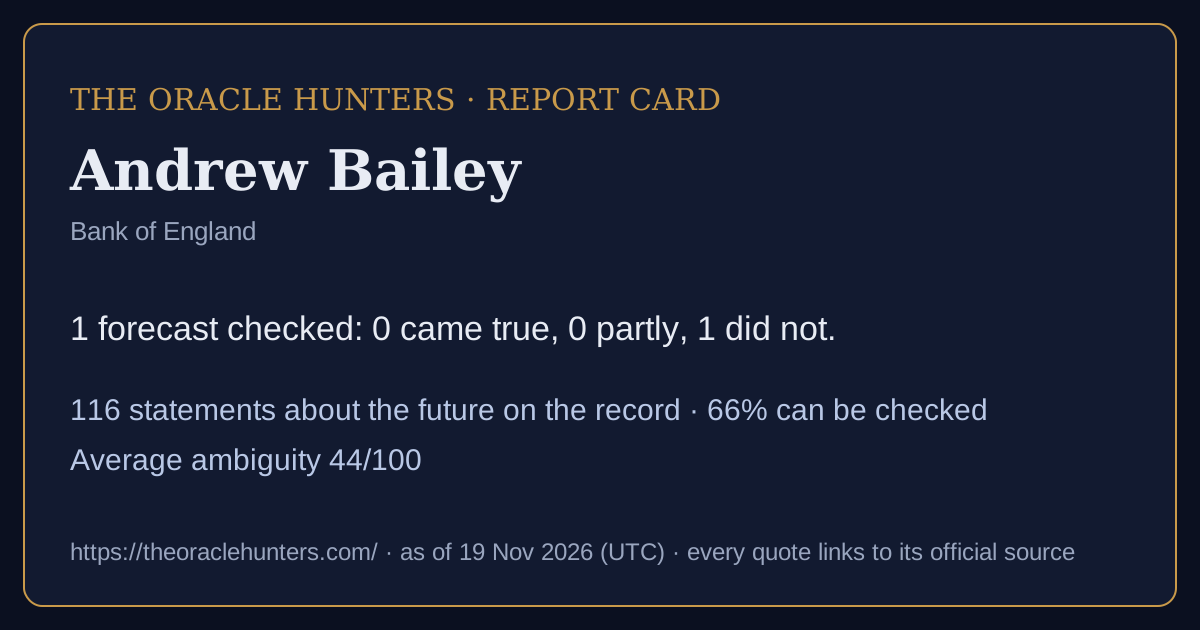
Track record: 1 forecast checked: 0 came true, 0 partly, 1 did not.
116forecasts & commitments on the record
66%can be checked as stated
44average ambiguity (0-100)
0goalpost moves recorded
0confirmed U-turns
Timeline
came true partly did not not due / being checked / too vague
Calibration score: shown after 10 checked forecasts with a stated likelihood (now 1).
How they speak about the future: based on data 74, stated on authority 25, educated guess 17.
Kinds of claim: forecast 79, mixed claim 19, scenario (if… then) 14, commitment 4. · Download this report card as a picture
In the nine words
πρόγνωσιςInference from evidence70 · 60%μαντείαInspired knowledge23 · 20%πρόνοιαPreparing for the future14 · 12%προαναγγελίαPublic pre-announcement4 · 3%εἰκασίαConjecture4 · 3%πρόβλεψιςSeeing the signs1 · 1%
How to read this
Each box is one sentence a public figure or institution said about the future, word for word, with a link to the official text. Can be checked means it names what will happen, by when, and how likely - so it can be compared with official figures later. Too vague to check means it does not. Ambiguity (0-100) is how many different ways the sentence can be read. When the date passes, the forecast is compared with official data and marked came true, partly or did not come true. Labels judge the sentence, never the person. Full guide and glossary.Checked
Last calendar year, UK GDP declined by an annual growth rate of 9¾%, and based on our last forecast in early May we expect it to grow by 7¼% this year.
Did not come true. Said: economic growth around 7.25% in 2021. Official figure for United Kingdom: 8.5% (World Bank open data). Missed. Off by 1.3 points. official data · checked 14 Nov 2026 · automatic check against official data (rules v3)
On the record (116)
All of this is for one purpose – to ensure CPI inflation returns to the 2% target in the medium term.
I am going to start by describing the overall economic situation in the UK, explain the MPC’s recent decision to raise Bank Rate by a quarter of a percent to 4%, and then go on to look more at activity in the economy and growth around the regions.
Household consumption growth so far this year has been supported by somewhat stronger than expected growth in real incomes.
Across much of the world, global economic activity has been stronger than expected this year, despite the conflicts in the Middle East, Russia’s continuing illegal invasion of Ukraine, higher energy prices and continued trade tensions.
We expect annual GDP growth to be around 1.6% this year, whereas back in the summer, we expected just over 1%.
In the November MPR, it is expected to rise to around 5% by the middle of next year, after which it is projected to fall as the impact of rising energy prices on 12-month inflation rates fades and restrictive monetary policy bears down on inflation.
We will ensure inflation returns to target and the context is currently encouraging, although uncertainty remains a feature of the situation.
I was expecting inflation to return to its 2.0% target in around April or May, and then we would need to assess what level of interest rate would keep it there.
Regardless of what happens, the task for monetary policy is to ensure that, as the adjustment to the shock happens, inflation does not become embedded – and in the United Kingdom that means returning 12-month inflation in the Consumer Price Index to our 2% target in the medium term.
While we are ready to adjust course as needed depending on how the situation evolves, our decision to hold our policy rate – Bank Rate – at 3.75% at our most recent meeting was an active choice given the range of possible outcomes.
But responding too early may generate undesirable volatility in output – and inflation may drop below the 2% target in the medium term – if second-round effects turn out smaller than anticipated.
In the Monetary Policy Report we published in April, we presented three scenarios – A, B and C – for possible outcomes for the UK economy and inflation over the next three years, without any one being designated as a central projection as we would normally do, and without assigning any probability weights to them.
And inflation is likely to go higher over this year as utility bills rise and firms pass higher costs through supply chains.
He emphasises that while energy-driven inflation will temporarily push prices above target, monetary policy should focus on preventing persistent second‑round effects and remain ready to adjust as uncertainty evolves to return inflation sustainably to 2%.
But as economic history has shown, if it is likely that policymakers will deliberately renege on the promise of low and stable inflation, people will factor that into their expectations, driving up inflation without any benefit to the real economy.
Regardless of what happens, the task for monetary policy is to ensure that, as the adjustment to the shock happens, inflation does not become embedded - and in the United Kingdom that means returning 12month inflation in the Consumer Price Index to our 2% target in the medium term.
While we are ready to adjust course as needed depending on how the situation evolves, our decision to hold our policy rate - Bank Rate - at 3.75% at our most recent meeting was an active choice given the range of possible outcomes.
But responding too early may generate undesirable volatility in output - and inflation may drop below the 2% target in the medium term - if second-round effects turn out smaller than anticipated.
In the Monetary Policy Report we published in April, we presented three scenarios - A, B and C - for possible outcomes for the UK economy and inflation over the next three years, without any one being designated as a central projection as we would normally do, and without assigning any probability weights to them.
- A review of implementation of FSB recommendations on data frameworks and bank and non-bank regulation and supervision, which will take place early in 2027.
With moderate growth and a softer labour market, a wider margin of slack in the UK economy will support continued disinflation in the domestic economy and a gradual return of headline inflation to the 2% target as we look beyond the near-term increase.
But services price inflation remains elevated, at 4.7% in the latest data for May.
Also on our watch list is food price inflation, which has risen materially, from 3.0% to 4.4% in May.
Monetary policy needs to continue to remain restrictive for sufficiently long until the risks to inflation returning sustainably to the 2% target in the medium term has dissipated further.
This year inflation has taken a step up again, to 3.4% in the latest data for May, and we expect it to remain around 3.5% at least into the Autumn before returning to back towards our 2% target next year.
It follows that if the level of trade is lowered by some action, it will have an effect to reduce productivity growth and thus overall growth.
Whilst the growing scale of these non-bank exposures has been absorbed by banks acting as prime brokers so far, such trends, if they continue, could have a profound effect on banks ' balance sheet capacity in the future.
We expect to report on the results by the end of this year.
For the UK, this is consistent with how we have revised our outlook for growth, and the numbers themselves so far this year.
Policy setting will need to remain restrictive for sufficiently long until the risks to inflation remaining sustainably around the 2% target in the medium term have dissipated further.
Say if Bank Rate were ever to return to its effective lower bound, a repo portfolio could quickly be displaced by asset purchases, or a funding scheme, for monetary policy purposes.
But they do suggest that we may reach the PMRR as soon as the second half of next year.
Chart 7: The Preferred Minimum Range of Reserves could be reached in 2025 Illustrative future paths of reserves supply backing QT and TFSME
So, if more of the funding liabilities take the form of equity and the risks faced by the bank remain the same, you might expect the cost of equity per unit of capital to fall.
I expect the future level of reserves to fall from where it is today (£467 billion), and to settle at a point which is likely to be determined more by the financial stability demand for reserves - the traditional Bagehot point.
Services inflation came in a touch lower than expected at 6.6% in October.
And we expect it to continue to fall over the coming months (shaded area) given easing cost pressures throughout the food supply chain.
It fell to 10.1% in October, and we expect it to fall further, probably to about 3% by the end of our short-term forecast in March next year.
In our forecast, it then continues to fall back towards the 2% target over next year.
Interest rates will have to stay high enough for long enough to make sure we get all the way back to the 2% target.
Next year we will introduce the new settlement engine.
Reflecting those risks, conditional on the market-implied path for Bank Rate, the MPC's mean forecast path for inflation, the expected path if you like, is at or just below the 2% target at years 2 and 3.
That contribution is likely to drop significantly to about 1 percentage point in next week's data for April as large increases in energy prices from a year ago drop out of the annual calculations.
Nominal pay growth has fallen back slightly, and near-term indicators suggest that pay growth could ease further later this year.
Looking ahead to the end of the year, if energy prices evolve as financial market prices now suggest, the contribution from energy will fall further.
We do, however, have good reasons to expect inflation to fall sharply over the coming months, beginning with the April number to be released on 24 May.
In the MPC's baseline modal projection from its May Report, which is conditional on a market-implied path for Bank Rate that peaks at 4¾% in the fourth quarter of this year, an increasing degree of economic slack, combined with declining external pressures, lead inflation to fall materially below the 2% target in the medium term.
On our latest estimates, the growth rate of the potential of the UK economy - the supply side - is probably now around 1% per annum.
It is primarily for this reason that we expect to see a sharp fall in inflation during the course of this year, starting probably in a couple of months or so from now.
If they develop as futures prices now suggest, it is likely that Ofgem's energy price cap will fall below the Energy Price Guarantee.
Showing the newest 50 - the ledger has all 116.
Also said - not checkable as stated (12 newest)
Remarks about the future with no date, figure or likelihood that could be checked. They are kept on the record and shown here, but not scored.
You don’t need to take any ideological position to believe in this nexus of connections – you could be Hayek, Keynes, Marx or Schumpeter.
I am just going to make a few opening comments across the subjects of central bank independence, financial stability and technology – as a prompt to get our discussion going.
In the UK, economic activity is turning out to be more resilient than we had expected, and some of that is due to AI investment, particularly in the business services sector.
There is though an important further step in this line of argument, which may seem obvious but needs stating.
I am an optimist on AI, digital technology and most probably robotics too.
More broadly, it has led to concerns which may call into question public trust in AI.
Interest rates may need to rise even as economic activity weakens.
Existing vulnerabilities in sovereign debt markets, credit markets and asset valuations could crystallise together.
A recent history of higher inflation can cause people to expect further inflation.
If earnings expectations or confidence in the pace of AI adoption were sharply revised, the consequences could spread through equity, credit and sovereign markets.
Policymakers should therefore pursue sustainable growth, maintain credible monetary and fiscal frameworks, and strengthen core financial markets so they can absorb future shocks without amplifying them.
Central banks must make forward-looking judgements and update them as the evidence changes.