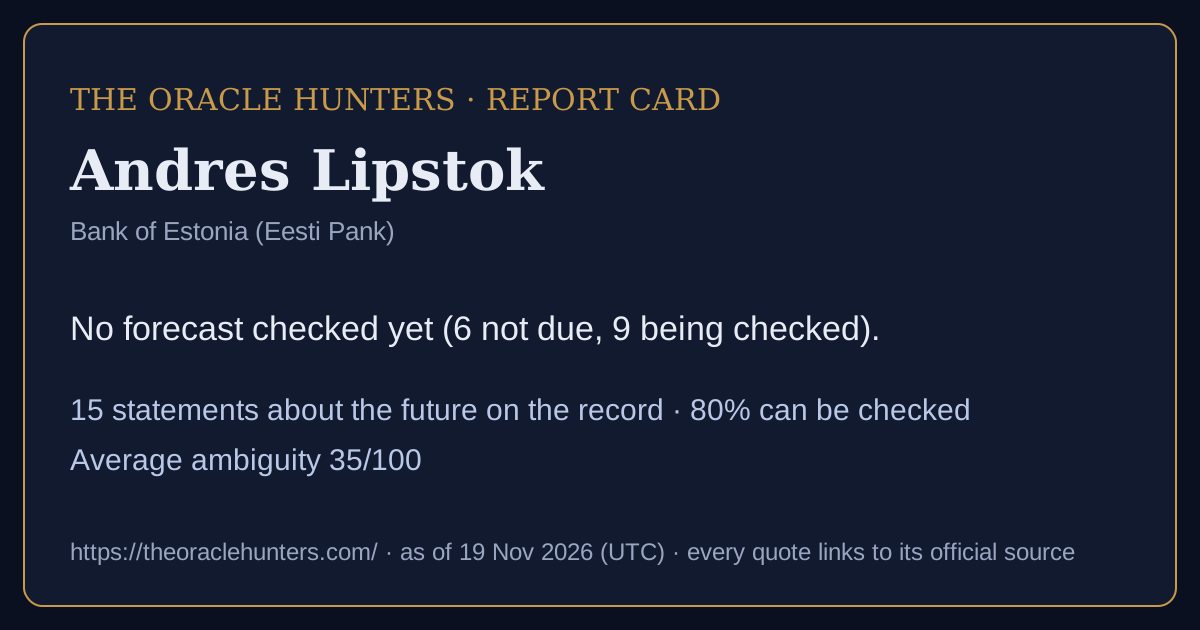
Andres Lipstok
Bank of Estonia (Eesti Pank)
Track record: No forecast checked yet (6 not due, 9 being checked).
15forecasts & commitments on the record
80%can be checked as stated
35average ambiguity (0-100)
0goalpost moves recorded
0confirmed U-turns
Timeline
came true partly did not not due / being checked / too vague
Calibration score: shown after 10 checked forecasts with a stated likelihood (now 0).
How they speak about the future: based on data 14, stated on authority 1.
Kinds of claim: forecast 12, mixed claim 3. · Download this report card as a picture
In the nine words
How to read this
Each box is one sentence a public figure or institution said about the future, word for word, with a link to the official text. Can be checked means it names what will happen, by when, and how likely - so it can be compared with official figures later. Too vague to check means it does not. Ambiguity (0-100) is how many different ways the sentence can be read. When the date passes, the forecast is compared with official data and marked came true, partly or did not come true. Labels judge the sentence, never the person. Full guide and glossary.On the record (15)
Looking back, it has to be admitted that the annual growth in consumer prices was faster than expected, amounting to 2.7%.
This means that in the medium term, the inflation rate has to remain below but close to 2%.
If the price hike of commodities stops, the increase in the euro area's prices could remain below 2% already next year.
Sweden and Finland, our close neighbours, can expect a recession of up to 4.7%.
When speaking about this year's forecasts, the EU economy as a whole is expected to undergo a 4% recession.
Declining inflation has created all the possibilities in Estonia to meet the Maastricht criteria by end-2009, which makes it possible to join the euro area on 1 January 2011 at the latest.
We are likely to meet the numerical values of the Maastricht criteria by the end of 2009 and Estonia expects to join the euro area in 2011, in full accordance with the Treaty provisions.
Estonian economy may start to recover towards the end of 2009, albeit the resumption of growth is very much dependent on the state of economies of our main trading partners.
According to Eesti Pank's spring forecast, this year's economic downturn in Estonia will be around 12%.
In the IMF's opinion GDP in EU countries will decrease 4% in 2009 and may decline by 0.3% next year.
GDP in leading industrial countries will decrease 3.8% this year with growth in the USA contracting by 2.8%.
Therefore, global economic growth will not be able to lean on the US domestic demand and exports of goods and services to the States either this or the next year.
According to the current outlooks, the economy should stabilise in the second half of this year and it may start growing again either at the end of 2009 or at the beginning of 2010.
This year, the share of state expenditures in GDP may rise to 43%.
The IMF forecasts Asian new industrial countries' economic growth will be 5.6% in 2009 and 0.8% in 2010.
Also said - not checkable as stated (12 newest)
Remarks about the future with no date, figure or likelihood that could be checked. They are kept on the record and shown here, but not scored.
To ensure an outlook for growth, we must implement structural reforms to enhance economic flexibility, competitiveness and employment.
Speech by Mr Andres Lipstok, Governor of the Bank of Estonia (Eesti Pank), at the presentation of Eesti Pank's 2011 Annual Report to the Riigikogu (the Parliament of Estonia), Tallinn, 29 May 2012.
Then, I am going to focus on the euro area economic and monetary policy, as well as on economic developments in Estonia and the activities of the central bank against the backdrop of the euro area financial crisis.
It is not only the central banks that can contribute to a successful exit from the crisis the governments of member states must, as soon as possible, implement the measures taken and agreements made by the European Council and the euro area heads of state and government.
Even though budget adjustments may curb economic growth in the immediate future, they will help ensure the sustainability of public finances and lower the risk premia of sovereign bonds.
Otherwise, the competitiveness of the country with the faster inflation rate will suffer: in the best case, the country's economic growth will slow down gradually, but in the worst case the country will have to adjust through a difficult crisis similar to the situation in Greece.
While in Austria or Slovenia, or in Estonia for that matter, inflation may temporarily differ from that of the euro area, we have to look at the whole picture when making decisions.
The more detailed picture is, of course, more diverse and future monetary policy measures will also have to take that diversity into account.
It should be stressed that the Governing Council of the European Central Bank is monitoring the economic situation very carefully and will not commit to future decisions in a form that would render the Council a prisoner of their own words.
It is clear the Estonian monetary policy or the monetary policy framework will not and must not be changed.
First of all it must be made sure that the current account deficit, which cannot be avoided in the prevailing economic environment, remains below 3% of GDP both this year and in 2010.
In order to achieve this, Eesti Pank is of the opinion that in addition to the steps taken in February, this year's fiscal deficit needs to be reduced by a further 6.5 billion kroons.