Andreas Dombret
Deutsche Bundesbank
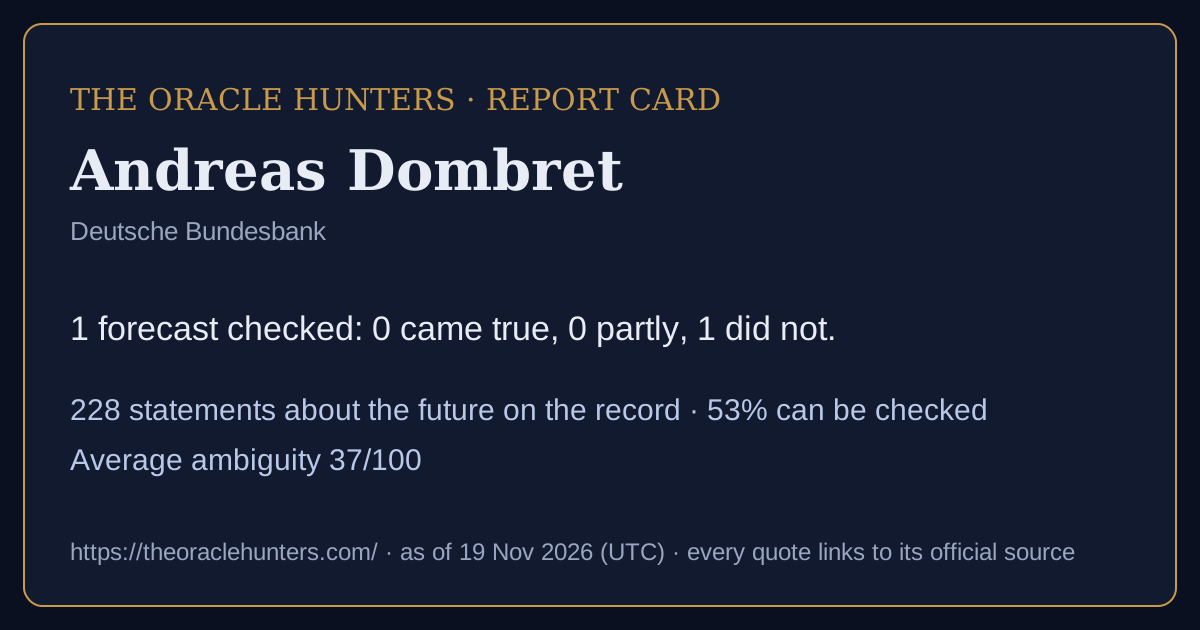
Track record: 1 forecast checked: 0 came true, 0 partly, 1 did not.
228forecasts & commitments on the record
53%can be checked as stated
37average ambiguity (0-100)
0goalpost moves recorded
0confirmed U-turns
Timeline
came true partly did not not due / being checked / too vague
Calibration score: shown after 10 checked forecasts with a stated likelihood (now 1).
How they speak about the future: based on data 173, stated on authority 30, educated guess 25.
Kinds of claim: forecast 185, mixed claim 24, scenario (if… then) 17, commitment 2. · Download this report card as a picture
In the nine words
πρόγνωσιςInference from evidence171 · 75%μαντείαInspired knowledge28 · 12%πρόνοιαPreparing for the future17 · 7%εἰκασίαConjecture9 · 4%προαναγγελίαPublic pre-announcement2 · 1%πρόβλεψιςSeeing the signs1 · 0%
How to read this
Each box is one sentence a public figure or institution said about the future, word for word, with a link to the official text. Can be checked means it names what will happen, by when, and how likely - so it can be compared with official figures later. Too vague to check means it does not. Ambiguity (0-100) is how many different ways the sentence can be read. When the date passes, the forecast is compared with official data and marked came true, partly or did not come true. Labels judge the sentence, never the person. Full guide and glossary.Checked
real GDP will grow by 1.6 % in 2016 and by 1.7 % in both 2017 and 2018.
Did not come true. Said: economic growth around 1.7% in 2017. Official figure for Germany: 2.8% (World Bank open data). Missed. Off by 1.1 points. official data · checked 14 Nov 2026 · automatic check against official data (rules v3)
On the record (228)
At this point, let me remind you of one of the most fascinating findings from the latest low-interest-rate survey: nearly 50% of small and medium-sized German credit institutions can see a prospect of mergers and acquisitions over the medium term. 9
Over 70% of institutions are expecting intensified competition from other banks and savings banks.
I am certain that - as I mentioned in my third theory - we will see more of this type of merger if we create positive economic conditions, including a stable banking union in a stable euro area.
If we manage to do this, we will make the banking union more stable and more credible.
And thus, my first hypothesis was that, in the years to come, we will likewise see a moderate shrinkage of bank balance sheets and transaction volumes in the euro area - albeit, of course, with a certain variation from one country to the next.
The recent lowinterest-rate survey conducted by the Bundesbank and BaFin has shown that small and medium-sized German credit institutions are expecting a 9% drop in their profits from 2016 to 2021; this represents a whopping 16% decline in the return on assets over the same period. 3 4
- I.e. a period during which the UK is no longer part of the EU but will remain within the single market and the customs union; this 21-month phase, which starts on 30 M arch 2019, creates time: time for policymakers to develop the rules of a new partnership; and time for businesses to adapt to the new reality strategically …
During the implementation phase, which is to last until end 2020, EU rules would continue to apply in the UK and the exact terms of the future partnership shall be worked out.
And there is nothing to say that weather and climate-related losses of this kind will still be insurable if climate change continues to dramatically increase the likelihood of natural catastrophes and the expected amount of losses.
The European Commission anticipates that additional annual investment of €180 billion will be needed in the European Economic Area in order to achieve the Paris climate targets by 2030.
Many have upgraded their growth expectations - Eurosystem staff projections for 2018 are at 2.3% for 2018.
Many businesses are holding out high hopes that a transition phase will give them certainty on the shape of relations between the UK and the EU, at least until year-end 2020.
The plan is to have a political declaration on what the future partnership will look like by October this year; at the same time negotiation parties should have a draft withdrawal treaty ready. 2
Now, since negotiations have been going rather slowly, there may be a transition period of two years from 2019 to 2021 - during which the old rules would still apply and the terms of the new partnership could be implemented.
The World Bank recently estimated that growth will be 3.1%; this means that the world economy's growth potential will be fully or almost fully reached for the first time since 2008.
Young expects 1.8 million new jobs to be created over the course of 2018.
According to the December 2017 Eurosystem staff macroeconomic projections, the annual real GDP is set to rise by 2.3% in 2018, 1.9% in 2019, and 1.7% in 2020.
And the Bundesbank expects a further rise of 2.5% for 2018, while growth in 2019 is seen at 1.7%.
The Eurosystem staff macroeconomic projections forecast annual HICP inflation of 1.5% in 2017, 1.4% in 2018, 1.5% in 2019 and 1.7% in 2020.
In all likelihood, the United Kingdom will be leaving the European Union on 29 March 2019.
While risk sensitivity will be diminished by setting the output floor at this level, it still represents a far better outcome than the originally envisioned output floor of 80 per cent.
The more important, then, to grasp that the reforms being discussed today will only actually prevent bubbles from forming and strengthen banks if the rules are applied consistently and effectively.
Minsky has therefore tendered a guiding principle for discussion: if regulators develop new rules, they have to ensure that the build-up of a bubble through excessive credit growth is less likely than it would be in a wholly unregulated financial market with an inclination towards exaggeration.
Because age cohorts with a stronger tendency to work part-time will be larger, the average weekly working hours per employed person are likely to decline slightly by 2025.
Depending on which net immigration flows one assumes, this potential will pass its peak between 2020 and 2023.
Given cumulative net immigration of 2.5 million people, the labour force potential in 2025 will be roughly as high as today's.
This means that world trade, too, will finally gain more impetus, with growth accelerating from 2.4% last year to 4.2% this year.
According to IMF forecasts, the global growth rate, which was 3.2% last year, will go up to 3.6% this year and 3.7% in 2018.
According to the latest projection of the German Council of Economic Experts, the German economy will experience real growth of 2% this year and 2.2% next year.
IFRS 9 will very soon - as of 1 January 2018 - be replacing IAS 39, which is still in force, as the international standard for the accounting of financial instruments.
Credit institutions in the euro area may have trimmed their balance sheets by slightly more than 15% between 2008 and the end of 2015, and German banks have shrunk their balance sheets by roughly 30%.
The decision of the ECB Governing Council to reduce net bond purchases from 1 January 2018 from €60 billion to €30 billion and to continue the programme until at least September next year certainly doesn't amount to slamming on the monetary policy brakes - it's the equivalent of removing the accelerator from the floor - but only ever so slightly.
We expect the total number of visitors this year to be in the region of 50,000. 11
This year's winner of the Nobel Memorial Prize in Economic Sciences, Richard Thaler, has also remarked that the branch of behavioural economics he has played a large part in bringing to the mainstream makes no claim to absolute validity, saying: 'All economics will be as behavioural as the topic requires.' 7
Since negotiations have been going rather slowly, there may be a transition period of two years from 2019 to 2021 - during which the old rules would still apply and the terms of the new partnership could be implemented.
At the moment, it is possible that we could start this second phase in December of this year - this is the guidance of the EU Council, but for it to happen substantial progress has yet to be made on several fundamental issues such as the rights of EUcitizens in the UK after Brexit.
GDP projection by ECB staff; 2017: 2.2% (+0.3 pp); 2018: 1.8% (+0.0 pp); 2019: 1.7% (+0.0 pp). 1
- GDP projection by IM F: 2017: 2.1% (+0.2 pp); 2018: 1.9% (+0.2 pp);
Since negotiations have been going rather slowly, there may be a transition period of two years from 2019 to 2021 - during which the old rules would still apply and the terms of their new partnership could be drawn up.
The UK and the EU will go their separate ways in March 2019.
A second aspect that is sometimes part of the discussion surrounding Green Finance are the risks that climate change might bring for the financial sector and the question of how financial institutions need to adapt if they are not to fall prey to these risks.
- The findings of the low-interest-rate survey suggest that two-thirds of institutions are expecting competition from other banks to increase, and no fewer than 85% of them expect greater competition from fintech companies. 1
The heaviest losses are projected to come from the 0.27% pre-tax drop in net interest income, corresponding to a contraction of more than 3 billion euro in absolute terms, and from the increase in loss provisions - the latter including positions such as expected credit losses.
- One thing that increases in the low-interest-rate environment is competition: over 70% of institutions expect competition from other banks and savings banks to pick up - and as many as 85% see fintechs as a source of mounting rivalry.
In concrete terms, they expect their pre-tax profit to dwindle by 9% and their total return on capital to fall by 16%.
Smaller and medium-sized German credit institutions are expecting results - measured in terms of their pre-tax total return on capital - to shrink by an average of 16% by 2021.
- Small and medium-sized German credit institutions expect their profits to continue shrinking between 2016 and 2021, according to their planning.
But coming back to the figures: if we were just to apply a threshold value of €3 billion, around 1,300 banks and savings banks in Germany could fall under the simplified rules, or just over 80% of all institutions, as mentioned earlier.
The corresponding MREL requirements are expected to be determined by the resolution authorities by the end of this year.
The European Central Bank, for example, has raised its forecast for the euro area slightly - to 1.9% for this year and 1.8% for next year.
Showing the newest 50 - the ledger has all 228.
Also said - not checkable as stated (12 newest)
Remarks about the future with no date, figure or likelihood that could be checked. They are kept on the record and shown here, but not scored.
And if you find one or the other sculpture here on the Bank's grounds aesthetically pleasing or displeasing, the chances are that's another thing I will have to take responsibility for.
Being unable to express my gratitude to everyone in person, I will have to make do by expressing my cordial thanks to 'my' Directors General: Messrs Bartholomae, Bischofberger, Fehr, Loeper, Reischle and Ziebarth and Ms Sung.
You can't measure anyone, least of all a banking supervisor - Felix Hufeld will know what I'm talking about - in terms of whether they keep everyone happy.
You will no doubt have gathered by now that the international dimension was always particularly important to me.
Structural change in the banking world, sparked by the triple whammy of low interest rates, digitalisation and regulatory reforms, is something we all need to get to grips with - credit institutions, central banks, banking supervisors and not least consumers and bank customers.
I think we all agree that sound domestic policies should always be the first line of defence and that capital flow measures should not substitute for warranted macroeconomic or exchange rate adjustments.
This will most likely become law; and for good reason, because we need to have a better, consolidated understanding of what is going on at international banks doing business in Europe.
We need to carefully analyse which divergence option will be best suited - in terms of financial stability, democratic accountability, and cost efficiency.
So we will have to make do with complicated, second-best solutions.
Thus, while a smart system of enhanced equivalence might be sensible, we would first have to find a suitable approach.
Since it will play a greater role in any of the remaining, realistic scenarios, how can we best administer this - that is to say, what should we expect to be ring-fenced in both jurisdictions, and what shouldn't?
And we should not blind ourselves to the fact that we will continue to experience headwinds here: from those who go against internationally agreed policies and rules, from those who think banking and the economy would profit from a looser grip, and from those in the financial sector who claim that they've been treated unfairly and that they'll have a …