Andréa M Maechler
Bank for International Settlements
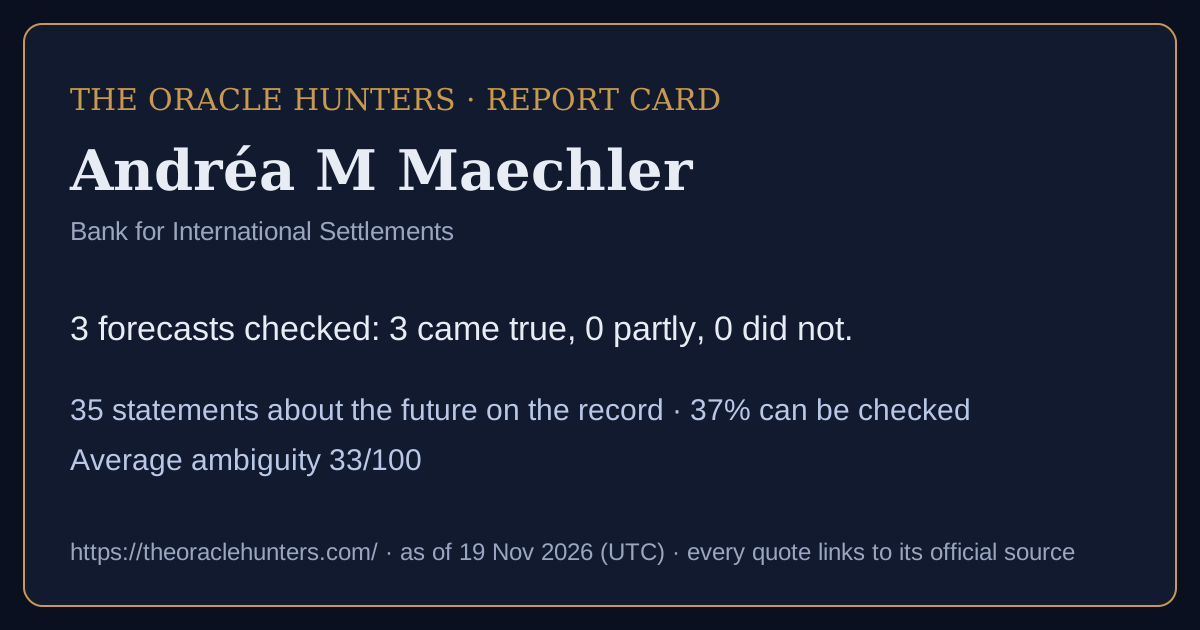
Track record: 3 forecasts checked: 3 came true, 0 partly, 0 did not.
35forecasts & commitments on the record
37%can be checked as stated
33average ambiguity (0-100)
0goalpost moves recorded
0confirmed U-turns
Timeline
came true partly did not not due / being checked / too vague
Calibration score: shown after 10 checked forecasts with a stated likelihood (now 3).
How they speak about the future: based on data 28, stated on authority 7.
Kinds of claim: forecast 29, scenario (if… then) 3, mixed claim 3. · Download this report card as a picture
In the nine words
πρόγνωσιςInference from evidence25 · 71%μαντείαInspired knowledge7 · 20%πρόνοιαPreparing for the future3 · 9%
How to read this
Each box is one sentence a public figure or institution said about the future, word for word, with a link to the official text. Can be checked means it names what will happen, by when, and how likely - so it can be compared with official figures later. Too vague to check means it does not. Ambiguity (0-100) is how many different ways the sentence can be read. When the date passes, the forecast is compared with official data and marked came true, partly or did not come true. Labels judge the sentence, never the person. Full guide and glossary.Checked
For this year, we expect an inflation rate of -0.8%.
Came true. Said: inflation around -0.8% in 2016. Official figure for Switzerland: -0.4% (World Bank open data). On target. Off by 0.4 points. official data · checked 14 Nov 2026 · automatic check against official data (rules v3)
For 2016, we expect average inflation of -0.5%.
Came true. Said: inflation around -0.5% in 2016. Official figure for Switzerland: -0.4% (World Bank open data). On target. Off by 0.1 points. official data · checked 14 Nov 2026 · automatic check against official data (rules v3)
In our estimation, GDP is likely to grow by close to 1% this year.
Came true. Said: economic growth around 1% in 2015. Official figure for Switzerland: 1.5% (World Bank open data). On target. Off by 0.5 points. official data · checked 14 Nov 2026 · automatic check against official data (rules v3)
On the record (35)
During the course of this year, the SIC system itself will become instant payment-capable.
And from August 2024, the largest commercial banks active in retail payment transactions will be offering their customers the possibility of receiving instant payments.
For domestic banks, this threshold is calculated on the basis of their minimum reserve requirements. 1 By remunerating sight deposits above the threshold now at 0.5%, we ensure that our tighter monetary policy will continue to be passed through efficiently to interest rates in the money market overall.
As shown on Slide 10, if the scale of the reserve-absorbing operations is large enough, the new money market equilibrium will be characterised both by a lower supply of reserves and, as desired, by SARON being close to the SNB policy rate.
In Swiss francs, SARON will completely replace Libor as the key money market reference rate at the end of 2021.
However, as with the US dollar, no new Liborreferencing business will be possible in these currencies from the end of this year.
Only for the US dollar will Libor rates remain in place for specific maturities until June 2023.
The Libor reference interest rate will be discontinued at the end of this year for the Swiss franc, the euro, the Japanese yen and the pound sterling.
Nevertheless, the last remaining operational adjustments that need to be made before year-end - for example, those relating to certain interest rate swaps or interest rate futures - will once again require close attention on the part of all market participants.
The prototype is expected to be ready later this year.
This package of measures enabled firms to receive a government-guaranteed bank loan within one business day at the attractive rate of 0% and with a minimum of bureaucracy, and the banks could refinance their loans at the SNB policy rate of 0.75%. 3
Only the heavily used tenors of US Libor are expected to be granted an extension until mid-2023.
The SNB itself continues to make progress with the changeover to SARON - we will have no outstanding Libor-based derivatives in our investment portfolio by the end of 2021.
Moreover, from end-2021, we will exclude all Libor-based floating-rate notes from the list of collateral eligible for SNB repos when implementing monetary policy.
At the end of September, the NWG noted that it expects Swiss franc Libor fixing to be discontinued at the end of 2021 - a mere 14 months from now.
In addition, the switch ensured that our conditional inflation forecast for the next three years, a core element of our monetary policy strategy, will continue to be based on an existing and economically meaningful interest rate over the entire forecast horizon.
This Hub Centre, which is scheduled to commence operations at the beginning of 2020 alongside the Hub Centres in Hong Kong and Singapore, will initially focus on two projects.
As you know, the UK's financial regulator will only be supporting Libor until the end of 2021, so it is important that the transition process on the market take place now.
11 This could happen if pressure on the Swiss franc were to ease due to a significant reduction in global uncertainty or a widening of the interest rate differential versus foreign countries.
As the SNB announced at the beginning of this year, it will grant fintech companies access to the SIC system and to SNB sight deposit accounts, provided they have a fintech licence and their business model makes them significant participants in the area of payment transactions.
We now expect an inflation rate of 0.3% for 2019.
For the year 2019, we expect growth of around 1.5% in Switzerland, compared to 2.5% growth in 2018.
In response, the UK's Financial Conduct Authority has announced that it will no longer maintain the Libor after 2021.
If you search the internet for the word 'bitcoin' you will find more than 300 million entries.
The FCA will exercise its power to compel panel banks to take part in the Libor panel only until the end of 2021.
For this reason, the TOIS fixing will be abandoned as of end-2017.
Index value and expected earnings per share for next year
As you can see from slide 12 , we are expecting that, given an unchanged threemonth Libor of -0.75%, the inflation rate will return to positive territory next year.
For this year, we expect an inflation rate of -0.8%.
Came true. Said: inflation around -0.8% in 2016. Official figure for Switzerland: -0.4% (World Bank open data). On target. Off by 0.4 points. official data · checked 14 Nov 2026 · automatic check against official data (rules v3)
For this year, we expect growth of between 1% and 1.5%.
These forecasts assume that the three-month Libor remains at -0.75% over the entire forecast horizon, that the Brent crude oil price remains at USD 50 per barrel and that the Swiss franc weakens.
As you can see from the chart, inflation will move back into positive territory in early 2017.
For 2016, we expect average inflation of -0.5%.
Came true. Said: inflation around -0.5% in 2016. Official figure for Switzerland: -0.4% (World Bank open data). On target. Off by 0.1 points. official data · checked 14 Nov 2026 · automatic check against official data (rules v3)
For this year, we expect consumer price inflation to average about -1.2%.
In our estimation, GDP is likely to grow by close to 1% this year.
Came true. Said: economic growth around 1% in 2015. Official figure for Switzerland: 1.5% (World Bank open data). On target. Off by 0.5 points. official data · checked 14 Nov 2026 · automatic check against official data (rules v3)
Also said - not checkable as stated (12 newest)
Remarks about the future with no date, figure or likelihood that could be checked. They are kept on the record and shown here, but not scored.
Both are needed to explore how the established correspondent banking model could operate in a tokenised environment.
The challenges facing central banks will only grow more complex.
Neither central banks nor private institutions will hold all the answers.
So, the question is not whether central banks should engage with the private sector.
A central bank must also consider the stability and resilience of the wider system.
That is what we, collectively, must strive to achieve – at the BIS, in the central banking community and with the private financial sector.
As for token settlement, we are examining how central bank money could also be made available in a regulated token ecosystem, should the need for it arise.
This evening, we will be looking at the future of cashless payments.
We will now show you which private and government-issued forms of money qualify under principle 1 within the two-tier financial system.
As part of the project, we will issue real wholesale CBDC on SDX for a limited time and test selected transactions with market participants.
After reviewing the rationale for adopting the new implementation approach, we will give you an overview of how the new approach has played out so far.
For the remainder of this speech, we will refer to reserves above the threshold as 'excess reserves'.