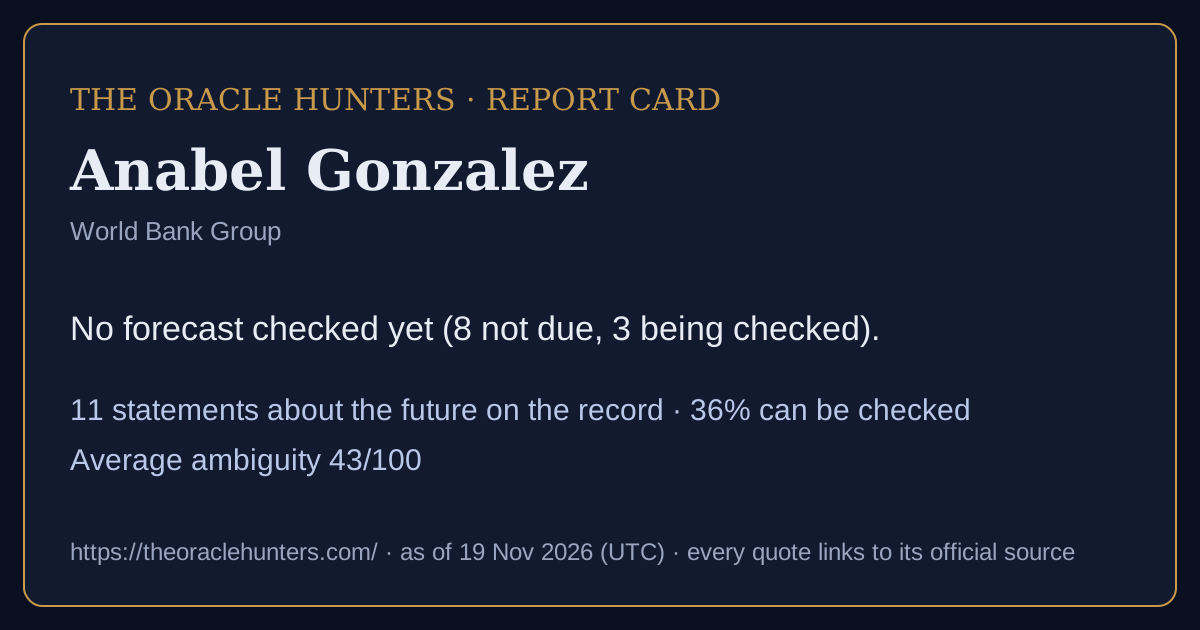
Anabel Gonzalez
World Bank Group
Track record: No forecast checked yet (8 not due, 3 being checked).
11forecasts & commitments on the record
36%can be checked as stated
43average ambiguity (0-100)
0goalpost moves recorded
0confirmed U-turns
Timeline
came true partly did not not due / being checked / too vague
Calibration score: shown after 10 checked forecasts with a stated likelihood (now 0).
How they speak about the future: based on data 11.
Kinds of claim: forecast 11. · Download this report card as a picture
In the nine words
How to read this
Each box is one sentence a public figure or institution said about the future, word for word, with a link to the official text. Can be checked means it names what will happen, by when, and how likely - so it can be compared with official figures later. Too vague to check means it does not. Ambiguity (0-100) is how many different ways the sentence can be read. When the date passes, the forecast is compared with official data and marked came true, partly or did not come true. Labels judge the sentence, never the person. Full guide and glossary.On the record (11)
Our practical work through trade-related projects totaling more than $13 billion is focused on addressing the sources of these high trade costs.
Trade will be just as important in achieving the first of the World Bank Group’s Twin Goals, and the first Sustainable Development Goal, of ending poverty by 2030.
We are currently financing more than $13 billion in trade-related projects around the world, and there is clear potential for this to grow even further.
Due to strong demand from our client governments, the World Bank’s portfolio of trade facilitation projects has grown from $322 million in 2004, to more than $7 billion today.
These high trade costs mean that firms that might otherwise trade and invest in these markets of more than 600 million people go elsewhere.
Concluding these negotiations this year could be an important feature of G20 efforts to reinvigorate global trade.
Further changes to continue introducing quality indices will be rolled out in DB 2017.
We all hope and believe that negotiators in Paris will produce a strong agreement in the COP 21 next month.
One study undertaken in the Trade & Competitiveness Global Practice showed that over the next decade, there will be USD 6.4 trillion invested in climate-related sectors in developing countries alone.
Through vision 2035, Kuwait is expected to have a business climate that encourages local investment, competition, diversification, and growth.
Approval of the agreement was ultimately subjected to the first and only referendum ever in the history of the country and with 60% of the electorate going to the polls, it was finally approved to come into force in 2009.
Also said - not checkable as stated (12 newest)
Remarks about the future with no date, figure or likelihood that could be checked. They are kept on the record and shown here, but not scored.
We are going to talk in more detail this afternoon about the future agenda on trade and poverty, but I would like to flag two important areas of action. 1.
Actions by the World Bank Group In the final session today we are going to have a chance to consider these five issues in more detail, but to give you a quick preview of some of the actions we are taking at the Bank Group:We are furthering our collaboration with the WTO and other partners on advocacy, data, and supporting …
In Conclusion I believe that the importance of this agenda for us and for the developing countries we work with will only grow over time.
The main message of the report was that trade has a central role in achieving our goal of ending poverty, but that more needs to be done to take full advantage of the opportunities presented by trade.
A G20 approach to restoring growth through lower trade costs could have four pillars:Cutting protectionism;Delivering results through trade negotiations;Implementing new reforms beyond trade negotiations;Further integrating developing countries into global trade.
We have seen numerous estimates of how important implementation of the TFA will be.
I will divide my initial remarks into three topics:Why worry about GVCsWhe World Bank Group’s work on Global Value ChainsWorld Bank Group’s contribution to this conference Why worry about GVCs?
Understanding how best to participate in GVCs and how to produce at world class standards will become increasingly important to achieve structural transformation and development in the 21st century.
Assessing the impact on GDP growth suggests however that the lack of effect on income growth in high-income countries may be due to unobserved heterogeneity.
First, policies targeting investment and trade flows must address infrastructure, connectivity, investment and trade policy.
Second, policies must support the business climate and institutions, including financial and labor markets.
Third, policies need to target the quality and conditions of input and output factors, which flow through education, skills development, product standards, innovation, and environmental, social, and labor standards.