Amber Rudd
Department of Energy & Climate Change · GBR
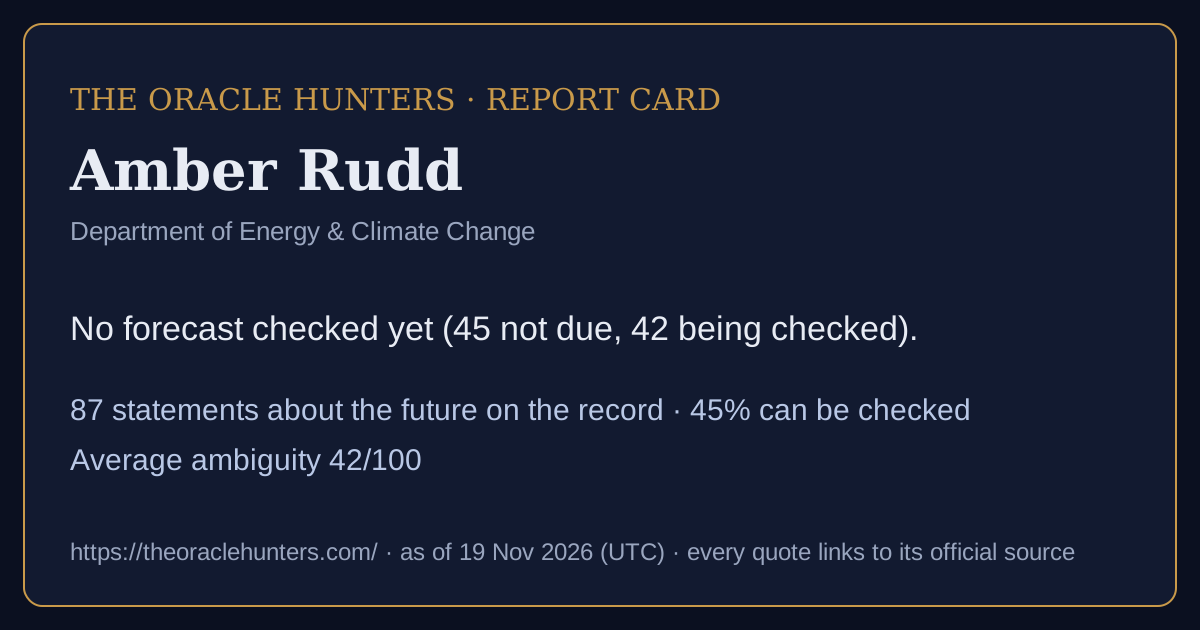
Track record: No forecast checked yet (45 not due, 42 being checked).
87forecasts & commitments on the record
45%can be checked as stated
42average ambiguity (0-100)
0goalpost moves recorded
0confirmed U-turns
Timeline
came true partly did not not due / being checked / too vague
Calibration score: shown after 10 checked forecasts with a stated likelihood (now 0).
How they speak about the future: based on data 70, stated on authority 14, educated guess 3.
Kinds of claim: forecast 61, mixed claim 13, commitment 11, scenario (if… then) 2. · Download this report card as a picture
In the nine words
πρόγνωσιςInference from evidence62 · 71%μαντείαInspired knowledge11 · 13%προαναγγελίαPublic pre-announcement11 · 13%πρόνοιαPreparing for the future2 · 2%εἰκασίαConjecture1 · 1%
How to read this
Each box is one sentence a public figure or institution said about the future, word for word, with a link to the official text. Can be checked means it names what will happen, by when, and how likely - so it can be compared with official figures later. Too vague to check means it does not. Ambiguity (0-100) is how many different ways the sentence can be read. When the date passes, the forecast is compared with official data and marked came true, partly or did not come true. Labels judge the sentence, never the person. Full guide and glossary.On the record (87)
Indeed, the government’s role is to create conditions for people and businesses to succeed, and crucially, to create a social security system that will support them if they fall.
This government is creating new Institutes of Technology, rolling-out T–levels in 2020, and will soon publish the Augar Report on the best ways to support Further and Higher education.
And we cannot expect the school system to pick up the slack, two thirds of 2030’s expected workforce has already left secondary education.
Additionally, our £1.6 billion Stronger Towns Fund will help spread opportunity and growth to places that have felt left behind.
Every day we see new reports in the paper that 10, 20 or 30% of people may lose their jobs to robots – yes, even MPs!
So I will be reviewing our goal to get one million more disabled people in work by 2027.
And it’s very exciting that from April this year, Citizens Advice will be working to deliver this new support across the country.
Universal Credit migration will be completed, as planned, by the end of 2023.
And today I’m pleased to announce that we will give a further £5.5m for projects aimed at strengthening the Commonwealth’s response to these crimes.
This will bring the UK’s total programme of support for Commonwealth partners to nearly £15 million over the next 3 years to help improve cyber security capabilities.
So today I’m pleased to announce that we will be giving over £9 million to enhance the UK’s specialist capabilities which will include work to combat the criminals who continually exploit the anonymity of the Dark Web.
We will also be giving £3 million to continue the great work of CyberAware; our nationwide campaign to educate the public and businesses with the latest advice on how to take simple steps to protect against cybercrime.
That’s why today I’m pleased to announce that we will be investing over £50 million over the next year to bolster cyber capabilities within law enforcement at a national, regional and local level.
That’s why I’m pleased to announce that this government will provide £3.6 million to support a new National County Lines Co-ordination Centre which is currently being developed by the National Police Chiefs’ Council and the National Crime Agency to support more effective action against these types of gangs.
That’s why the policing minister will have visited or spoken to every force in the country ahead of this year’s spending settlement.
We’re investing £1.9 billion in cyber security which will contribute to relieving pressures on individual forces tackling online and cyber enabled crime.
This will be complemented next year by the publication of a new strategy to combat serious violence.
And I can announce today that we will finish the review early next year.
And we will also give £1.4 million to a programme in South Wales to provide a wide-ranging programme of support using the ‘Change that Lasts’ framework.
There were 113 convictions in 2015 and we expect more convictions under the Modern Slavery Act this year.
We will be investing over £1 million in UN University, the research and academic arm of the UN.
And today I am very pleased to announce that we will be spending £6 million from this £11 million fund on 10 new projects.
We will provide £13.4 million for security measures in the Jewish community in the coming year.
We will be continuing the funding of the Jewish community protective security grant for 2017 to 2018.
And our counter-terrorism work overseas is essential too, which is why in April, we established a new Joint International Counter Terrorism Unit which has become the strategic centre for UK counter-terrorism work internationally, and will oversee our increased investment from £23 million in 2016 to 2017 to over £31 million in 2019 to 2020 - in support and capacity-building overseas.
I understand that the college will be in contact with forces about next year’s intake of Direct Entry and I hope that still more forces will get involved.
Following recommendations from the Police Reform and Transformation Board for the second round of the fund, I am delighted to announce today that there will be an extra £26 million allocated over the next 3 years to support 28 projects.
At the Police Federation Conference in May earlier this year, Theresa May announced that she would bring forward proposals with the college to develop minimum training and standards for certain specialist roles and to give the college responsibility to enforce those standards through a system of national accreditation.
This investment will extend the scheme to almost half of all forces and fund it until 2018.
So far there have been 2 cohorts of Direct Entry and this year - the scheme has been widened to include the rank of inspector, meaning there will be 25 direct entrants starting their training next week.
At the Police Federation Conference in May earlier this year, the previous Home Secretary announced that we would work with the College of Policing to accredit key roles within the service.
The UK will continue its global leadership on this important issue and build on the far-reaching measures to tackle corruption in all its forms, including corporate secrecy, government transparency, the enforcement of international anti-corruption laws, and the strengthening of international institutions.
We will deliver the Criminal Finances Bill, with Royal Assent in the spring of 2017 with the powers commenced later that year.
That is why I am pleased to announce that next year’s awards will include a new category to recognise technical innovation.
As investors and businesses, you can be confident we remain committed to building a secure, affordable low carbon infrastructure fit for the 21st Century.
We remain committed to new nuclear power in the UK – to provide clean, secure energy.
And however we choose to leave the EU, let me be clear: we remain committed to dealing with climate change.
We are likely to see significant investment following the auction later this year.
Annual support for renewables is expected to double during this Parliament to more than £10 billion.
And the budget deficit has been brought down from 11% of national income, and was forecast to be below 3% this year.
These new connections alone could save British households nearly £12bn over the next two decades by driving down the price of electricity.
Existing EU energy efficient product standards for items such as TVs, fridges and washing machines, will save UK households an average of £60 on their energy bills this year, rising to £120 a year by 2020.
By 2030, even if we develop the potential of UK shale gas, we are expected to import about three quarters of our gas.
It has been estimated that a fully integrated internal energy market could save up to £50bn per year by 2030.
Our consultation will set out proposals to close coal by 2025 - and restrict its use from 2023.
Over 8GW of solar is already deployed and even with the costs controls we have proposed we expect to have around 12GW in place by 2020.
On current plans we expect to see 10GW of offshore wind installed by 2020.
This could provide up to 30% of the low carbon electricity which we’re likely to need through the 2030s and create 30,000 new jobs.
We currently import around half of our gas needs, but by 2030 that could be as high as 75%.
By 2025, with a new nuclear power station built, offshore wind competing with other renewables, unabated coal a thing of the past, and smart energy coming into its own we will have transformed our energy system.
Showing the newest 50 - the ledger has all 87.
Also said - not checkable as stated (12 newest)
Remarks about the future with no date, figure or likelihood that could be checked. They are kept on the record and shown here, but not scored.
We will shortly consult on reforming Statutory Sick Pay, in order to better support employers to retain staff who experience health problems.
Secondly, we will test the feasibility of using a single assessment to determine eligibility for PIP, and ESA-Universal Credit.
We will therefore explore how a single assessment could improve the experience of those who apply for PIP and ESA-Universal Credit at the same time.
We will shortly consult on reform of Statutory Sick Pay and improving access to occupational health.
I will be looking at this matter over the coming months.
We will no longer regularly review the PIP awards for claimants who have reached State Pension age, unless they tell us that their needs have changed.
This is an opportunity to learn how we can best facilitate the transition – before returning to Parliament with the legislation which we will need for future managed migration.
So we need to make it easier for tenants in the private sector to find and keep a good home, by giving landlords greater certainty that their rent will be paid.
We want to ensure the process goes smoothly for claimants, so we will provide tailored communications, help with applications, and even home visits - with bespoke support for the most vulnerable claimants.
From July, we will carefully migrate up to 10,000 claimants, monitoring and adjusting our approach as needs be, before reporting our findings to Parliament.
That is why the Commonwealth Cyber Declaration, which foreign ministers and leaders will be considering this week, is such a powerful demonstration of common resolve to address our collective cyber security.
As today’s panellists will I’m sure make clear, cyber security is a shared endeavour.