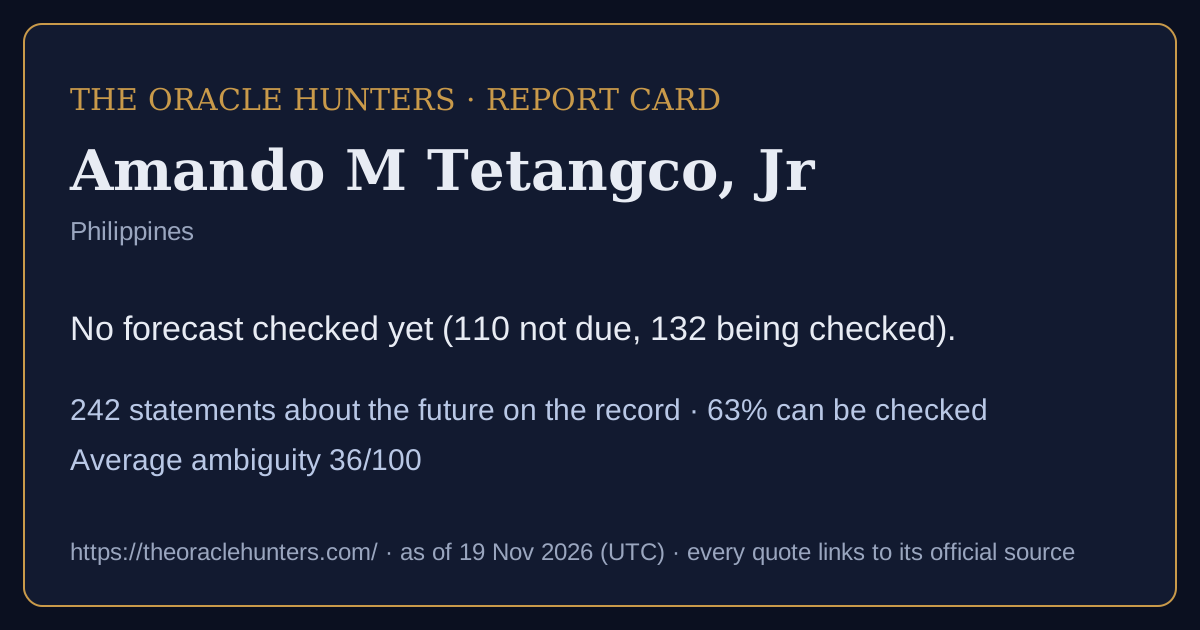
Amando M Tetangco, Jr
Philippines
Track record: No forecast checked yet (110 not due, 132 being checked).
242forecasts & commitments on the record
63%can be checked as stated
36average ambiguity (0-100)
0goalpost moves recorded
0confirmed U-turns
Timeline
came true partly did not not due / being checked / too vague
Calibration score: shown after 10 checked forecasts with a stated likelihood (now 0).
How they speak about the future: based on data 164, stated on authority 56, educated guess 22.
Kinds of claim: forecast 176, commitment 29, scenario (if… then) 19, mixed claim 18. · Download this report card as a picture
In the nine words
πρόγνωσιςInference from evidence161 · 67%προαναγγελίαPublic pre-announcement28 · 12%μαντείαInspired knowledge27 · 11%πρόνοιαPreparing for the future19 · 8%εἰκασίαConjecture5 · 2%πρόβλεψιςSeeing the signs1 · 0%φρόνησιςPractical wisdom1 · 0%
How to read this
Each box is one sentence a public figure or institution said about the future, word for word, with a link to the official text. Can be checked means it names what will happen, by when, and how likely - so it can be compared with official figures later. Too vague to check means it does not. Ambiguity (0-100) is how many different ways the sentence can be read. When the date passes, the forecast is compared with official data and marked came true, partly or did not come true. Labels judge the sentence, never the person. Full guide and glossary.On the record (242)
The fourth improvement is the sustained build-up of the country's foreign exchange reservesfrom a GIR level of $18.5 billion enough to cover about 4.6 months' worth of imports of goods and services in 2005, our import cover had moved up to about 9 months on a GIR of $82.2 billion as of end May 2017.
From January to May this year, inflation has remained stable and averaged 3.1%.
Even so, our forecast path suggests that monthly inflation will slow down thereafter, resulting in within-target full-year averages over the policy horizon or the next two years.
In terms of the world economic outlook, global growth is projected to improve modestly over the next two years, with upward adjustments to the projections of the IMF for the US, EU, UK and Japan for 2017.
Our latest projections indicate that inflation is likely to settle within the target range of 2-4 percent for 2017-2018-at the moment, our forecasts are at 3.4 percent for 2017, and 3.0 percent for 2018.
Going forward, we see average inflation will be within the target range of 2-4 percent for 2017-2018.
The National Government expects growth to average 6.5-7.5 percent this year, higher than last year's target of 6-7 percent. 3
With an estimated value of USD19 trillion over the next decade, digitization has the power to enable countries to boost GDP growth, job creation, and innovation.
This is consistent with our expectation that inflation will settle within the target range of 2 -4 percent in 2017 and 2018.
If critical infrastructures are not built in time, this could hold back the country's current economic growth momentum.
If the shift to 'inward-looking policies' gains traction, this can potentially further shrink global trade, which could lead to even lower global growth.
While average inflation is below the Government's target range, inflation is projected to rise toward the midpoint of the target range in 2017 and 2018.
The median age of the population is now 24.4 years old and we are projected to reach a median age of only 31 years old by 2045.
In 2016, inflation will average below the lower end of the target band, but in 2017 and 2018, we see fullyear inflation averaging closer to the middle of the target range of 2-4 pct.
If we take a step back and look at all the actions of policymakers around the world, the end goal has really been to restore the appetite of investors, so they would move along the financial risk spectrum, encourage asset creation and in the process, reinvigorate real demand that will spur growth and job creation.
Together with refinements in auction sizes, we will continue to implement the agreed phase-out of access by trust entities to the ODF and TDF windows by June 2017.
While inflation in 2016 is forecast to average below the lower end of the target range at 1.7pct, we see this gradually rising to within the target range in 2017-2018.
For monetary policy, this means we will continue to be guided by our outlook on inflation, which right now remains manageable.
Empirical estimates before the 2008 GFC (that is from 1980-2007) show that output losses after a financial crisis could result in losses of more than 25 percent of GDP.
Our latest assessment shows that inflation will be just below the lower end of the government's target range for this year, but should move to within the target range of 2-4 percent in 2017-2018.
Lastly, despite the weakness in external demand, we expect merchandise trade to show some modest improvements in 2016 - 2017.
- Foreign interest rate could likewise remain low for 2016 - 2017.
- In the primary market, the 364-day T-bill rate could settle at 2.0 - 4.0 percent for 2016 - 2017.
- In the global oil market, the per barrel price of Dubai crude oil is expected to trade within US$35 - 50 range in 2016 and to pick up slightly to US$40 - 55 band in 2017.
Inflation is expected to be within the Government's target in 2017, supported by favorable supply conditions and well-calibrated monetary policy.
- Inflation is projected to average slightly below the low end of the 2.0 - 4.0 percent target range in 2016, and to approach the midpoint of the target in 2017.
While our assessment showed that inflation would be slightly below the NG target range for 2016, we expect that inflation would be within the target of 2-4% in 2017-2018, with an upside bias for 2017.
By 2017, old-design banknotes will no longer be accepted by banks; an exception to this rule are Overseas Filipinos who have up to next year to exchange their old-design banknotes.
Beyond an efficient cheque clearing system, we are committed to promoting the modernization of our payment system through projects like the National Retail Payment System (NRPS) and other payments innovation projects to put in place secure, efficient, and affordable electronic payment platforms to drive the growth of trade and commerce.
For the next day and half, we will be covering the full mandate of central banking, not just financial stability but monetary policy and the growth objective as well.
On our part, we will remain your partner in this important task.
On the part of the BSP, not only as your regulator but also your partner, we remain committed in providing an enabling regulatory environment that will support rural banks in overcoming emerging challenges and provide you with various opportunities to be more responsive to the markets that you would like to serve.
Given this, I am confident that the nomination process for CMA that we are launching today will generate an even better harvest for this year.
And third, the SDA rate of 2.5 percent will be kept steady when it is transformed to the overnight deposit facility.
That said, we also recognize that inclusive growth will only be realized if our countrymen are given sustainable access - not just to finance- but also to basic human necessities: including safe and clean water.
If US growth will continue and gain further traction, this could mitigate the impact of a slowdown in China.
We could, however, be adversely affected if the low oil prices cause export destinations of our OFWs in the Middle East to cut back on employment.
We see this deficit as temporary and we expect a turnaround in the BOP position later this year, similar to what we experienced in 2015.
Our models showed that even as inflation is currently below our target range of 2-4 percent (i.e., 1.3 percent in January 2016), inflation will slowly move to within target in 2016 (i.e., 2.2 percent) and 2017 (i.e., 3.2 percent).
And in support of the national goal of inclusive growth, we will pursue with 12 other government agencies the implementation of our National Strategy for Financial Inclusion.
Well, I can say that if the first seven days of this year is any indication, 2016 will be far from boring - it will be riveting and challenging.
As the oldest Rotary Club in Asia, dating back to 1919, RCM will turn 97 years old this year.
Our latest forecasts show that the path of inflation will be consistent with the National Government's target range of 2 to 4 percent in 2016-2017.
Among others, we will adopt by the second quarter this year, what we call the interest rate corridor or IRC system.
Good corporate governance as a bedrock is essential for an economy whose combined GDP is expected to grow 4 times to US $10 trillion by 2030 12 and is projected to become the 4th largest in the world by 2050. 13 With this forecast, we are therefore beginning strong with that trajectory in mind.
At the end of 2014, ASEAN (at $2.57 trillion GDP) was just smaller than France and the United Kingdom but larger than Brazil, Russia and India. 1 The expectation, however, is that ASEAN will continue to outpace the rest of the world.
For those of us in the financial markets, however, the more critical target is 2020 at which time the ASEAN Financial Integration Framework or AFIF is expected to be in place.
The reason possibly why ASEAN integration has become more elevated in public consciousness lately is that the AEC will be 'formally' launched at year-end.
Simulations from the joint work 5 of ADB and the ILO show that high-skill employment in Cambodia, Indonesia, Lao, Philippines, Thailand and Vietnam could grow by 41% between 2010 and 2025.
With 81 million households already in 2013, this is projected to double to 163 million households by 2030 4 , creating an engine that naturally fuels further demand and further growth.
Showing the newest 50 - the ledger has all 242.
Also said - not checkable as stated (12 newest)
Remarks about the future with no date, figure or likelihood that could be checked. They are kept on the record and shown here, but not scored.
I hope therefore that Gov Nesting and all the Members of the Monetary Board will receive all the support they need to craft, formulate, innovate and implement effective policies and programs to serve the best interest of our people, our economy and our country.
Last May, a report published by the international credit rating agency S&P said our 'central bank has a record of supporting sustainable economic growth and responding appropriately to changing economic circumstances.' S&P added that our 'ability to maintain macroeconomic and price stability through an economic cycle has been tested, including a period of exogenous shocks.'
Let us also welcome the three appointees of the President who will join the Monetary Board for a term of six-years each - former trade secretary and veteran banker Peter Favila who returns to the MB; former economic planning secretary and eminent economist Dr. Phillip Medalla who was reinstated for another term at the Board; and veteran banker and corporate …
In this connection, we will continue to enhance, innovate and diversify our outreach programs to determine the most effective and efficient ways to reach our target audience and attain our education objectives.
To make this economic growth meaningful and inclusive, we should continue to empower our people to prosper and achieve financial security.
Banks need to see financial viability and attractive risk-return profiles of green projects and unbundle the mainstream perception of high transaction and compliance costs.
This is the primary intent of the BSP-IFC agreement which we will sign today, with everyone here as witnesses, and maybe even future partners.
We will surely keep you involved in the next steps of the BSP-IFC partnership.
Speech by Mr Amando M Tetangco, Jr, Governor of Bangko Sentral ng Pilipinas (BSP, the central bank of the Philippines), at the BSP-IFC Mini Forum (and Ceremonial MOU Signing), Manila, 26 May 2017.
As keepers of 80 percent of the financial system's assets, Philippine banks must hold up to high CG standards.
Nevertheless, the BSP remains confident that our CG-related regulations will continue to guide the banks toward full compliance, further strengthening and enabling them to serve a wider market.
At the BSP, we believe that history must inform our country's journey; we must learn from the past so that we will be better and stronger for the future.