Alistair Darling
Chancellor of the Exchequer · GBR
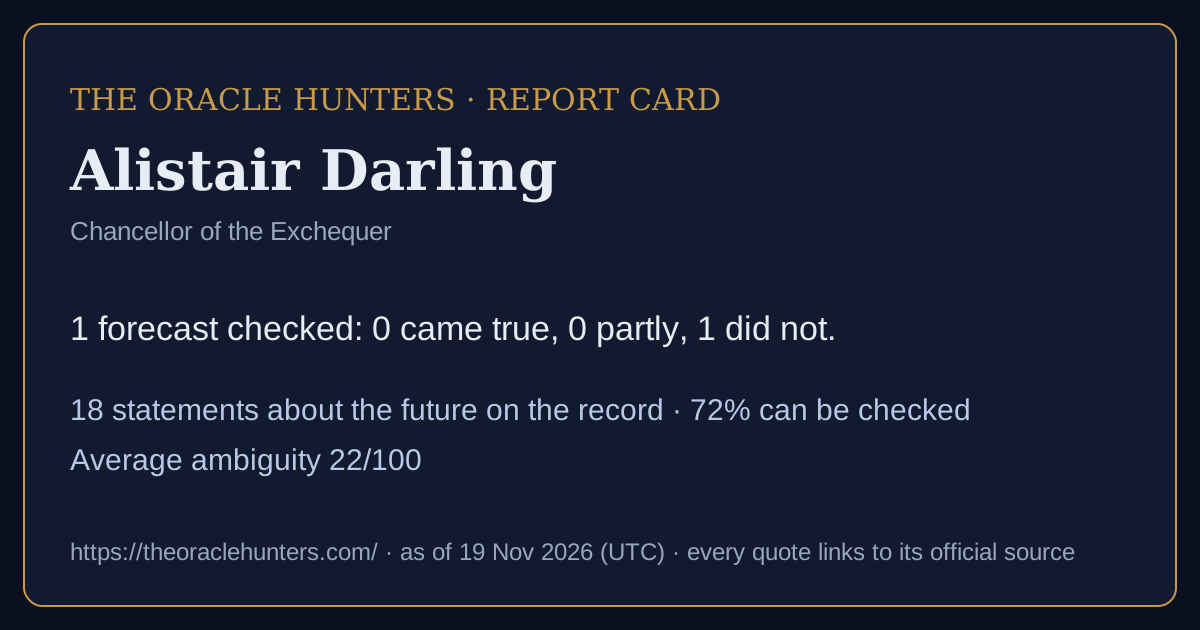
Track record: 1 forecast checked: 0 came true, 0 partly, 1 did not.
18forecasts & commitments on the record
72%can be checked as stated
22average ambiguity (0-100)
0goalpost moves recorded
0confirmed U-turns
Timeline
came true partly did not not due / being checked / too vague
Calibration score: shown after 10 checked forecasts with a stated likelihood (now 1).
How they speak about the future: based on data 15, stated on authority 3.
Kinds of claim: mixed claim 11, forecast 7. · Download this report card as a picture
In the nine words
How to read this
Each box is one sentence a public figure or institution said about the future, word for word, with a link to the official text. Can be checked means it names what will happen, by when, and how likely - so it can be compared with official figures later. Too vague to check means it does not. Ambiguity (0-100) is how many different ways the sentence can be read. When the date passes, the forecast is compared with official data and marked came true, partly or did not come true. Labels judge the sentence, never the person. Full guide and glossary.Checked
Inflation is expected to continue coming down sharply, reaching 1 per cent by the end of this year.
Did not come true. Said: inflation at the end of the year around 1% in 2009. Official figure for United Kingdom: 2.9% (Eurostat HICP (December, annual rate)). Missed. Off by 1.9 points. official data · checked 17 Nov 2026 · automatic check against official data (rules v4)
On the record (18)
I have decided to revise slightly downwards my forecast for 2011 to bring it into line with those of the Bank of England, to growth of between 3 and 3.5 per cent.
This year, as I said in last year’s Budget speech and last year’s pre-Budget report, I expect the economy to grow by between 1 and 1.5 per cent.
To help them to do this, we are going to provide extra one-off funding of £270 million in 2010-11 through a modernisation fund that will help universities to create 20,000 more university places, largely in key subjects such as science, technology, engineering and maths, starting in September this year.
I can also confirm that we will allocate over £4 billion from next year’s reserve to fund operations in Afghanistan.
So we will stick to our spending plans for next year, which will see a 2.2 per cent. real-terms increase.
More countries now agree on the need for an international systemic tax on banks, which must be brought forward quickly, as I will urge international Finance Ministers in Washington when they meet next month.
In the United States, for example, the Congressional Budget Office expects the deficit to be 13 per cent. of GDP in 2009, 10 per cent. in 2010, and even in 2019, to be above 5 per cent.
The housing market is also being held back by a lack of mortgage credit, and the Government have already taken action to encourage an increase in mortgage lending; this year the major UK banks will increase the availability of mortgages by around £20 billion.
Retail prices index inflation is forecast to remain negative, falling to minus 3 per cent. by September, before moving back to zero next year.
Inflation is expected to continue coming down sharply, reaching 1 per cent by the end of this year.
Did not come true. Said: inflation at the end of the year around 1% in 2009. Official figure for United Kingdom: 2.9% (Eurostat HICP (December, annual rate)). Missed. Off by 1.9 points. official data · checked 17 Nov 2026 · automatic check against official data (rules v4)
We agreed to take whatever action was necessary to deliver the International Monetary Fund forecast of global growth of over 2 per cent. by the end of next year.
In order to help the car industry and retail trade, I can announce that we will implement a scrappage scheme next month.
I believe that we need to go further, and I can announce today that new non-domestic buildings will become zero-carbon by 2019.
Next month we will launch the most ambitious household emissions reduction programme.
By 2010, we will be spending over £6 billion a year supporting British science and innovation.
To make further progress, we will spend a further £125 million over the next three years targeting help on those who need it most and where the challenges are the hardest, developing new approaches that help families in the long term.
From October 2009, we will change the rules for housing and council tax benefit so that parents are better off in work than on benefit.
We will now spend £8 billion more on new, affordable and social housing over the next three years.