Alessandra Perrazzelli
Bank of Italy
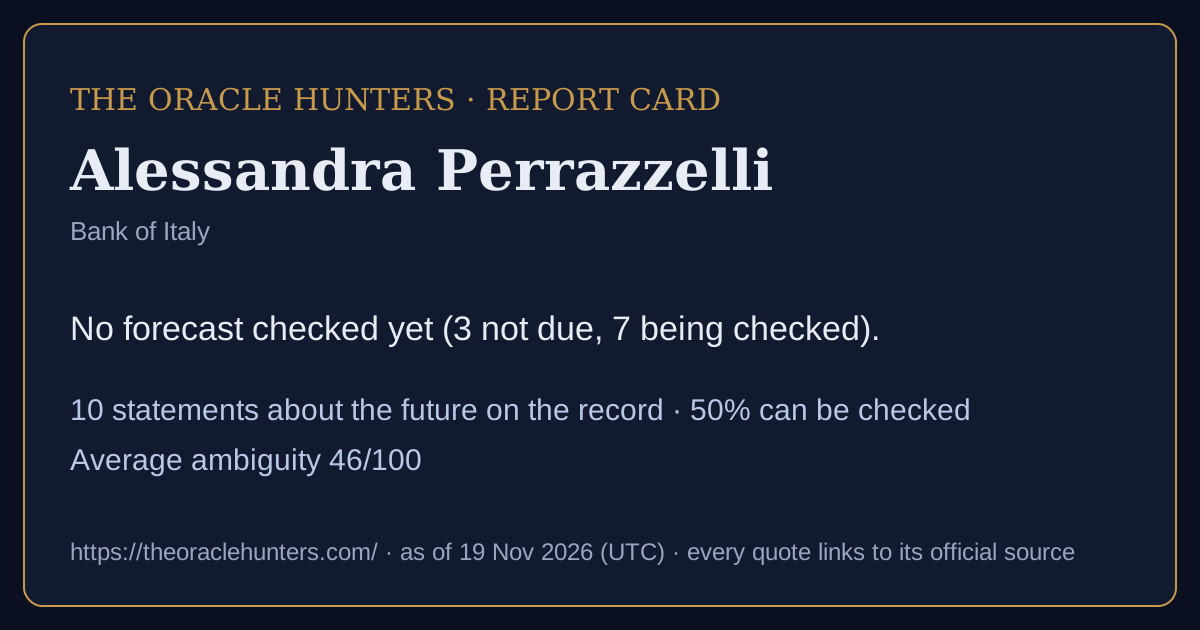
Track record: No forecast checked yet (3 not due, 7 being checked).
10forecasts & commitments on the record
50%can be checked as stated
46average ambiguity (0-100)
0goalpost moves recorded
0confirmed U-turns
Timeline
came true partly did not not due / being checked / too vague
Calibration score: shown after 10 checked forecasts with a stated likelihood (now 0).
How they speak about the future: based on data 8, stated on authority 2.
Kinds of claim: forecast 10. · Download this report card as a picture
In the nine words
How to read this
Each box is one sentence a public figure or institution said about the future, word for word, with a link to the official text. Can be checked means it names what will happen, by when, and how likely - so it can be compared with official figures later. Too vague to check means it does not. Ambiguity (0-100) is how many different ways the sentence can be read. When the date passes, the forecast is compared with official data and marked came true, partly or did not come true. Labels judge the sentence, never the person. Full guide and glossary.On the record (10)
Customers benefit from lower service costs - with charges on online accounts being 60 per cent of what they are for traditional accounts - as well as from easier access to banking services. 'The Governor's Concluding Remarks', Banca d'Italia, May 2024.
In 2020, the total amount of data created, captured, copied, and consumed globally was around 100 zettabytes (an astounding value of 10 23 bytes), and it is expected to rapidly increase, reaching 180 zettabytes in 2025. 1
From the domestic point of view, according to the regular FinTech survey performed by the Bank of Italy, DLT projects set up by Italian financial institutions in 2021 have been constant overall in number compared with the previous survey, but they focused significantly more on smart contract applications (up from 42per cent in 2019 to 85 per cent in 2021).
MiCAR represents an important step forward in this field, although it will enter into force in the first semester of next year.
In this respect, forecasts suggest that worldwide spending on blockchain solutions will continue to grow in the coming years, reaching almost US $20 billion by 2024.
When it comes to our role, the SSM issued well-defined and clear supervisory expectations on climaterelated and environmental risks; next year a targeted micro-prudential stress test exercise will be run.
Over a ten-year horizon, we assess that the reforms and the incentive plans for research and innovation laid out in the NRRP could boost productivity and thus increase GDP by between around 3 and 6 percentage points.
In its latest assessment, the European Commission projects Italian GDP growth to exceed 6 per cent this year, 4 per cent next year and to remain above 2 per cent in 2023, with output regaining its pre-crisis level in the first half of 2022, which is earlier than previously anticipated.
According to our estimates, the measures envisaged by the NRRP could raise Italy's GDP by more than 2 per cent by 2024, an outcome consistent with interventions that are strongly concentrated in public investment spending.
Since in Italy this year we are celebrating the 700th anniversary of Dante, let me say that I hope that this competition will attract modern Ulysses that, as Dante recalls in the 26th canto of the Inferno, are craving for 'worth and knowledge' and are eager to discover new lands.
Also said - not checkable as stated (12 newest)
Remarks about the future with no date, figure or likelihood that could be checked. They are kept on the record and shown here, but not scored.
Regulation and supervision will need to be adapted to make them future-proof for the fintech ecosystem.
From payments to wealth management, from lending to anti-money laundering (AML), AI applications will reshape the fintech sector in the upcoming years.
Once again, the lesson learnt from the crypto scandals in 2022 is that regulation should not be introduced only after households and firms have been affected.
They represent a challenge for central banks that should be addressed swiftly, as financial stability is a prerequisite for durable and sustainable economic growth.
AI algorithms, clouds, and big data analytics allow for the processing and management of vast amounts of data; as a result, public authorities must consider new risks, such as privacy concerns and infrastructure resilience, to name a few.
These variables lead me to the following question: what should a central bank's approach to fintech look like?
I am confident that through our collective expertise and collaboration in the remainder of the workshop we will succeed in laying out actionable outcomes for steering the financial system's transition towards a quantum-safe world.
As we will see through the lunch session, some solutions to mitigate cyber issues are already available.
The roadmap should include all initiatives that are essential for a quantum-resilient financial system and could be implemented under the responsibility of different multinational organizations.
Against this backdrop of high uncertainty, we expect that the quantum machine capacity necessary to give rise to a significant cybersecurity threat will be achieved in a foreseeable future. 1
In particular, such technologies could be exploited to break the encryption algorithms currently underpinning the security of critical communication systems and digital assets.
They include the financial infrastructures of the future - which will support, for instance, central bank digital currencies and crypto-assets - as the two techniques of key encapsulation and digital signature currently used are both based on asymmetric encryption, which is vulnerable to the quantum threat.