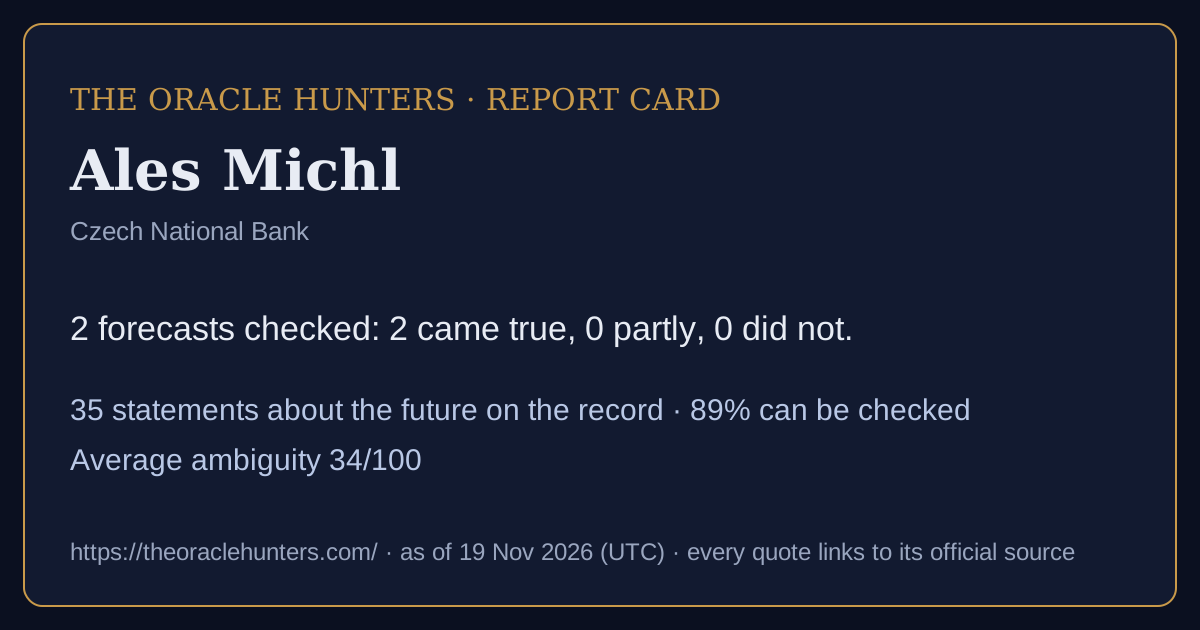
Ales Michl
Czech National Bank
Track record: 2 forecasts checked: 2 came true, 0 partly, 0 did not.
35forecasts & commitments on the record
89%can be checked as stated
34average ambiguity (0-100)
0goalpost moves recorded
0confirmed U-turns
Timeline
came true partly did not not due / being checked / too vague
Calibration score: shown after 10 checked forecasts with a stated likelihood (now 2).
How they speak about the future: based on data 18, stated on authority 12, educated guess 5.
Kinds of claim: forecast 13, mixed claim 11, commitment 7, scenario (if… then) 4. · Download this report card as a picture
In the nine words
πρόγνωσιςInference from evidence18 · 51%προαναγγελίαPublic pre-announcement7 · 20%μαντείαInspired knowledge5 · 14%πρόνοιαPreparing for the future4 · 11%εἰκασίαConjecture1 · 3%
How to read this
Each box is one sentence a public figure or institution said about the future, word for word, with a link to the official text. Can be checked means it names what will happen, by when, and how likely - so it can be compared with official figures later. Too vague to check means it does not. Ambiguity (0-100) is how many different ways the sentence can be read. When the date passes, the forecast is compared with official data and marked came true, partly or did not come true. Labels judge the sentence, never the person. Full guide and glossary.Checked
In the third phase, inflation needs to continue to fall to levels close to 2% next year, which will be the best news for the economy.
Came true. Said: inflation around 2% in 2024. Official figure for Czechia: 2.4% (World Bank open data). On target. Off by 0.4 points. official data · checked 14 Nov 2026 · automatic check against official data (rules v3)
And then, in the third phase, inflation needs to continue to fall to levels close to 2% next year, which will be the best news for the economy.
Came true. Said: inflation around 2% in 2024. Official figure for Czechia: 2.4% (World Bank open data). On target. Off by 0.4 points. official data · checked 14 Nov 2026 · automatic check against official data (rules v3)
On the record (35)
As a board, we also communicated that if budget deficits remained high, we would need to maintain higher interest rates to keep inflation at 2%.
We will definitely stay hawkish, guarding inflation and not allowing a long period of zero interest rates as in the past.
If we lower interest rates further, we will do so very cautiously - the outlook still shows higher core inflation.
Over the next two years, our focus will shift to enabling Czech clients to make instant payments in euros, not only domestically, but also with clients across the Eurozone.
Looking ahead, core inflation may need to be slightly below 2%.
At that time, actual inflation was 17.5%, the key interest rate was 7%, perceived inflation was 35% and inflation expected in 12 months was 27%.
Although the nominal rate stayed at 7% for most of 2023, ex ante real interest rates — which reflect expected inflation — gradually rose to historical highs.
We will stay hawkish and do our utmost to achieve price stability.
In addition, inflation was 2% year on year in February and March, but 2.9% in April and 2.6% in May.
The closer we get to our neutral interest rate, the more likely it is that we will slow down or even interrupt the normalisation of our policy.
We will stay hawkish and do everything we can to achieve long-term price stability and not trigger inflation.
Then we will be very cautious about further rate cuts.
The Bank Board will discuss the results of these assessments and we expect to publish the conclusions early next year.
As a board, we also discussed that if budget deficits remain high, we will need to maintain higher interest rates to keep inflation at 2%.
If fiscal policy records increasing budget deficits even in good times, monetary policy will find it very hard to ensure low inflation on its own in a system with such a huge liquidity surplus and a willingness of banks to buy bonds.
In the speech | gave on my appointment, | said that the goal would be to gradually return inflation to 2% and that | expected this to take two years (Michl, 2022a).
It is possible that in a week's time, when we have a monetary policy meeting, we will lower rates even further.
In particular, we will stay hawkish and do our utmost to achieve price stability and not cause inflation.
If you are interested in this issue, | recommend you read the findings of the research we conducted with my colleagues Tomas Adam and Michal Skoda (Adam, Michl, Skoda, 2023). | cannot guarantee that we will record a profit again this year.
Inflaní paradox: íjnovÆ inflace vyskoí, i kdyby se už nezdražovalo [The inflation paradox: Inflation will jump in October even if prices stop rising].
Our forecast predicts that inflation will decline from January 2024 onwards on the back of the previous tight monetary policy.
Because of this base effect, however, inflation is expected to be higher until the end of this year than it would have been with no such intervention (for details, see Adam and Schwarz, 2023).
Our forecast predicts that inflation will rise temporarily in the final months of this year.
Whether or not we reduce rates - moderately, gradually and cautiously - by the year-end, we will stay hawkish and do everything to protect our country from more high inflation.
In the third phase, inflation needs to continue to fall to levels close to 2% next year, which will be the best news for the economy.
Came true. Said: inflation around 2% in 2024. Official figure for Czechia: 2.4% (World Bank open data). On target. Off by 0.4 points. official data · checked 14 Nov 2026 · automatic check against official data (rules v3)
Fiscal policy could be a big help if the government deficit were to fall in 2023 relative to 2022 and in 2024 relative to 2023 - see, for example, Cochrane (2023) and my notes from Jackson Hole last year (Michl, 2022b, 2022c, 2022d).
To give you an idea, the CNB paid CZK 15.3 billion to the banks in interest on deposited liquidity in May 2023, which may amount to CZK 185 billion for 2023 as a whole.
The inflation figure for May (11.1%) was published on Monday this week.
Nominal wages increased half a percentage point more slowly than expected in our May forecast, which expects inflation to return to the target in the first half of next year.
There are still two more phases in the fight against inflation: In the second phase, inflation needs to fall to below 10% in the second half of this year, in line with our forecast.
If fiscal policy records increasing budget deficits, monetary policy will find it very hard to ensure low inflation on its own, in a system with such a huge liquidity surplus and a willingness of banks to buy bonds.
To give you an idea, the CNB paid CZK 14.7 billion to the banks in interest on deposited liquidity in April 2023, which may amount to CZK 180 billion for 2023 as a whole.
And then, in the third phase, inflation needs to continue to fall to levels close to 2% next year, which will be the best news for the economy.
Came true. Said: inflation around 2% in 2024. Official figure for Czechia: 2.4% (World Bank open data). On target. Off by 0.4 points. official data · checked 14 Nov 2026 · automatic check against official data (rules v3)
In the second phase, inflation needs to fall to below 10% in the second half of this year, in line with our forecast.
If the central bank increases rates, it will cause a recession.
Also said - not checkable as stated (12 newest)
Remarks about the future with no date, figure or likelihood that could be checked. They are kept on the record and shown here, but not scored.
It not only produces the most probable trajectory of inflation, but also quantifies the risks of a renewed acceleration in inflation.
According to our DSGE model, we should have raised interest rates from 7% to 8%, 9%, 10% or even higher to lower inflation expectations and inflation.
Overall, we focused on the bank's income statement and started with operations, as it could be tackled immediately.
This could easily have led to further inflation.
In our case, it had been a mistake to keep real interest rates negative for so long and to believe that when inflation arrived, it could be quickly reversed by raising rates.
In monetary policy, a central bank must be conservative.
First, a weaker koruna might help exporters - but at the same time, it brings very high inflation into the country (Michl, 2016).
Remarks by Mr Aleš Michl, Governor of the Czech National Bank, for the panel discussion "Should the Czech Republic adopt the euro?" at the Bloomberg event "The future of the euro in CEE", Prague, 10 June 2025.
We should remain a country with a strong koruna, an independent monetary policy, and robust FX reserves - not follow the example of Croatia.
Importantly, the CNB's assets are now structured in such a way that their long-term expected return exceeds the anticipated cost of liabilities (see Adam, Škoda, Michl, 2023).
The bank will soon fully adopt Microsoft Copilot in the cloud.
Soon, the Czech National Bank will be an institution that uses artificial intelligence and perhaps even blockchain - for better financial market supervision.