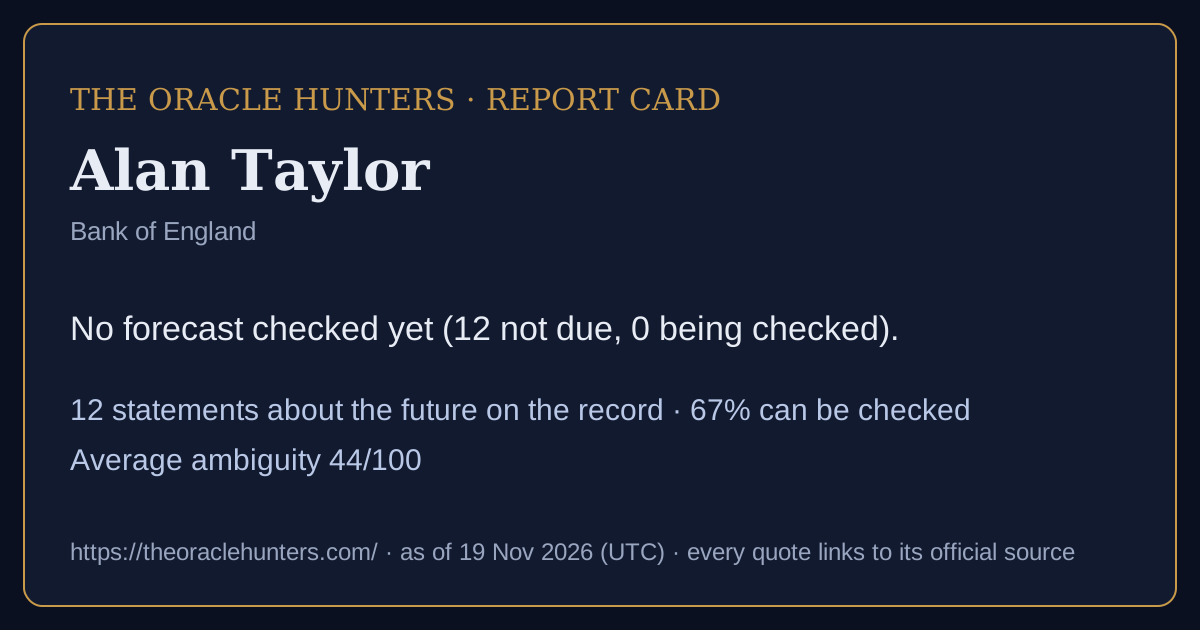
Alan Taylor
Bank of England · GBR
Track record: No forecast checked yet (12 not due, 0 being checked).
12forecasts & commitments on the record
67%can be checked as stated
44average ambiguity (0-100)
0goalpost moves recorded
0confirmed U-turns
Timeline
came true partly did not not due / being checked / too vague
Calibration score: shown after 10 checked forecasts with a stated likelihood (now 0).
How they speak about the future: based on data 9, educated guess 2, stated on authority 1.
Kinds of claim: forecast 9, scenario (if… then) 2, mixed claim 1. · Download this report card as a picture
In the nine words
πρόγνωσιςInference from evidence8 · 67%πρόνοιαPreparing for the future2 · 17%εἰκασίαConjecture1 · 8%μαντείαInspired knowledge1 · 8%
How to read this
Each box is one sentence a public figure or institution said about the future, word for word, with a link to the official text. Can be checked means it names what will happen, by when, and how likely - so it can be compared with official figures later. Too vague to check means it does not. Ambiguity (0-100) is how many different ways the sentence can be read. When the date passes, the forecast is compared with official data and marked came true, partly or did not come true. Labels judge the sentence, never the person. Full guide and glossary.On the record (12)
Even if oil markets stabilise, relatively low inventories mean gas prices could remain sensitive to cold weather, stronger demand or further supply disruptions.
Notes: Local projections of a 10% gas price shock show that more exposed sectors see a negative impact on wage growth within the 1st year after the shock as the cost of production increases (“cost-of-input channel”).
Local projections of a 10% gas price shock
If a temporary increase in inflation leads households and firms to revise up their expectations persistently (Stage 1), and those expectations then feed through into wage and price-setting (Stage 2), the original shock can become more persistent and the force of transmission could mean that perceptions self-validate.
A one percentage point increase in perceived inflation is associated with a rise in expected inflation one year ahead of around 0.4 to 0.5 percentage points.
But symmetrically, if the economy evolves broadly as expected, with demand weakening and underlying domestic inflationary pressures continuing to moderate, then at some point, once energy risks abate, policy will need to move in the other direction — not because the risk has disappeared, but because maintaining an unnecessarily restrictive stance would itself carry costs.
UK RPI is due to be aligned with CPIH from February 2030 which will affect the pricing of instruments spanning or beyond the effective date of RPI reform.
If we look at the bars here on the right, we can see that the April CPI inflation was 2.8% actual versus 2.0% in the February forecast.
That February forecast, as we all now painfully recall, had inflation hitting the 2% target in April and remain there or thereabouts over the rest of the horizon, alongside a modest amount of slack.
As such, when the MPR forecasts are rationalised through the lens of the COMPASS model, it implies the presence of positive demand shocks for the duration of the forecast, in order to justify inflation ending up at or close to – rather than below – 2 percent by the 2-3-year mark under such restrictive rates (Chart 6).
And looking to the second half of this year, the more favourable energy curves combined with a recent inflation print 0.4 points below expectations, lead us to expect inflation to peak a 3¼ % later this year, ½ point lower than the 3¾% projection in the April MPR.
After the MoU, a benign outcome for energy prices by next year is now more likely.
Also said - not checkable as stated (7 newest)
Remarks about the future with no date, figure or likelihood that could be checked. They are kept on the record and shown here, but not scored.
Should monetary policy “lean against the wind” of credit booms, raising interest rates more than would be justified by inflation and output alone, in order to reduce the risk of future crises?
We will not find all the answers in the past.
But we will find some of the mechanisms, some of the warnings, and some of the possibilities there.
If we keep the two-way street open – if we allow ideas, evidence, and questions to flow between economic history and macroeconomic policy – then we will be better equipped to navigate whatever lies ahead.
I will draw on examples from the literature, and the recent past, but also on my own experience as a member of the Bank of England’s Monetary Policy Committee, to illustrate how historical thinking can helpfully and constructively influence the way we take a critical stance as we interpret data, assess risks, and choose policy paths.
It mainstreamed the idea that monetary policy could have powerful real effects, advancing a line of thinking that had been around since Thornton and advanced by Keynes, but now amplified and illustrated by a cataclysmic real-world event.
Looking at possible scenarios shows that difficult trade-offs could lie ahead.