Alan Milburn
Social Mobility and Child Poverty Commission · GBR
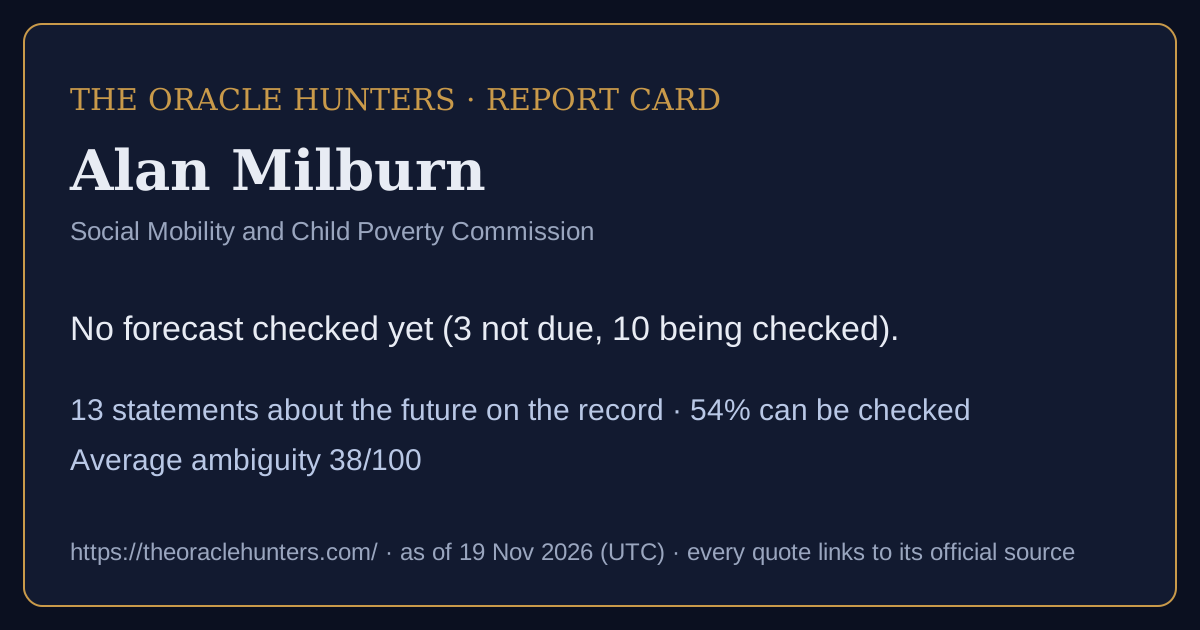
Track record: No forecast checked yet (3 not due, 10 being checked).
13forecasts & commitments on the record
54%can be checked as stated
38average ambiguity (0-100)
0goalpost moves recorded
0confirmed U-turns
Timeline
came true partly did not not due / being checked / too vague
Calibration score: shown after 10 checked forecasts with a stated likelihood (now 0).
How they speak about the future: based on data 13.
Kinds of claim: forecast 12, mixed claim 1. · Download this report card as a picture
In the nine words
How to read this
Each box is one sentence a public figure or institution said about the future, word for word, with a link to the official text. Can be checked means it names what will happen, by when, and how likely - so it can be compared with official figures later. Too vague to check means it does not. Ambiguity (0-100) is how many different ways the sentence can be read. When the date passes, the forecast is compared with official data and marked came true, partly or did not come true. Labels judge the sentence, never the person. Full guide and glossary.On the record (13)
We hope that the Scottish government will develop a new measure of whether children are school-ready and ensure that all children are school-ready by 2025 at the latest.
If we do not act, 2020 will mark a watershed between an era when rising living standards were shared by all and a future in which rising living standards by-pass too many in our society.
We share the view of those experts who predict that 2020 will mark not the eradication of child poverty but the end of the first decade since records began in which absolute child poverty increased.
Both universities and professions will expand rapidly by 2020.
The impact of welfare cuts and entrenched low pay will bite between now and 2020.
By 2020 we expect to see three quarters of the poorest children – and 85 per cent of all children - to be school-ready at age 5 as a staging post towards all children being school-ready by 2025.
For families in the middle – those on average earnings - it will be at least 2018 before their wages are back to where they were before the recession.
The professions will account for over 80% of employment growth in Britain in the next decade.
My Commission estimates that the cost of Housing Benefit for families who are in work could be as high as £3 billion.
We conclude that the statutory goal of ending child poverty by 2020 will in all likelihood be missed by a considerable margin, perhaps by as many as 3 million children.
We conclude that the statutory goal of ending child poverty by 2020 will in all likelihood be missed by a considerable margin, perhaps by as many as 2 million children We challenge all political parties to say how they would make progress.
The professions will account for approximately 83% of all new jobs in Britain in the next decade.
Scotland has a lower rate - 17 per cent – but the Institute for Fiscal Studies predicts that it will rise to nearer 23% by 2020.
Also said - not checkable as stated (12 newest)
Remarks about the future with no date, figure or likelihood that could be checked. They are kept on the record and shown here, but not scored.
Our central conclusion was that Britain is on the brink of becoming a permanently divided nation and that the next UK Government and the current Scottish government will have to adopt radical new approaches if poverty is to be beaten and mobility improved.
The question facing our country is whether we will choose to ignore it or to address it.
But early years services have to be a priority for investment and the Commission will be looking to every country in the UK to develop a long-term plan to make childcare and early years services as universal as they are in those Scandinavian countries which enjoy far higher levels of social mobility and far lower levels of child poverty than …
Clearly, there are tensions and trade-offs that will need to be made.
If we are to successfully tackle poverty and increase mobility we will have to do much more, as a nation to help the working poor of Britain.
We conclude too that the economic recovery, of which we have seen further evidence in today’s jobs figures, is unlikely to halt the trend of the last decade, where the top part of society prospers and the bottom part stagnates.
We conclude that Government will need to devise new ways of sharing that burden with employers in a way that is consistent with growing levels of employment.
Our key recommendations for Government are that it firstly, aims to end long-term youth unemployment by increasing learning and earning opportunities for young people who should be expected to take up those opportunities or face tougher benefit conditionality.
Secondly, we call on half of all firms to offer apprenticeships and work experience as part of a new effort to make it easier for those who aren’t going to university - “the other 50 per cent” - to pursue high quality vocational training.
Finally, and perhaps most importantly, we say that every citizen who can should be expected actively to work their way out of poverty by seeking jobs, working enough hours and seizing the opportunities made available to them.
Next, employers will need to more actively step up to the plate.
We will examine the consequences of welfare and education reform as well as changes in taxation and public spending.