Agus D W Martowardojo
Bank Indonesia
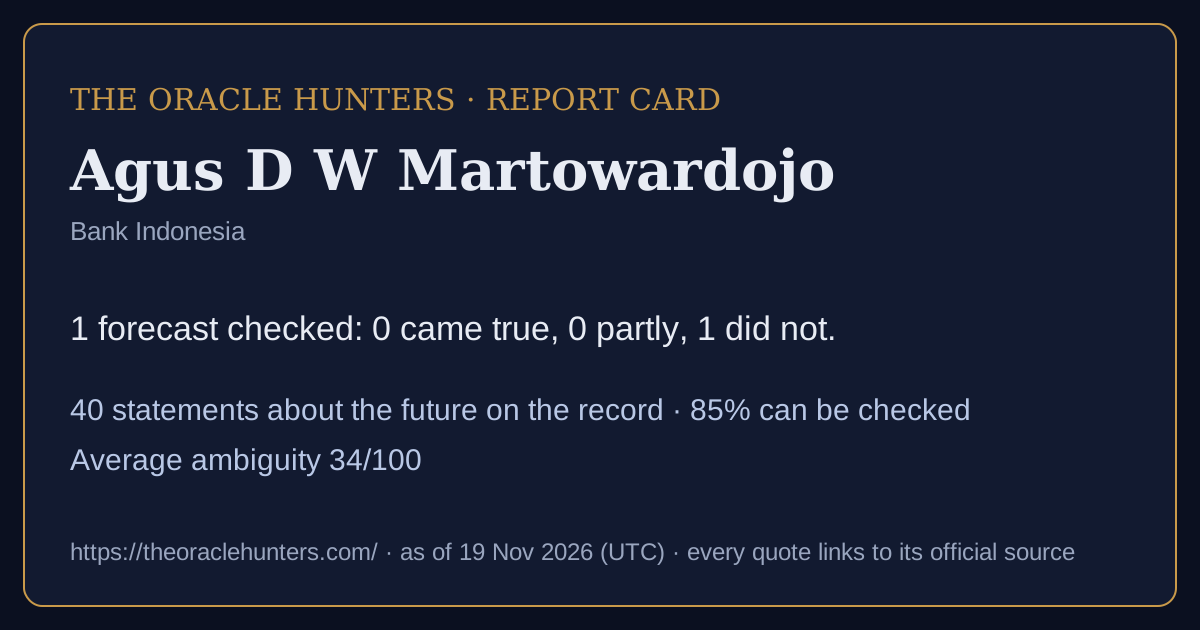
Track record: 1 forecast checked: 0 came true, 0 partly, 1 did not.
40forecasts & commitments on the record
85%can be checked as stated
34average ambiguity (0-100)
0goalpost moves recorded
0confirmed U-turns
Timeline
came true partly did not not due / being checked / too vague
Calibration score: shown after 10 checked forecasts with a stated likelihood (now 1).
How they speak about the future: based on data 38, educated guess 1, stated on authority 1.
Kinds of claim: forecast 32, mixed claim 7, commitment 1. · Download this report card as a picture
In the nine words
πρόγνωσιςInference from evidence38 · 95%προαναγγελίαPublic pre-announcement1 · 2%εἰκασίαConjecture1 · 2%
How to read this
Each box is one sentence a public figure or institution said about the future, word for word, with a link to the official text. Can be checked means it names what will happen, by when, and how likely - so it can be compared with official figures later. Too vague to check means it does not. Ambiguity (0-100) is how many different ways the sentence can be read. When the date passes, the forecast is compared with official data and marked came true, partly or did not come true. Labels judge the sentence, never the person. Full guide and glossary.Checked
Economic growth in 2014 is expected to improve within the range of 5,8-6,2%.
Did not come true. Said: economic growth between 5.8% and 6.2% in 2014. Official figure for Indonesia: 5.0% (World Bank open data). Missed. Off by 0.8 points. official data · checked 14 Nov 2026 · automatic check against official data (rules v3)
On the record (40)
Second, with ASEAN Economic Community 2025 agenda underway, the region will be increasingly integrated, stable and inclusive.
It is my hope that all of us will continue to be engaged in various programs of the 'Voyage to Indonesia.' We also hope that you will attend and experience the IMF-World Bank Annual Meetings in Bali along with its enriching back-to-back programs in October 2018.
The IMF has revised its assessment in April pointing to the 2017 growth of 3.5% vis-a-vis 3.4% in the previous projection, and by 3.6% in 2018.
For that purpose, Bank Indonesia will begin to introduce the Reserve Requirement (GWM) Averaging system in 2017.
The global economic recovery up to 2020 is expected to continue to remain below 4% (Figure 6).
On this basis, we project economic growth within the 2018-2021 period will be on an upward trend and arrive at 5.9-6.3% in 2021 through the support of low and controlled inflation.
With these economic prospects, we estimate that bank credit and deposits growth in 2017 will arrive at 9-11% and 10-12% respectively.
Meanwhile, inflation will remain within the target range of 4.0±1% in 2017, which is in line with Bank Indonesia's commitment to drive inflation within its target range.
Third, we will also accelerate the establishment of institutions that will operate the management functions of the National Standard of Indonesian Chip Card Specification (NSICCS) that we are targeting to be established no later than June 30, 2017.
Nevertheless, the first half of 2015 has posted a non-annualized upswing growth of 7.96% and therefore, global Islamic banking assets growth in 2015 is expected to once again sustain its double-digit rate.
Otherwise, there is a likelihood that we will be trapped in a vicious circle, in a way that the policy uncertainty undermining confidence will instill slower and stagnant growth, which will erode political cohesion, making the crisis legacy challenges harder to resolve, which will later induce further increase in policy uncertainty.
Bank Indonesia found that modest increase in electricity capacity and human development will each enhance growth of around 0.25% per year, while enhancement in the quality human capital will contribute to an increase in employment of around 0.50%.
Inflation is expected to be at around of the 4±1% inflation target, with the current account deficit projected to be below 3% of GDP.
Currently, Indonesia is in the period of demographic bonus for up to 30 years ahead, where the period of 2015-2045 will be marked by 70% working class out of the total population.
However, this outlook is presented with some overshadowing risks in the horizon, both external and domestic, including another FFR increase expected in the second half of 2016, the slowdown in the Chinese economy, the continuing decline in commodity prices, and domestically, rising volatile food inflation.
Hereafter, provided that we could unwaveringly sustain the reforms' momentum, I am convinced that GDP growth will turn up above 6,0 percent in the medium term.
Inflation in 2016 is expected to stay within the 4±1 percent target, backed by well managed domestic capacity utilization, anchored inflation expectations, and declining commodity prices.
The current account deficit (CAD) is projected to increase to around -2,5 percent of GDP in 2016, on the back of a pickup in fixed investment and a further deterioration in commodity export prices, while the balance of payments (BOP) is projected to return to a surplus.
We will remain vigilant and stress the importance of monitoring risks to price stability closely, while stand ready to respond if external pressures resume or inflationary pressures reemerge.
remains sound and shows some improvements as indicated by improvement of current account deficits, trade balance surplus in the last two quarters of 2015, and a managable inflation rate which is expected to fall within Bank Indonesia's target of 4±1% in 2015.
In addition, the region will need to spend approximately USD300 billion on regional pipeline infrastructure projects, involving physical construction works and coordinated policies spanning two or more Asian countries as well as having a significant cross-border positive impact.
Furthermore, it is also estimated that during the same period, Asia will need to invest approximately USD8 trillion in overall national infrastructures for energy, transport, telecommunications, water, and sanitation.
To ensure that different structural reform programs supporting economic growth will be implemented, we are consistent in seeking to anchor inflation rate and its expectation on the medium term target at 4±1%.
Slide 19: With such optimism, we estimate that Indonesia's economy will grow by 5.4%-5.8% in 2015 and 5.6%-6.0% in 2016, in a reduced deficit in the current transaction balance.
The global Islamic financial industry is expected to reach the total assets of USD 2 Trillion this year.
Inflation will remain under control and within its target corridor of 4.5%±1% in 2014.
That being said, we expect the current account deficit to continue shrinking below 3,0%.
Bank credit is projected to grow at 15-17% range which is reliable with the effort to bring the current account to a healthier.
Credit is projected to grow at 15-17% range which is consistent with the effort to bring the economy to a healthier and more balanced level.
Bank Indonesia asserts that inflation will remain under control and within its target corridor of 4.5±1% in 2014.
We estimate the current account deficit will be below 3% in 2014.
Therefore, growth in 2014 is projected to hit the lower end of the 5.8-6.2% range.
In the last two months inflation remains under control and expect could be brought back to its target corridor of 4.5%±1% in 2014 ( Graph 1 ).
Bank Indonesia will continue to pursue monetary policy that is consistently directed towards reducing current account deficit to healthier level and controlling inflation within its target corridor of 4.5±1% in 2014 and 4.0±1% in 2015.
In this sense, we forecast that credit growth from banking in 2014 will be within the range of 15-17%, supported by growth in Deposits along the same pace.
For the prospect of banking in 2014, potentially fragile economy and interest rates increases need to be anticipated.
From the perspective of price, we project that inflation in 2014 will be back under control, within the target range of 4,5±1%.
Economic growth in 2014 is expected to improve within the range of 5,8-6,2%.
Did not come true. Said: economic growth between 5.8% and 6.2% in 2014. Official figure for Indonesia: 5.0% (World Bank open data). Missed. Off by 0.8 points. official data · checked 14 Nov 2026 · automatic check against official data (rules v3)
In managing liquidity risk, we will improve the syariah minimum reserve requirement and introduce a staged Liquidity Coverage Ratio (LCR) instrument starting from January 1, 2015.
On the contrary, China's economy in the subsequent five years will have to accept a new normal growth of around 7%, after expanding at an average 10.25% in the last two decades.
Also said - not checkable as stated (12 newest)
Remarks about the future with no date, figure or likelihood that could be checked. They are kept on the record and shown here, but not scored.
We are also delighted to have speakers from ASEAN central banks who will share their views on a number of key issues surrounding the economic development in ASEAN.
Therefore, the discussion will touch upon how ASEAN countries have progressed in various areas especially in central banking policy making, and in furthering the ASEAN economic integration process to form what we call the ASEAN Economic Community.
Among the key takeways from the recently concluded IMF-World Bank Spring Meeting is that, in the near term, the global economic recovery is better than expected for the first time after some years of downward revision, with the resurgence of commodity prices, and less pressure on
The three sectors covering Islamic banking, Islamic capital market and also takaful could serve as additional pillars to foster the Islamic economic development.
Transfer payments to needy people will continue when the economy faces further recession.
Later we will have an honor to learn from his vast experience and wisdom by listening to his luncheon speech.
Today we have an excellent line of speakers, who will be deliberating a current and important issue in the global economy: an increasingly divergent global recovery paths in growth and policies, particularly from central bank perspectives.
Against this backdrop, Bank Indonesia and the Federal Reserve Bank of New York have decided to co-host a seminar that will look deeper and expand the boundaries of thinking, nurturing, and offering new insights pertaining to these challenges, with the spirit of putting both East and West perspectives on the table.
First, pursuing growth objectives after the crisis, where factors impeding the global economy will be discussed, and initiatives to balance structural reform and support for growth will be deliberated.
Topics surrounding challenges that are unique to small open economies, along with strategies to achieve sustained economic growth, hopefully will make this seminar very relevant and interesting.
I believe that the seminar will provide a great opportunity to discuss how structural reform can provide a breakthrough which accelerates growth, and make it more sustainable and inclusive .
What may happen next after the recent normalization of US monetary policy and China's current economic rebalancing process could be a heightened pressure in emerging economies' growth and financial market.