Agnès Benassy-Quere
Bank of France
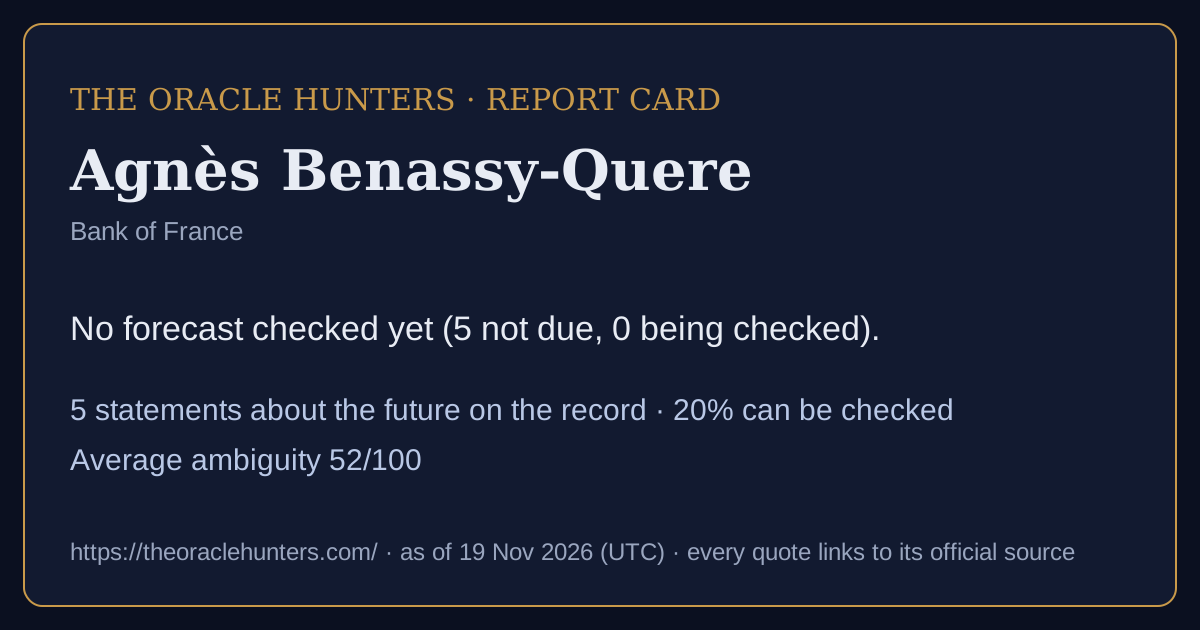
Track record: No forecast checked yet (5 not due, 0 being checked).
5forecasts & commitments on the record
20%can be checked as stated
52average ambiguity (0-100)
0goalpost moves recorded
0confirmed U-turns
Timeline
came true partly did not not due / being checked / too vague
Calibration score: shown after 10 checked forecasts with a stated likelihood (now 0).
How they speak about the future: based on data 4, stated on authority 1.
Kinds of claim: forecast 5. · Download this report card as a picture
In the nine words
How to read this
Each box is one sentence a public figure or institution said about the future, word for word, with a link to the official text. Can be checked means it names what will happen, by when, and how likely - so it can be compared with official figures later. Too vague to check means it does not. Ambiguity (0-100) is how many different ways the sentence can be read. When the date passes, the forecast is compared with official data and marked came true, partly or did not come true. Labels judge the sentence, never the person. Full guide and glossary.On the record (5)
According to the European Commission, the estimated net present value of depollution costs for the EU could reach up to €1.7 trillion by 2050, largely due to wastewater treatment costs. 8
Starting in July this year, a climate factor will be applied to certain individual assets, on top of regular evaluation of eligible collateral.
In such event, could fall by about 4 to 5 percent in just one year in Europe or GDP North America, and as much as 12 percent in Africa, compared to a theoretical benchmark scenario with neither climate change nor mitigation policies.
According to Dupraz and Marx (2023), the optimal response to a temporary shock in commodity prices would be to 'look through' without reacting forcefully, provided that inflation expectations remain 'anchored', which assumes that the 2% target remains credible over the medium term.
The European Central Bank defines price stability as an inflation rate 'close to 2% over the medium term'.
Also said - not checkable as stated (12 newest)
Remarks about the future with no date, figure or likelihood that could be checked. They are kept on the record and shown here, but not scored.
Because transition policies will not eliminate all damages, we must continue to improve our understanding of physical risks, from both a climate and a nature perspective, and enhance our adaptation strategies.
It will show how existing data and methods can already be used by central banks and supervisors.
Our work will focus primarily on the macro-financial effects of droughts which lie at the intersection of climate and nature risks and affect many European countries every year.
Policymakers in general, and central banks in particular need to rely on solid research and data when they incorporate climate and nature-related issues in their strategies and policy decisions.
In the Spring, for the first time, the NGFS published a series of short-term scenarios describing the economic impact of very severe but still plausible climate events, for each region, successively; a combination of heatwaves, droughts and wildfires, followed by floods the next year. 3
If we manage to simplify the reporting framework while ensuring the availability of robust and comparable data necessary for the transition, we will have a win-win situation: our framework will gain in both efficiency and "acceptability."
I can only hope that in the run-up to the COP 30, we will see renewed commitment from all stakeholders to accelerate the transition towards a more and concrete actions sustainable and resilient future.
Of course, the of climate change and nature degradation will not change its reality course.
A recent study led by Banque de price stability France shows that temporary shocks to major crops due to nature degradation could raise food inflation by over 2 pp, and headline inflation by 0.5 pp within a two-year horizon.
Today | would like to discuss with you the policy mix in a world of supply shocks, a subject of growing importance in the global economic landscape. | will share my views on how monetary and fiscal policy should adapt to this new macroeconomic environment.
Going forward, because of the level of government debt, euro area governments may not be able to implement such massive support again should another inflationary episode occur, particularly in the event of persistent shocks..
When prices rise, particularly energy prices, one might assume that the government has no need to intervene, particularly in France where the minimum wage and means-tested social benefits are index-linked.